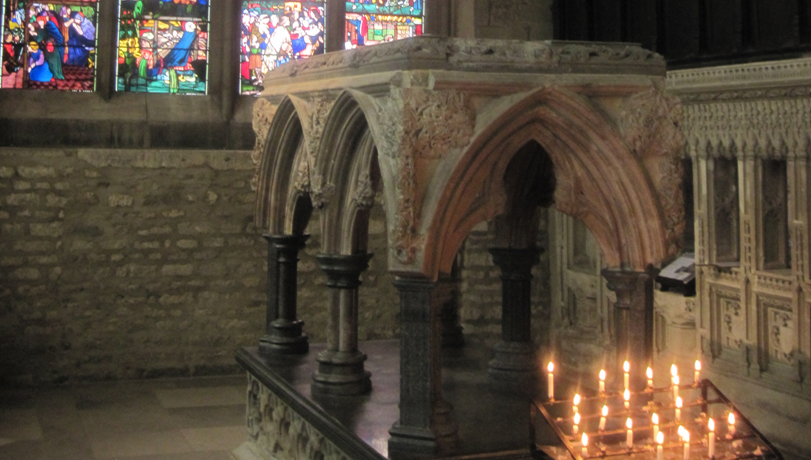
Shrine of St. Frideswide, Christ Church Cathedral Oxford.
Showing posts with label Northumbria. Show all posts

Tuesday, March 19, 2013

St. Cuthbert of Lindisfarne, March 20.

St. Cuthbert with the head of St. Oswald in 15th century glass at York Minster. 
     St. Cuthbert is certainly one of Britain's, if not of all Anglicanism's, greatest bishops. The humility, love and compassion that he shared with his community, along with the many centuries of devotion paid to him after his death mark him both as one of the most loving and most loved leaders of English Christianity. Love is a reflexive act; the compassion, and trust shown to him by the Northern community is equally important to the care that he held for the people of his bishopric in the 7th century. The memory he left for his followers has survived right down to our generation and continues to act as a rock for the Church in Britain. His cult has survived war and peace; the Viking invasions beginning in 793, the danish invasions of the 10th century, the Norman Invasion, and it has even survived the impious destruction of the Reformation. His bones still lie at Durham, 1326 years later, where he is visited daily by pilgrims.
St. Cuthbert from the Vita by Bede.

Cuthbert was born in 634, near Melrose. He was a shepherd until he saw a vision as a boy. It is one of the early chapters in the Vita Sancti Cuthberti by the Venerable Bede, the primary source for the life of St. Cuthbert, that is dedicated to this vision called Quomondo cum pastoribus positius animam Sancti Aidiani Episcopi ad coelum ab angelis ferri aspexerit (literally, how while he was posted with the shepherds, he witnessed the soul of the Holy Bishop Aidan being carried to heaven by angels). This is what prompted him to enter into the monastery of Melrose at an early age. Cuthbert did well as a monk in the eyes of the abbot, Boisil. He came to accept the Roman customs after the Synod of Whitby and was made prior of Melrose. When his new abbot, Eata, went to Lindisfarne, Cuthbert followed and became prior of Lindisfarne where he pursued missionary work in Northumbria and southern Scotland. As prior, and later as bishop, he was confronted with near schism in the aftermath of the Synod of Whitby (663-4). The Synod had decided to adopt the Roman Rite in place of the Celtic Rite, which it had been using since St. Aidan brought Christianity to Northumbria in 631. Cuthbert, in accordance with his monastic vows of obedience  required that the abbey use only the new rite because it was what the Church had decided in council. Cuthbert was not a supporter of the Roman or Celtic right....he was a supporter only of the Church. In 676 he decided to take monastic life a step further and live as a hermit on the Farne islands of the Northumbrian coast. there he remained for 9 years, living on a simple diet of onions and fish. He built himself an oratory and practiced the Celtic rite of saying the psalms in the cold sea water. It is recorded that when he came out from the water, the otters dried his feet and the birds brought him fish out of their own admiration. And while on the island he would bless those who came to seek his comfort.
St. Cuthbert in my own book of hours. 

In 685 Cuthbert was appointed the Bishop of Hexham, (which he swapped for Lindisfarne) by the Archbishop of Canterbury, Theodore of Tarsus. He left the Farne with King Ecgfrith and Bishop Trumwine and returned to his missionary work in the bishopric. During his short episcopate, he traveled through his diocese on foot, ministering to the rural and urban poor alike and performing miracles for their relief. Her returned to his hermitage 687 where he died two months later with the words "Always keep Peace and Divine Charity amongst yourselves," stressing the importance of a united Church. He lived first to extol and praise God and to worship him by living like him and to extend the good news of Christ's love to all people in his flock so that we might be comforted and learn to comfort others.
Monks use torches to tell of Cuthbert's death.

     The Saint left an impression on Northern England that never wore away. In 875, the community on Lindisfarne, where the Saint was first buried, was forced to move after a Viking attack. In an account of the event, the bishop at the time, Eardulf, required that he the monks leave the island before the attack. They took the precious relics of St. Cuthbert and of Lindisfarne's many other saints west, away from the sea while some of the monks stayed and died trying to save the Church at Lindisfarne from the Vikings. The community traveled all over the north of England for 7 years, collecting treasures donated to the shrine by neighboring kings, including the stole pictured below, and even attempting to go to Ireland -but were prevented by a storm which is believed to have been caused by the Saint. In 882, the community settled at Chester-le-Street, where they remained until the Danish incursions and in 995 relocated to Durham. By the time William the Conqueror came to England, Cuthbert was so important that he knew he would have to demonstrate his loyalty to their saint which he did during the Harrying of the North, when he visited Durham. Cuthbert's last miracle, so some claim, was shrouding the city of Durham in fog while the Luftwaffe passed overhead during the Second World War.
Durham Cathedral on its hilltop bend in the river Wear. 

     The cult of St. Cuthbert that continued to grow in England was never overtaken by another saint in the North, and perhaps only in all of England by St. Thomas Becket. In fact,Thomas death in 1170, caused the next few decades, under the leadership of the Norman bishop, Huge de Puiset, to be dedicated to a renaissance in art, architecture and liturgy for the promotion of his cult. The City of Durham and the people of the Durham diocese  became the city and people of St. Cuthbert. Their dedication was so strong to him as their protector and Christian example that they were called the people of the saint, or in Old-English the Haliwerfolc. The Bishops of Durham were given princely status as the successors of St. Cuthbert, and their lands became an autonomous 'Palatine' state within the Kingdom of England sometime referred to as the "Patrimony of St. Cuthbert." St. Cuthbert fostered a Christian community during his life by his example but established a Christian community on his memory that has lasted for centuries.
Feast of St. Cuthbert in the Codlingham Breviary.

     The monastic and the daily life of the community of the Cathedral was so focused on St. Cuthbert that the liturgy offered in Durham also came to revolve around its patron. All the offices and masses for the feast and translation feast of St. Cuthbert (September 4) were specially written to include the themes of Cuthbert's life and the example imprinted on the community. The antiphons, versicles, sequences and of course collects all recalled miracles from the history of St. Cuthbert. A Lenten Vespers antiphon follows -commemorating Cuthbert as an apostle to the English of Christ:

Oriens sol iustitiae dignatus est illustrare
Per ministros lucis suare cunctos fines orbis terrae
Ipsi laus qui dedi Anglis lucernam suae salutis
Cuthbertum bonum doctorem ac pro huis untercessorem

The rising sun of Justice deigned to illuminate
through the ministers of his light all the boundaries of the earth
Praise to Him who gave the English the lamp of His salvation,
Cuthbert the good Doctor, and praise Him for his intercession

And the antiphon for Matins recalls an early miracle where Cuthbert calls back the monk's rafts to land by prayer:

Dum iactantur puppes salo: sanctus orans heret solo
Mox ventorum vis mutate: naves vertit ad litora.

When the ship was cast about in the sea, the praying saint remained alone.
At once the force of the winds changes and the ship turned to the coast.

Several other miracles are recalled including his vision of St. Aidan's soul rising to heaven and Cuthbert's prophecy of his own death.

Cuthbert's stole.
The cult took a blow at the Reformation when the Calvinist wife of the new dean of the cathedral ordered many of relics associated with Cuthbert, but not the relics of the saint himself, to be destroyed along with the stained glass windows that depicted his miracles and the shrines built in other parts of the church where the saint had previously rested. But Calvinism has never defined Anglican Christianity, only invaded it, and the cult of St. Cuthbert at Durham, with the presence of his tomb, never really disappeared and has been greatly revived since the episcopate of Bishop Cosin in the 17th century.

Today Cuthbert remains the most venerated saint in the north of England, if not in its entirety. There is an endless stream of pilgrims to the sites associated with him including Melrose Abbey, the Holy Island of Lindisfarne, his chapel on the inner Farne Island and, most of all, to his tomb-shrine at Durham Cathedral. St. Cuthbert has regained a spot as an example and the 'lamp to salvation' in the devotion of Anglicans around the world. It remains, however, more important that the leaders of the Church look to people like St. Cuthbert in the times of Schisms and a shrinking Church. St. Cuthbert himself confronted these problems, dealt with them and strengthened the Church of Northumbria. The same can be done today in his example. The Church must remember that its purpose is to spread the words of Christ's love around the world as one Church, with one faith under one head; Christ. This is why schism remains one of the most urgent of the Church's -including Anglican, Orthodox and Roman- problems. Discord in the Church prevents it from its duty. Cuthbert recognized this and forgot his personal opinions on the Roman versus Celtic rite issues for the sake of the Church. By being righteous, the Church is neglecting its duty; its duty to Christ and its duty to his people. Hopefully people, priests and most importantly bishops will look to Cuthbert and those like him as examples of where the Church needs to return. When we invoke the names of saints in our prayers, this is what we are doing.
St. Cuthbert's Isle, Lindisfarne. The cross stands on the site of his first hermitage.

Collect (from the Church of St. Mary the Virgin, Holy Island):
We thank you Father for the life of St. Cuthbert of Lindisfarne: his reverence for all living creatures, his observance of a dedicated life under rule, his missionary zeal, his kindness to all who came  to him for comfort-and all for love of you. So in our pilgrimage of life strengthen us to walk with care in these ways that he observed through the study of prayer and personal example, that we may bring peace and integrity to your world in the name of Jesus Christ our Lord. Amen.


Thursday, August 30, 2012

St. Aidan of Lindisfarne; a father of the Anglican Church

St. Aidan by the Church of St. Mary on Lindisfarne; the site of his abbey.
St. Aidan of Lindisfarne can be treated equally as a father of the Church in England with Augustine of Canterbury and likewise of the whole Anglican Church. It was Aidan, who in A. D. 635 brought the light of Christ into the Kingdom of Northumbria, which then extended from the firth of Forth to the river Humber, and established the monastery of Lindisfarne as his episcopal seat. Aidan came on invitation of Oswald from the church of Iona, which was not under the bishop of Rome until the eleventh century, and evangelized in England as far south as London often travelling by foot. 
Bede later recorded of him "He neither sought nor loved anything of this world, but delighted in distributing immediately to the poor whatever was giver to him by kings or rich men of this world. He traversed both town and country on foot, never on horseback, unless compelled by some urgent necessity. Whenever on his way he saw any, either rich or poor, he invited them, if pagans, to embrace the mystery of the faith; or if they were believers, he sought to strengthen them in their faith and stir them up by words and actions to alms and good works."
St. Aidan died on August 31 in 651 and the Church in Bamburgh is built over the site of his death. He was buried on Lindisfarne but his bones were taken with the body of St. Cuthbert to Durham were they remain to this day. The altar in the center of the chapel of the nine altar is dedicated to his memory.
Aidan, as bishop, proved  wholly dedicated to Christ in his work as a missionary and in his effort to give to the poor. He is important to the Anglican Church not only as a father but also as model for bishops today and for what the church should look for in choosing bishops. Our codes of conduct in modern society has changed since the seventh century, but poverty has not gone away and not everyone has been fairly invited to "embrace the mystery of the faith." Words are powerful tools, but as Aidan shows us it is more than just preaching that Christians must do to follow in Jesus' footsteps. Aidan, his episcopal colleges and successors dedicated their lives to give Christ to the Father's children, it is our duty, as Christians, whether we are lay-people, priests or bishops, to make sure that the Anglican Church gives the faith of Christ, preserved and unviolated, to our own brothers, sisters and children. 

Heavenly Father, we thank you for your holy servant Aidan and his strength and commitment to bringing the light of your son to the Northumbrians and we pray that that we may muster the same strength and commitment to extend his mission, his kindness and our faith to all corners of the Earth. Amen


Icon of St. Aidan presenting the gospel to King Oswald at the Church of St. Aidan, Bamburgh. 

St. Aidan altar at Durham Cathedral.

Wednesday, August 1, 2012

A Pilgrimage for St. Cuthbert and the Northumbrian Saints.

St. Cuthbert window at Durham Cathedral.

     The lands north of the Humber river have always had a rich association with its ancient Anglo-Saxon saints. The cathedrals at Durham, Ripon and Carlisle a long with many parish churches best express Northumberland's and County Durham's love for bishops, abbesses, and monks who first brought the light of Christ to Northern England. Holy wells where the sick where healed pocketed at the edges of villages, Holy islands where hermits lived scattered along the coast, and battlefields where Holy martyrs died scar the countryside: only Jerusalem is home to more hallowed sites...
     I was able to visit many of these places on a recent trip to Northern England and was happy to find that these saints are not mere historical artifacts but remembered and venerated as ancient mothers and fathers of a living Church.

Durham Cathedral.
      Durham Cathedral, which was the first "Northumbrian" Church I visited maintained an aura of holiness that no other Cathedral in Europe can compete with. There were three offices during the day: morning prayer, noon mass, and evensong. The bells in the towers that dominated the whole city and country for miles around rang for each service. The church houses the tomb of St. Cuthbert, who is strongly appreciated in Durham Cathedral simultaneously known as "The Shrine of St. Cuthbert" a name which fully marks the cathedral as a lasting monument to the most beloved saint of the northern Church. The cathedral is architecturally remarkable as the only completely Norman cathedral in England made of a dark reddish stone and the interior pillars, clerestory and vaulted arches can only be described as massive. All around the cathedral are memorials and altars dedicated to the Northumbrian saints: the tomb and altar of St. Bede in the Galilee Chapel, altars, altarpieces and icons of St. Hilda, St. Aidan, and St. Margret and behind the high altar the simple marble slab that reads "Cuthbertus" surrounded by candles and flowers left by the countless modern pilgrims and banners and icons depicting the exemplary bishop and christian who dedicated his life to Christ.

^ Church of St. Mary the Virgin with  reredos of Lindisfarne saints and carpet from gospels.
< The Pilgrims way across the sands. 
    From Durham I went to the Holy Island of Lindisfarne which lies just north of Bamburgh and south of Berwick. The island is accessible only part of the day as the tide covers the causeway that is built on the sand on the bottom of the tidal bay. Holy Island is home to a population of only 162 people who live mainly off of sheep farming, fishing, lobstering, and tourism. The parish church of St. Mary the Virgin, which stands on just off of the town cross near the beach, was built in the 13th century and incorporates Saxon elements. It is packed with beautiful memorials to St. Cuthbert and St. Aidan, the Lindisfarne Gospels, the viking raids and St. Olaf, and the local fishing industry. Stained glass windows, carved sculptures, paintings, and textiles all conjure up the holiness of this tiny church. The church stands on the site of St. Aidan's abbey, built in A.D. 635, and embodies St. Cuthbert's life of faith and simplicity. Like Durham, there is morning prayer, mass, and evening prayer each day. Pilgrimage groups come to the island every week and often these pilgrims have come from Cuthbert's first abbey, Melrose, in the lowlands of Scotland and cross the pilgrims way across the Lindisfarne sands barefooted. I spent much of my time on the island searching for the "St. Cuthbert's beads" which are tiny fossils found on the beach in between St. Cuthbert's isle and the church that are said to be forged by St. Cuthbert on his hermitage at night and were made into rosaries by medieval pilgrims.

Ruined chapel on St. Cuthbert's Isle off of Lindisfarne.


Shrine on the spot where St. Aidan died.

     After Lindisfarne I journeyed to the parish church of St. Aidan in Bamburgh. St. Aidan first came to Bamburgh when King Oswald sent to Iona for a bishop to bring Christianity. The castle there remains associated with St. Oswald and a stone crucifix has been erected below its walls to commemorate the wooden cross the Oswald erected when Christianity first came to Northumbria. The church itself marks the spot where St. Aidan died and retains the timber which he leaned on as he took his last breaths. The timber remains suspended over the font. The church is rather large and has a reredos that incorporates many of Northumbria's saints into the witnesses of the Eucharistic sacrifice.

St. Aidan and St. Oswald
icon at Bamburgh.
Altarpiece at Ripon with the Northumbrian  Saints.
     Finally I stopped at Ripon Cathedral established by St. Wilfrid in 672. The stone choir screen features saints and kings associated with Ripon and the pulpit and Ninian Comper altarpiece features the most famous saints of Northumbria. The church also retains a crypts from the first building that was built here.
     The Church in Northern England maintains the holiness of her ancient saints to this day: they are examples to all Christians of how we can find a role in the Church to dedicate our own lives to Christ, for, as St. Julian of Norwich puts it, "all the help that we receive from the blessed saints, is by Christ's goodness."
    The holiness of St. Cuthbert, the Northumbrian saints and all the saints is help to us to find Christ's love and likewise spread it to the rest of the world.