 |
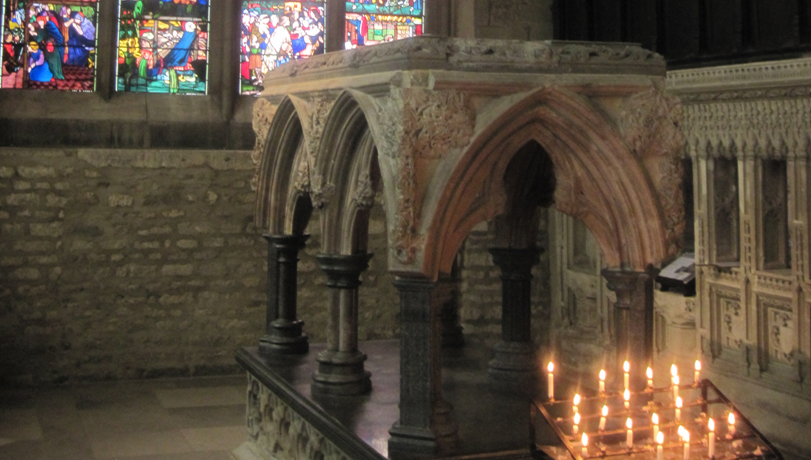
| All Saints, Hawton, Easter Sepulcher. |
"Then a chair is placed for the bishop in Golgotha behind the Cross, which is now standing; the bishop duly takes his seat in the chair, and a table covered with a linen cloth is placed before him; the deacons stand round the table, and a silver-gilt casket is brought in which is the holy wood of the Cross. The casket is opened and (the wood) is taken out, and both the wood of the Cross and the title are placed upon the table. Now, when it has been put upon the table, the bishop, as he sits, holds the extremities of the sacred wood firmly in his hands, while the deacons who stand around guard it. It is guarded thus because the custom is that the people, both faithful and catechumens, come one by one and, bowing down at the table, kiss the sacred wood and pass through. And because, I know not when, some one is said to have bitten off and stolen a portion of the sacred wood, it is thus guarded by the deacons who stand around, lest any one approaching should venture to do so again."
The liturgy made its way into several regional rites including the Sarum and Durham rites in England, where it became part of the larger and more genuinely English 'Liturgy of the Easter Sepulcher.' In English Cathedrals and parish churches, the Easter Sepulchre served as the Easter Garden or Altar of Repose, which are more common today. The rite for the Easter Sepulchre, however, stretched through each day of Triduum. This way, all parts of the Triduum liturgies focused on the Resurrection. After all, we don't venerate the cross because by it Christ was killed, but because "by the Cross, joy hath come into the whole world." We venerate the cross for Christ's resurrection, as the instrument which brought about our Salvation. This is part of the rite for the veneration in the Sarum Missal.
Priest: Behold the wood of the Cross, on which hung the savior of the world. O Come let us adore.
Choir: We adore Thy Cross, Or Lord, and we praise and glorify Thy holy Resurrection, for by the Cross, joy hath come into the world.
The liturgy made its way into several regional rites including the Sarum and Durham rites in England, where it became part of the larger and more genuinely English 'Liturgy of the Easter Sepulcher.' In English Cathedrals and parish churches, the Easter Sepulchre served as the Easter Garden or Altar of Repose, which are more common today. The rite for the Easter Sepulchre, however, stretched through each day of Triduum. This way, all parts of the Triduum liturgies focused on the Resurrection. After all, we don't venerate the cross because by it Christ was killed, but because "by the Cross, joy hath come into the whole world." We venerate the cross for Christ's resurrection, as the instrument which brought about our Salvation. This is part of the rite for the veneration in the Sarum Missal.
Priest: Behold the wood of the Cross, on which hung the savior of the world. O Come let us adore.
Choir: We adore Thy Cross, Or Lord, and we praise and glorify Thy holy Resurrection, for by the Cross, joy hath come into the world.
After the Veneration of the Cross, or Creeping to the Cross as it was called in England, the crucifix was taken in procession with the reserved sacrament from Maundy Thursday to a stone structure on the north side of the chancel that bore resemblance to either the sedelia or a wall-tomb. Both the crucifix and the sacrament were then placed in a carved wooden or gilded box similar to a reliquary which rested like a chest or feretory on the stone slab (like an altar) of the sepulchre much like a saint's reliquary rests on the stone of a table-shrine (like the shrine of St. Frideswide pictured in the blog cover). The sepulchres often feature the soldiers sleeping round the tomb, the women visiting and the angels. Some even have a special compartment for the Sacrament which resembles the carved tomb.
 |
| St. Peter's East Harling. The chest sat like a reliquary on the slab. |
The author of the "Rites of Durham" recorded the performance of the Liturgy of the Easter Sepulchre at Durham Cathedral which, because of the local importance of St. Cuthbert, interestingly included an image of Christ with St. Cuthbert.
"Within the Abbye Church of Durham uppon good friday theire was marvelous solemne service, in the which service time after the passion was sung two of the eldest monkes did take a goodly large crucifix all of gold of the picture of our saviour Christ nailed uppon the crosse lyinge uppon a velvett cushion, havinge St Cuthberts armes uppon it all imbroydered with gold bringinge that betwixt them uppon the said cushion to the lowest stepps in the quire, and there betwixt them did hold the said picture of our saviour sittinge of every side on ther knees of that , and then one of the said monkes did rise and went a prettye way from it sittinge downe uppon his knees with his shoes put of[f] verye reverently did creepe away uppon his knees unto the said crosse and most reverently did kisse it, and after him the other monkes did so likewise , and then they did sitt them downe on eyther side of the said crosse and holdinge it betwixt them, and after that the prior came forth of his stall, and did sitt him downe of his knees with his shooes of[f] and in like sort did creepe also unto the said crosse and all the monkes after him one after an nother, in the same order, and, in the meane time all the whole quire singinge an Himne, the service beinge ended the two monkes did carrye it to the sepulchre with great reverence, which sepulchre was sett upp in the morninge on the north side of the quire nigh to the high altar before the service time and there did lay it within the said sepulchre, with great devotion with another picture of our saviour Christ, in whose breast they did enclose with great reverence the most holy and blessed sacrament of the altar senceinge and prayinge unto it uppon theire knees a great space settinge two taper lighted before it, which tapers did burne unto Easter day in the morninge that it was taken forth."
The precise liturgy, though different than the one at Durham, is also found in the Sarum Missal. At Salisbury, after Communion from the reserved Sacrament, the celebrant and a deacon removed their vestments and their shoes and approached the Sepulchre, placing the wooded crucifix (often described as a cross or image of the Christ on the cross) and the pyx with the Sacrament inside the chest in the Easter Sepulchre.
The priest began:
P. I am counted as one of them that go down into the pit: I have been even as a man that hath no strenght, free among the dead.
V. Thou hast laid me in the lowest pit, in a place of Darkness and in the Deep. There have I been.
The Sepulcher door was then shut and the service ended with no dismissal as it is still done.
The Liturgy of the Easter Sepulchre continued on Easter Day as the first part of the ceremonies. At Sarum the procession went first to the Sepulchre and "after censing it with great veneration" removed the pyx and the cross and after proclaiming "Christ being raised" began the great Alleluia and took the Sacrament to the high altar for adoration.
The 'Rites of Durham' also contains a record of this ceremony:
"There was in the abbye church of duresme [Durham] verye solemne service uppon easter day betweene 3 and 4 of the clocke in the morninge in honour of the resurrection where 2 of the oldest monkes of the quire came to the sepulchre, being sett upp upon good friday after the passion all covered with redd velvett and embrodered with gold, and then did sence it either monke with a paire of silver sencors sittinge on theire knees before the sepulchre, then they both risinge came to the sepulchre, out of the which with great reverence they tooke a marvelous beautiful Image of our saviour representinge the resurrection with a crosse in his hand in the breast wheof was enclosed in bright Christall the holy sacrament of the altar, throughe the which christall the blessed host was conspicuous, to the behoulders, then after the elevation of the said picture carryed by the said 2 monkes uppon a faire velvett cushion all embrodered singinge the anthem of christus resurgens they brought to the high altar settinge that on the midst therof whereon it stood the two monkes kneelinge on theire knees before the altar, and senceing it all the time that the rest of the whole quire was in singinge the foresaid anthem of Xpus resrugens, the which anthem being ended the 2 monkes tooke up the cushines and the picture from the altar supportinge it betwixt them, proceeding in procession from the high altar to the south quire dore where there was 4 antient gentlemen belonginge to the prior appointed to attend theire cominge holdinge upp a most rich cannopye of purple velvett tached round about with redd silke, and gold fringe, and at everye corner did stand one of theise ancient gentlemen to beare it over the said Image, with the holy sacrament carried by two monkes round about the church the whole quire waitinge uppon it with goodly torches and great store of other lights, all singinge rejoyceinge and praising god most devoutly till they came to the high altar againe, wheron they did place the said Image there to remaine untill the assencion day."
The Veneration of the Cross and the Liturgy of the Easter Sepulcher, though rarely used, both bear relevance to the Triduum experience for the Church today. These are not merely medieval filler, added to lengthen the ceremonies or embellish the celebration, but are a liturgical reenactment of the death and Resurrection of Christ, the foundations of our Christian faith. Just as these acts in the life of Christ complete the foundation of our faith, their reenactment remains the core of our Triduum liturgies. These rites allow each of us to engage in the acts of crucifixion and Resurrection that happened two thousand years ago. Physically and emotionally we experience the sadness and rejection of sin and death leading to the cross and the unmatchable joy in the resurrection, Christ's victory over death on the cross, and in the comfort that Christ, God made human, has lived, died, lived again and stayed with us so that we two may really live.
Collect (From the Episcopal Church, BCP, Easter):
O God, who for our redemption didst give thine only-begotten Son to the death of the cross, and by his glorious resurrection hast delivered us from the power of our enemy: Grant us so to die daily to sin, that we may evermore live with him in the joy of his resurrection; through Jesus Christ thy Son our Lord, who liveth and reigneth with thee and the Holy Spirit, one God, now and for ever. Amen.
 |
| Sepulcher with soldiers, Lincoln Cathedral. |
The precise liturgy, though different than the one at Durham, is also found in the Sarum Missal. At Salisbury, after Communion from the reserved Sacrament, the celebrant and a deacon removed their vestments and their shoes and approached the Sepulchre, placing the wooded crucifix (often described as a cross or image of the Christ on the cross) and the pyx with the Sacrament inside the chest in the Easter Sepulchre.
The priest began:
P. I am counted as one of them that go down into the pit: I have been even as a man that hath no strenght, free among the dead.
V. Thou hast laid me in the lowest pit, in a place of Darkness and in the Deep. There have I been.
The Sepulcher door was then shut and the service ended with no dismissal as it is still done.
The Liturgy of the Easter Sepulchre continued on Easter Day as the first part of the ceremonies. At Sarum the procession went first to the Sepulchre and "after censing it with great veneration" removed the pyx and the cross and after proclaiming "Christ being raised" began the great Alleluia and took the Sacrament to the high altar for adoration.
The 'Rites of Durham' also contains a record of this ceremony:
 |
| Coity, Glamorgan, Wales. The chest with symbols of the passion. |
 |
| St. Andrew Heckington sepulcher with the soldiers, women and angels. |
Collect (From the Episcopal Church, BCP, Easter):
O God, who for our redemption didst give thine only-begotten Son to the death of the cross, and by his glorious resurrection hast delivered us from the power of our enemy: Grant us so to die daily to sin, that we may evermore live with him in the joy of his resurrection; through Jesus Christ thy Son our Lord, who liveth and reigneth with thee and the Holy Spirit, one God, now and for ever. Amen.

+-+In+nomine+Domini+omne+genu+flectatur.PNG)
