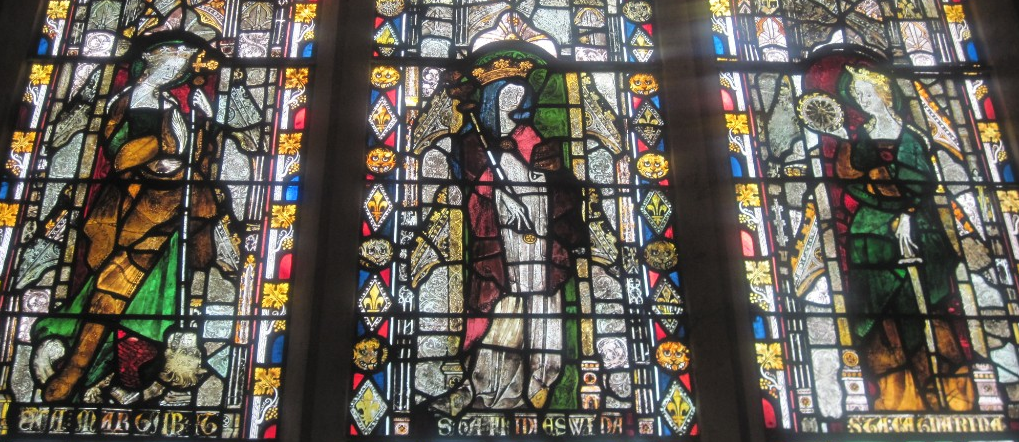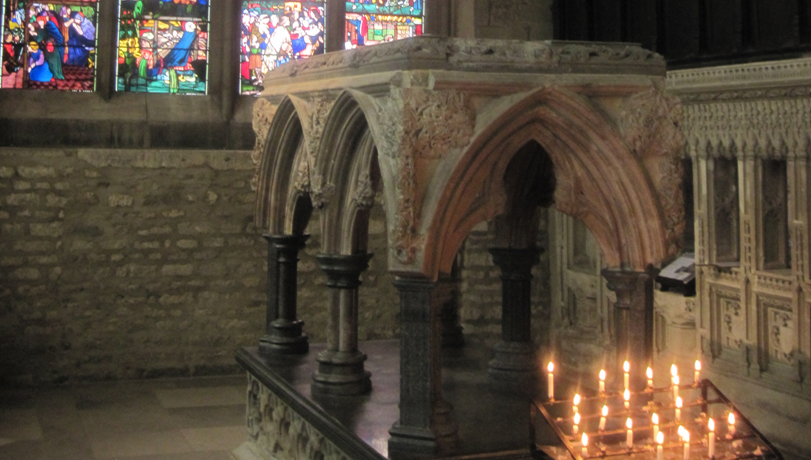
Shrine of St. Frideswide, Christ Church Cathedral Oxford.
Showing posts with label Shrines. Show all posts

Tuesday, March 19, 2013

St. Cuthbert of Lindisfarne, March 20.

St. Cuthbert with the head of St. Oswald in 15th century glass at York Minster. 
     St. Cuthbert is certainly one of Britain's, if not of all Anglicanism's, greatest bishops. The humility, love and compassion that he shared with his community, along with the many centuries of devotion paid to him after his death mark him both as one of the most loving and most loved leaders of English Christianity. Love is a reflexive act; the compassion, and trust shown to him by the Northern community is equally important to the care that he held for the people of his bishopric in the 7th century. The memory he left for his followers has survived right down to our generation and continues to act as a rock for the Church in Britain. His cult has survived war and peace; the Viking invasions beginning in 793, the danish invasions of the 10th century, the Norman Invasion, and it has even survived the impious destruction of the Reformation. His bones still lie at Durham, 1326 years later, where he is visited daily by pilgrims.
St. Cuthbert from the Vita by Bede.

Cuthbert was born in 634, near Melrose. He was a shepherd until he saw a vision as a boy. It is one of the early chapters in the Vita Sancti Cuthberti by the Venerable Bede, the primary source for the life of St. Cuthbert, that is dedicated to this vision called Quomondo cum pastoribus positius animam Sancti Aidiani Episcopi ad coelum ab angelis ferri aspexerit (literally, how while he was posted with the shepherds, he witnessed the soul of the Holy Bishop Aidan being carried to heaven by angels). This is what prompted him to enter into the monastery of Melrose at an early age. Cuthbert did well as a monk in the eyes of the abbot, Boisil. He came to accept the Roman customs after the Synod of Whitby and was made prior of Melrose. When his new abbot, Eata, went to Lindisfarne, Cuthbert followed and became prior of Lindisfarne where he pursued missionary work in Northumbria and southern Scotland. As prior, and later as bishop, he was confronted with near schism in the aftermath of the Synod of Whitby (663-4). The Synod had decided to adopt the Roman Rite in place of the Celtic Rite, which it had been using since St. Aidan brought Christianity to Northumbria in 631. Cuthbert, in accordance with his monastic vows of obedience  required that the abbey use only the new rite because it was what the Church had decided in council. Cuthbert was not a supporter of the Roman or Celtic right....he was a supporter only of the Church. In 676 he decided to take monastic life a step further and live as a hermit on the Farne islands of the Northumbrian coast. there he remained for 9 years, living on a simple diet of onions and fish. He built himself an oratory and practiced the Celtic rite of saying the psalms in the cold sea water. It is recorded that when he came out from the water, the otters dried his feet and the birds brought him fish out of their own admiration. And while on the island he would bless those who came to seek his comfort.
St. Cuthbert in my own book of hours. 

In 685 Cuthbert was appointed the Bishop of Hexham, (which he swapped for Lindisfarne) by the Archbishop of Canterbury, Theodore of Tarsus. He left the Farne with King Ecgfrith and Bishop Trumwine and returned to his missionary work in the bishopric. During his short episcopate, he traveled through his diocese on foot, ministering to the rural and urban poor alike and performing miracles for their relief. Her returned to his hermitage 687 where he died two months later with the words "Always keep Peace and Divine Charity amongst yourselves," stressing the importance of a united Church. He lived first to extol and praise God and to worship him by living like him and to extend the good news of Christ's love to all people in his flock so that we might be comforted and learn to comfort others.
Monks use torches to tell of Cuthbert's death.

     The Saint left an impression on Northern England that never wore away. In 875, the community on Lindisfarne, where the Saint was first buried, was forced to move after a Viking attack. In an account of the event, the bishop at the time, Eardulf, required that he the monks leave the island before the attack. They took the precious relics of St. Cuthbert and of Lindisfarne's many other saints west, away from the sea while some of the monks stayed and died trying to save the Church at Lindisfarne from the Vikings. The community traveled all over the north of England for 7 years, collecting treasures donated to the shrine by neighboring kings, including the stole pictured below, and even attempting to go to Ireland -but were prevented by a storm which is believed to have been caused by the Saint. In 882, the community settled at Chester-le-Street, where they remained until the Danish incursions and in 995 relocated to Durham. By the time William the Conqueror came to England, Cuthbert was so important that he knew he would have to demonstrate his loyalty to their saint which he did during the Harrying of the North, when he visited Durham. Cuthbert's last miracle, so some claim, was shrouding the city of Durham in fog while the Luftwaffe passed overhead during the Second World War.
Durham Cathedral on its hilltop bend in the river Wear. 

     The cult of St. Cuthbert that continued to grow in England was never overtaken by another saint in the North, and perhaps only in all of England by St. Thomas Becket. In fact,Thomas death in 1170, caused the next few decades, under the leadership of the Norman bishop, Huge de Puiset, to be dedicated to a renaissance in art, architecture and liturgy for the promotion of his cult. The City of Durham and the people of the Durham diocese  became the city and people of St. Cuthbert. Their dedication was so strong to him as their protector and Christian example that they were called the people of the saint, or in Old-English the Haliwerfolc. The Bishops of Durham were given princely status as the successors of St. Cuthbert, and their lands became an autonomous 'Palatine' state within the Kingdom of England sometime referred to as the "Patrimony of St. Cuthbert." St. Cuthbert fostered a Christian community during his life by his example but established a Christian community on his memory that has lasted for centuries.
Feast of St. Cuthbert in the Codlingham Breviary.

     The monastic and the daily life of the community of the Cathedral was so focused on St. Cuthbert that the liturgy offered in Durham also came to revolve around its patron. All the offices and masses for the feast and translation feast of St. Cuthbert (September 4) were specially written to include the themes of Cuthbert's life and the example imprinted on the community. The antiphons, versicles, sequences and of course collects all recalled miracles from the history of St. Cuthbert. A Lenten Vespers antiphon follows -commemorating Cuthbert as an apostle to the English of Christ:

Oriens sol iustitiae dignatus est illustrare
Per ministros lucis suare cunctos fines orbis terrae
Ipsi laus qui dedi Anglis lucernam suae salutis
Cuthbertum bonum doctorem ac pro huis untercessorem

The rising sun of Justice deigned to illuminate
through the ministers of his light all the boundaries of the earth
Praise to Him who gave the English the lamp of His salvation,
Cuthbert the good Doctor, and praise Him for his intercession

And the antiphon for Matins recalls an early miracle where Cuthbert calls back the monk's rafts to land by prayer:

Dum iactantur puppes salo: sanctus orans heret solo
Mox ventorum vis mutate: naves vertit ad litora.

When the ship was cast about in the sea, the praying saint remained alone.
At once the force of the winds changes and the ship turned to the coast.

Several other miracles are recalled including his vision of St. Aidan's soul rising to heaven and Cuthbert's prophecy of his own death.

Cuthbert's stole.
The cult took a blow at the Reformation when the Calvinist wife of the new dean of the cathedral ordered many of relics associated with Cuthbert, but not the relics of the saint himself, to be destroyed along with the stained glass windows that depicted his miracles and the shrines built in other parts of the church where the saint had previously rested. But Calvinism has never defined Anglican Christianity, only invaded it, and the cult of St. Cuthbert at Durham, with the presence of his tomb, never really disappeared and has been greatly revived since the episcopate of Bishop Cosin in the 17th century.

Today Cuthbert remains the most venerated saint in the north of England, if not in its entirety. There is an endless stream of pilgrims to the sites associated with him including Melrose Abbey, the Holy Island of Lindisfarne, his chapel on the inner Farne Island and, most of all, to his tomb-shrine at Durham Cathedral. St. Cuthbert has regained a spot as an example and the 'lamp to salvation' in the devotion of Anglicans around the world. It remains, however, more important that the leaders of the Church look to people like St. Cuthbert in the times of Schisms and a shrinking Church. St. Cuthbert himself confronted these problems, dealt with them and strengthened the Church of Northumbria. The same can be done today in his example. The Church must remember that its purpose is to spread the words of Christ's love around the world as one Church, with one faith under one head; Christ. This is why schism remains one of the most urgent of the Church's -including Anglican, Orthodox and Roman- problems. Discord in the Church prevents it from its duty. Cuthbert recognized this and forgot his personal opinions on the Roman versus Celtic rite issues for the sake of the Church. By being righteous, the Church is neglecting its duty; its duty to Christ and its duty to his people. Hopefully people, priests and most importantly bishops will look to Cuthbert and those like him as examples of where the Church needs to return. When we invoke the names of saints in our prayers, this is what we are doing.
St. Cuthbert's Isle, Lindisfarne. The cross stands on the site of his first hermitage.

Collect (from the Church of St. Mary the Virgin, Holy Island):
We thank you Father for the life of St. Cuthbert of Lindisfarne: his reverence for all living creatures, his observance of a dedicated life under rule, his missionary zeal, his kindness to all who came  to him for comfort-and all for love of you. So in our pilgrimage of life strengthen us to walk with care in these ways that he observed through the study of prayer and personal example, that we may bring peace and integrity to your world in the name of Jesus Christ our Lord. Amen.


Monday, December 24, 2012

St. Thomas Becket, Archbishop of Canterbury, 29 December. (Also known as Thomas of Canterbury)

Stained glass image of St. Thomas from Canterbury
     December 29 is the day on which one of England's most famous churchmen, Thomas of Canterbury, is remembered as the saint who stood up for the Church and was killed in the Cathedral Church of Christ at Canterbury. Thomas' actions leading up to his martyrdom are sometimes criticized as self-serving but all of these actions, and the martyrdom which surpassed them all, were and remain symbols of the Church's rightful position next to or above civil and secular authority in the world.
     Thomas was born into a Norman merchant family in London in around 1120. He was educated in a few monastic schools in London and spent some time in Paris before he returned to England to serve the Archbishop of Canterbury, Theobald of Bec, who was a Norman like Thomas and perhaps even related to him. Thomas was made the Archdeacon of Canterbury and held several ecclesiastical positions in Kent, the Cathedrals at London and Lincoln and even at the Yorkshire Benedictine Abbey at Beverly. His success as an administrator in these churches allowed him to become the Chancellor to King Henry II. During his time as chancellor, Thomas and Henry became close friends, and he for now, enjoyed the freedoms of a secular administrator. But after the death of Theobald, Henry nominated Thomas for Archbishop of Canterbury, the primate of all the Church in England,  thinking that as a friend Thomas would resolve the Church vs. State controversy by acknowledging Henry as his superior.
     On becoming Archbishop however, Thomas decided that his allegiance now lay directly and primarily with Christ and his Church. He also adopted a lifestyle of asceticism, wearing a hair shirt to mortify his skin and a black benedictine habit under his episcopal robes to symbolize humility and the vow of poverty. His first conflict with civil authority came at the Council of Clarendon, when Henry tried to take more control over the Church from Rome. Thomas refused to sign and was tried before the for not cooperating. In 1164, Thomas fled to France where he took sanctuary in the Cistercian Abbey of Pontigy in Picardy. Before his return in 1170, Henry tried to secure the succession of his son to the English throne by holding a coronation for him. Since Becket was not present, Henry allowed the Archbishop of York instead to crown the prince, which was traditionally a prerogative of the Archbishops of Canterbury. For this, Becket excommunicated York, the other bishops who attended the ceremony and a whole cast of candidates for privileged ecclesiastical offices who had taken to traveling with Henry. Finally after six  years of living as a monastic in exile,  Thomas was allowed to return to England. From Calais, he left for Canterbury in early December 1170. But Henry, while at Rouen, soon learned of the excommunications and, naturally infuriated by them, uttered that fateful phrase: "Will no one rid me of this troublesome priest?" as T.S Elliot wrote it. Meanwhile, Thomas preached a sermon on Christmas Day on Christian martyrdom which included a prediction that this would be his last sermon. On the 29th of December, four knights, who had been with the King at Rouen, arrived at the Palace of the Archbishop in Canterbury. Thomas was leaving with his attendant to go to vespers in the Cathedral. He was pursued through the cloister  but turned to face his murderers at a pier near the entrance of the chapel of St. Benedict. The knights demanded that he renounced the excommunications or come with them out of the Church. Thomas refused to do either and held fast to the pier while one of the knights tried to drag him out. Another knight struck him on the head and after falling to his knees where he received two more blows, saying "I  commend my soul to Christ and the Church." The tomb began to attract pilgrims immediately and hundreds of miracles were recorded. He was canonized just three years later and in 1174, Henry II did penitence there, receiving three blows from each of the eighty monks of Canterbury. His relics were translated into a new shrine in 1220 under Archbishop Langton into the chapel behind the high alter. The shrine remained there until 1538, when Henry VIII had it demolished and Thomas proclaimed a rebel in an effort to eliminate all vestiges of papal power in England.
The Place of Martyrdom in Canterbury Cathedral. The metal swords and cross                                                                  make a great memorial though the small altar is a bit of a let down.
     As says a booklet from Canterbury Cathedral, now the mother-Church of the Anglican Communion and still a place of pilgrimage for those who "seek the holy blissful martyr quick" (from Chaucer), "there is a law higher than the will of worldly princes, and that secular tyranny, in God's name, be resisted even unto death." By his example in martyrdom, Thomas shows that to protect the Church and its faith, martyrdom may even come by the hand of another Christian. Like Thomas, it is essential that all priests, especially bishops, must guard the traditional and continuing mission and faith of the Church perhaps even to other bishops. There are bishops in the Anglican and the Roman Churches who believe that the faith is too 'medieval' for modern Christians, and that the Church should be stripped of its faith to become a sort of moral, community force without borders. That is the very act of abandonment of Christ's mission to us, his Church. So, like St. Thomas of Canterbury, every archbishop, bishop, priest and layperson must stick fast to the Church and to its faith even if it means to be shunned, to be scolded, to be mocked, to be insulted, and yes, to be martyred. There is nothing more precious than the blood which is the love which Christ shed for us and we must be willing to shed that blood also for the love of Christ and his Church.
The Martyrdom on the tomb of Henry IV of Lancaster.
Collect:
O God, our strength and our salvation, who didst call thy servant Thomas Becket to be a shepherd of thy people and a defender of thy Church: Keep thy household from all evil and raise up among us faithful pastors and leaders who are wise in the ways of the Gospel and who are willing to serve your holy Church even unto death; through our Lord Jesus Christ the Shepherd of our souls who liveth and reigneth with thee and the Holy Spirit, One God, now and forever. Amen.
Canterbury Cathedral high altar. Behind is where Thomas's shrine stood.

An artist's interpretation of the shrine of St. Thomas.
Pilgrim's badge depicting the shrine.
The Shrine of St. Thomas at Canterbury. 
     As the most popular pilgrimage site in England and in much of northern Europe, the shrine of St. Thomas at Canterbury became one of the most lavishly decorated shrines in Christendom. When the Cathedral was rebuilt after the fire of 1174, the east end was designed with the tomb in mind. Behind the high altar steps were built up into a sort of second chancel which formed a smaller gothic apse. Pilgrims could pass the quire and the altar and ascend into the apse to circumnavigate the shrine which was built in the center of the apse. The shrine itself was a typical English one in structure. The golden reliquary-coffin which contained the body of St. Thomas rested on raised arches into which pilgrims could crawl to be closer to the relics. Over the reliquary was another lid, in the same shape as the reliquary and draped in precious cloths. This could be lowered and raised to allow pilgrims to view the reliquary and to protect the precious shrine from thieves. Over most of the ensemble there was a golden net upon which the gifts of any pilgrims from smaller relics to jewelry to ex-votos were hung. At the foot of the shrine was an altar and around the shrine were large, free-standing candlesticks. This kind of 'table'shrine was very popular in England and can still be seen with the shrine of St. Frideswide at Oxford, St. Alban, St. Thomas Cantilupe at Worcester and St. Edward at Westminster. In around the year 1500, a Venetian pilgrim left this account of the shrine: 


“The tomb of St. Thomas the Martyr, Archbishop of Canterbury, exceeds all belief.  Notwithstanding its great size it is all covered with plates of pure gold ; yet the gold is scarcely seen because it is covered with various precious stones, as sapphires, ballasses, diamonds, rubies, and emeralds ; and wherever the eye turns, something more beautiful than the rest is observed, Nor, in addition to these natural beauties, is the skill of art wanting ; for in the midst of the gold are the most beautiful sculptured gems, both small and large, as well as cameos ; and some cameos are of such a size that I am afraid to name it ; but everything is far surpassed by a ruby, not larger than a thumb nail, which is fixed at the right of the altar.  The church is somewhat dark, and particularly in the spot where the shrine is placed ; and when we went to see it the sun was near setting, and the weather was cloudy : nevertheless, I saw that ruby as if I had it in my hand. They say it was given by a king of France.”


Canterbury Cathedral, which already hosted the shrines of many saintly Anglo-Saxon archbishops, was turned wholly into a church built for pilgrims. St. Thomas's shrine was the most important part, but like the Church of the Holy Sepulcher in Jerusalem there were many other altars and shrine's associated with Becket. 
The following is a list of the various shrines in Canterbury associated with Thomas and the offerings made at them on April 18th, 1303. Each of these were relics associated with Becket's martyrdom (It was common atin English Cathedrals to build a separate shrine for the saint's head as it was at Lincoln with St. Hugh, Lichfield with St. Chad, and at Croyland Abbey with St. Guthlac). Becket's crown (of his head), which was struck of when he was killed, was kept in a part of the Cathedral called 'Becket's Crown,' a chapel at the extreme east end which is circular in shape. 

"At the Shrine of S. Thomas the Martyr, one brooch of gold.
At the same shrine in money . . . . . . . . . . . . . . . . . . . . . . . 7s.
At the Head of the same saint . . . . . . . . . . . . . . . . . . . . .  . 7s.
At the Point of the Sword whereby the same saint
     underwent his martyrdom . . . . . . . . . . . . . . . . . . . . . . . 7s.
At the Cloak of the same saint . . . . . . . . . . . . . . . . . . . . . . 7s.
At the Tomb of the same saint in the vault . . . . . . . . . . . . . 7s."
-From J. Charles Wall's Shrines of the British Saints

As Becket became an 'international saint,' there are images of him and his marytrdom all over Europe, here are some of my favorites: 
Some vestments worn by Thomas at Sens Cathedral.
Boss in Norwich Cathedral 
Sens Cathedral, the burial.
The Martyrdom in Bayeux Cathedral. 

The Martyrdom on a Limoges reliquary. 

Saturday, November 17, 2012

St. Hugh of Lincoln, Protector of the Oppressed, 17 November.

St. Hugh of Lincoln on a Carthusian altarpiece in Spain.
     St. Hugh was born at Avalon, France around 1140. A son of the Lord of Avalon, Hugh became affiliated with the Augustinians at an early age but eventually became a friar at the Grand Chartreuse  the head Carthusian monastery, because he desired a more isolated and contemplative life. It was during this time that Hugh became friends with the Cistercian Archbishop, St. Peter of Tarentaise, a man famously devoted to charity and humility, who became Hugh's mentor. Hugh  eventually became a priest and the procurator of the Grand Chartreuse which was a big deal for the Carthusian because unlike Black Benedictines, Cistercians or most other religious orders, only some Carthusian friars were ordained. In 1179, Hugh traveled to Witham in Dorset to fill the post as Prior of the first Carthusian House in England. Hugh nourished the community at Witham and settled disputes with the local villagers. It was at Witham that Hugh began his troublesome relationship with English Royalty, extending through the reigns of Kings Henry II, Richard I and John. In 1186 the chapter of Lincoln Cathedral elected Hugh as Bishop much to his surprise.
     It was during Hugh's episcopate that he really became a saint. Hugh worked to wrestle the church out from under royal authority, reminding several kings that they were not exempt from hell, and were, in fact, well into the journey there. His humility, a relic of his Carthusian day, was a trend in Hugh's episcopate that set him apart from most other bishops of his time, challenging the behavior of the Church. King Richard one said of him "If all the bishops were like my lord of Lincoln, no prince among us could raise his head against them." He regularly visited his diocese, moving systematically from palace to palace. On his visits he established a variety of charities for the disposed and never hesitated in counselling any person who approach him whether king, child or leper. It was recorded that he enjoyed children in particular and many times ate with lepers, instead of nobles, and washed their feet, a sincere demonstration of pious humility. He had a particular affinity to the burial of the dead, so that whenever he and his episcopal retinue came across neglected dead bodies, he would would personally bury them according to the appropriate rites preformed with deep piety, or when he came into a town where there was a funeral, he would ask permission to say the Mass. While Lincoln Cathedral was being built, Hugh helped to work on the its construction by carrying a yoke to and from the work site. He also protected the Jews of his diocese in Lincoln and Oxford from popular violence. It was recorded that all the Jews participated in his funeral procession along with the 3 Archbishops, 14 bishops, 100 abbots, 3 kings and thousands of others when he died on this day in 1200.
     If all the bishops of the modern Anglican Church were like St. Hugh of Lincoln, not only would all secular rulers be unable to raise their head against them, but the Church would be strong in faith and unity, and the greatest example of charity and care for human life in all the world.
     Even if just a few bishops, personally worked in communities to strengthen both people's role in society and relationship to Christ and the Church, by washing people's feet, by calling the homeless to sleep inside, to visit the homes of the lonely, the elderly, the afraid ...the list does not end, the Church would be what it really is...the body of Jesus Christ, living and doing what Christ did and does.
     The example of people like St. Hugh is key to the existence and mission of the Church. From his time to our time, the population for whom he showed so much Christian love had increased exponentially-and it its the Church's job to grow and do what he did-what Christ wants us to do-for all those people. The primary role of the Church is to maintain its true faith, to bring it to all people, and to treat them as Jesus would. There are other specifics, but in general it cannot afford to dwell elsewhere.

Collect:
Almighty God, who sent your servant Hugh to minister to kings and princes, children and lepers alike; to be an example of apostolic ministry for the Church and an example of Christian charity and humility for the world; grant that we, as the Church and as individuals, may minister to the world with the same penetrating humility, undaunted faith, and caring charity in the message of our Savoir Jesus Christ, Your son, who with You and the Holy Spirit, live and reign, one God, for ever and ever. Amen.


St. Hugh is often depicted with the goose that followed him around in one town in the diocese as here in stained glass from York and on a poly-chrome reredos.

Tuesday, November 13, 2012

St. Dyfrig of Wales, 14 November. (Also known as St. Dubricius or Devereux)

Bardsey Island where St. Dyfrid retired, North Wales. "The island of one thousand saints."
     St. Dyfrig was a monk and bishop of sixth century Wales. Raised a Christian he established abbeys at Hentland, where the parish church is dedicated to him, and Moccas, both in Herefordshire, which became renowned centers of Welsh Christian learning and produced many more saints. He acted as a missionary bishop to parts of Herefordshire and southern Wales and eventually became the Archbishop of Caerleon, Primate of the ancient Welsh Church. As Archbishop he fostered the Welsh monasticism to which he was so accustomed on a much larger scale establishing more abbeys and churches with the help of his friend, the Abbot St. Illtud and St. Cadog the hermit, and consecrating some of Wales' most important saints bishops, including St. Samson and St. Deiniol. In 545, he is said to have called a synod Llandewi Brefi for the Church to uniformly reject the Pelagian heresy, which suggests his possible association with St. Germanus of Auxerre. It was at this synod that Dyfrig passed the Archbishopric of Caerleon to St. David of Wales, and retired to Bardsey, the Island of Saints, where he died at the famous monastery. His relics were translated in the 12th century to the Cathedral at Llandaff, where they still rest. Though St. David is dully remembered as the great saint of the Welsh people, Dyfrig was key to the stability of the Welsh Church. Monasteries would remain the core of Celtic Christianity for centuries to come and Dyfrid greatly contributed to their establishment in Wales, securing the strength and ability of the Christian religion in a tumultuous time period with no end in sight. Dyfrig, although not the founder of Christianity in Wales should be considered one of its greatest fathers, and thus one of the fathers of Christianity in Britain and of the whole Anglican Church.
     The time period in which Dyfrig lived is dark with uncertainty. But what we do know about Dyfrig and his passionate nurturing of the faith is precious to our Church's history and modern life when she looks back to her roots to see who watered the seedling that became the tree. Although Dyfrig may seem, then, like an obscure, eclipsed figure, our Church is directly descended from his work and only through the revival of his work can the Church continue the mission established by Our Savior and nurtured by St. Dyfrig 1460 years ago. There are many saints like Dyfrig, whose lives are partly missing to us in the fog of time but who's examples and works passed the Church to us so that we, though we too may someday be obscured in the same fog, can pass on the same beloved faith for generations 1460 years from now.
Llandaff Cathedral, established by St. Dyfrig.

Wednesday, November 7, 2012

Feast of St. Willibrord, Apostle to Frisia, 7 November and the Dancing Procession of Echternach

St. Willibrord: Apostle to Frisia, first Archbishop of Utrecht.
     St. Willibrord was one of the earliest of the Anglo-Saxon missionaries to the Germanic peoples. His mission to the pagans of what are now the Netherlands sparked a century of English sponsored missions to bring the Gospel to Frisia and Germany. Many saints would follow this first Archbishop of Utrecht, penetrating deep into barbaric lands and placing their lives in jeopardy. Willibrord was born near York in Northumbria A.D. 658 and was educated in the abbey of St. Peter at Ripon by St. Wilfrid. When he returned to England in 690, he organized a mission with twelve other monks to bring Christ to Frisia. He gained support for his mission from Pippin II of the Franks and Pope Sergius who consecrated him a bishop. Willibrord soon established a cathedral at Utrecht and a flourishing monastery at Echternach, now Luxembourg, in much the same fashion that St. Augustine established the Church in Kent a century before. He was repelled once and his churches burned, but he returned and rebuilt everything and even sent further missions into Denmark and Germany. He died in 739 and his body was enshrined at the Abbey at Echternach where it remains.

    Willibrord's life is important to the modern Church as an example of missionary perseverance. The Church has lost members all over the world, and it is in need of leaders like St. Willibrord to penetrate into each and every community, even, and especially where there are church congregations already. The setbacks that Willibrord experienced to his work was much more forceful and damaging than the silent yet quick declination that the Church today is experiencing, and so a reformulated interest in his example and thanksgiving in the his work and the work of the many saints like him is important to the revitalization to the Church where she exists and to spread the love of Christ where it has yet to thrive.


     The Dancing Procession of Echternach
     The cult of St. Willibrord became very strong in Luxembourg, Belgium, and in the Netherlands, where, to this day, Europe's only dancing procession is held every year on St. Willibrord's day. The procession begins with the chanting of the Litany of St. Willibrord and then the procession dances through the city, into the abbey and right down into the crypt to pass the shrine of St. Willibrord, while the bishop sits over the entrance to the crypt, blessing pilgrims as they pass beneath him.

This video, though a bit dramatic in presentation, captures both older and more recent films of the St. Willibrord Dance. 
And this, from last year:

Collect:
     O Lord our God, who dost call whom thou willest and send them whither thou choosest: We thank thee for sending thy servant Willibrord to be an apostle to the Low Countries, to turn them from the worship of idols to serve thee, the living God; and we entreat thee to preserve us from the temptation to exchange the perfect freedom of thy service for servitude to false gods and to idols of our own devising; through Jesus Christ our Lord, who liveth and reigneth with thee and the Holy Spirit, one God, for ever and ever. Amen.

Heavenly Father, we ask you especially on this day when a new Archbishop of Canterbury has been chosen to give him the strength and perseverance of St. Willibrord and all thy saints, that he may help to heal the Church and extend its mission to all corners of the earth; we ask this through your Son Jesus Christ. Amen

Shrine of St. Willibrord at Echternach Abbey.
The Litany of St. Willibrord:

Lord, have mercy,
Christ, have mercy,
Christ, hear our prayer.
Christ, hear our prayer!
God the Father in heaven, Have mercy on us.
God the Son, Redeemer of the world, have mercy on us.
God the Holy Spirit, Have mercy on us.
God the Holy Trinity, Have mercy on us.
Blessed Mary, pray for us.
Blessed Mother of God, pray for us.
Blessed Virgin of all virgins, pray for us.
St Willibrord, pray for us!
St Willibrord, Guiding Light of the Church,*
*pray for us, St Willibrord
St Willibrord, Bright-shining star of our country,*
St Willibrord, Missionary to our homeland,*
St Willibrord, special protector of this our land,*
St Willibrord, first apostle of the Netherlands.*
St Willibrord, founder of monasteries and churches,*
St Willibrord, promotor of progress and knowledge,*
St Willibrord, teacher of truth,
St Willibrord, passionate interpreter of the teaching of Christ,*
St Willibrord, ceaseless proclaimer of the Holy Gospel,*
St Willibrord, teacher of true faith,*
St Willibrord, founder of peace and justice,*
St Willibrord, model of hope and reconciliation,*
St Willibrord, conqueror of injustice and discord,*
St. Willibrord, Architect of Community and Unity,*
St Willibrord, Destroyer of idols,*
St Willibrord, Patron Saint of children,*
St Willibrord Gentle guide of the lost,*
St Willibrord , Support of the homeless,*
St Willibrord, Friend of the persecuted,*
St Willibrord, Light of the blind,*
St. Willibrord, Refuge for the sick,*
St Willibrord, Gentle father of the poor,*
St Willibrord, Comforter of the afflicted and sorrowful,*
St Willibrord, Helper to the suffering,*
St Willibrord, True voice of God,*
St Willibrord, Humble servant of Jesus Christ,*
St Willibrord, Mighty advocate in heaven,*
St Willibrord, Miraculous healer,*
St Willibrord, True witness and confessor of Christ,*
St Willibrord, Saviour of those who doubt their faith,*
St Willibrord, Supporter of the carer and educator,*
St Willibrord, Hope of those who pray,*
St Willibrord, Model of patience and gentleness,*
St Willibrord, Example of active love,*
St Willibrord, Master of joy and life,*
St Willibrord, Disciple of Christ,*
Lamb of God, you take away the sins of the world,
Lord, have mercy on us!
Lamb of God, you take away the sins of the world.
Lord, hear our prayer!
Lamb of God, you take away the sins of the world.
Lord, have mercy on us!

Saturday, November 3, 2012

Feast of St. Winifred, 3 November (also called St. Winefride, Gwenffrewi or Wenefreda)

Fragments of St. Winifred's Shrine at Shrewsbury Abbey.
     Winifred was a welsh princess of the 7th century, who decided to become a nun instead of marrying, joining a monastery in northern Wales. The legend follows that her suitor, Caradog, was enraged with her decision and pursued her, similar to the stories of St. Frideswide and of St. Etheldreda in faraway East Anglia who chose the religious life much to the dismay of the young King Ecgfrith of Northumbria. Caradog struck of the head of Winifred and where it fell a spring appeared, a reoccurring theme in the cult of saints in Wales. Winifred picked up her head and brought it to the renowned missionary and abbot, St. Beuno who restored her to life. Winifred proceeded to become the abbess of Gwytherin, a monastery in Denbighshire, and made a pilgrimage to Rome. She died in A.D. 660 and was buried at Gwytherin but was translated by benedictine monks in the 12th century to the Abbey Church of St. Peter and St. Paul at Shrewsbury, where her relics were venerated in a shrine up to the reformation. The well, where her head landed, continues to be maintained as a pilgrimage site. Winifred is featured in the "Cadfael" series, by Ellis Peters, which takes place at Shrewsbury Abbey during the 12th century.
     Although few of us will ever have the honor of witnessing a miracle exactly like that of St. Winifred, her story remains part of the larger Christian journey. Her persistence to enter a life fully dedicated to the work and thought of Christ, is an example for all Christians today who may becoming priests or religious themselves or who may be looking for a way to integrate Jesus into every aspect of life outside of the religious life and find others who discourage them from doings so or suggest that a person's Christian life should be more private. Followers of Christ carry on a faith that must be expressed in every aspect of life and so by no means can we both live Christianity privately and support the faith fully. St. Winifred is among those saints who lead all Christians to seek full intimacy with Christ in an ordained religious, or lay life despite any form of persecution or discouragement. With St. Winifred's example, we, as Christians, must embody the faith in our own lives and proclaim the love of Christ for the rest of the world to know also.
Gwytherin Church; probably built on the foundations of Winifred's monastery.
The Martyrdom of St. Winifred in Shrewsbury Abbey.

Sunday, October 21, 2012

St. Frideswide, October 19 (also called St. Frithuswith).

Medieval stained glass in the chapel of St. Frideswide, Christ Church Cathedral. St. Frideswide is in the middle.
Frideswide was born in the late seventh century to King Didan and Queen Selfrida, rulers of a Mercian (the Anglo-Saxon kingdom of the Midlands) sub-kingdom. At an early age, Frideswide showed interest in becoming a nun and requested that her father give money for her to establish a nunnery in Oxford, then the capital of Didan's little kingdom. She was successful in establishing and nurturing a prominent nunnery, and her reputation as a miracle worker and a holy woman in general contributed to the hallowed story that surrounds her. The legend, from a twelfth century life, is told as such: Frideswide established her community of nuns on the edge of Oxford when the King Algar of Leicester demanded that she marry him. Frideswide refused Algar's request but was sized by Algar's men, who were stuck blind upon touching her. Algar then decided to find her himself, but Frideswide was warned and escaped to the river Thames where she was transported in a boat by an Angel to Bampton, where she took cover with some of her companions in the house of a swineherd in the forest. There she stayed for several years, after establishing a community and gathering a reputation as a miracle worker. Algar was struck blind in his pursuit upon entering the city. Frideswide moved back to her Oxford nunnery from her community at Bampton where she ruled as abbess and where her fervent prayers yield still more miracles until her death in 727. Frideswide is associated with a particular well at Binsey where she hid for a time founding a chapel and working miracles and a cult grew around her simple grave. By the twelfth century, however, the monastery at Oxford had become a house of secular canons and so the Augustinians, whose special purpose, they believed was to establish centers of learning for priests hospitals for the poor and to revive shrines of saints who had fallen out of popularity. St. Frideswide's became an Augustinian monastery and in approximately 1180 after much fasting and keeping of vigils the canons were revealed her grave by miracles. The bones were translated into a shrine on 12 February 1180 and again in 1289 were they remained until the reformation when they were interred with the body of Catherine Martyr.
The Shrine of St. Frideswide at Oxford has recently been rebuilt and dominates a chapel to the north side of the high altar in Christ Church Cathedral. Frideswide is an example, as the first among the people of Oxford to give up the '"inordinate love of things of this world," for us to follow Christ by throwing away all the treasures of this world and dedicate our lives to his work. We can do this in little ways, by sacrificing small, everyday distractions so that we can focus more on Christ, what he gave to us and what we can do to spread his love. Frideswide, like many other saintly monastics, is a model for how we can do this, give up earthly distractions. Not everybody is supposed to be exactly like Frideswide, not everybody should hide themselves in the cloister, rather Frideswide's many works show us how we can do what she did on our own terms.

Heavenly Father, who inspired thy servant Frideswide to give up earthly desires for a life of prayerful dedication to the work of your son, Jesus Christ; inspire us also to cast off earthly distraction and clothe ourselves in a life in the footsteps of our savior, through the same thy Son, our Lord, who lives and reigns with you in the unity of the Holy Spirit, one God, now and for ever. Amen.
Shrine of St. Frideswide. The widow tells her legend.

Thursday, October 4, 2012

St. Faith, 6 October.

St. Faith from a Norfolk rood screen. 
St. Faith, or Sainte Foy, was a martyr of the persecutions under the Emperor Diocletian in A.D. 303, tortured to death with a brazier in the Aquitaine city of Agen in France. Her remains were moved into a new church in the fifth century but eventually stolen and translated to the Benedictine Abbey of Conques, a later stop on the Way of St. James. The abbey became a pilgrimage church in its own rite and was rebuilt to be what remains a treasure of romanesque architecture. It retains the relics of St. Faith in a peculiar reliquary from the ninth century. Her cult spread, because of its location on an already popular pilgrimage route, to Spain, Italy, and England where numerous churches are dedicated to her. Near Norwich, Benedictine monks built an English shrine for the saint and kept here feast there, allowing her cult to assimilate among the names of popular English saints; her feast was added to the Sarum missal.

Martyrdom, does not always have to mean death like that of St. Faith. We can "take up the cross" of Christ everyday without death, and by doing so we show, as Faith showed, an ultimate dedication to Christ. The veneration of saints like Faith involve prayer that Church and its leaders will do all in their power to keep and maintain the faith, but also that we ourselves, in our private, everyday lives may be willing to accept any judgment against us as Christians for our deep faith. So when we think of St. Faith and her hallowed death, we must think of her 'faith' and our 'faith' and how we can follow in her footsteps in little, everyday ways that bring us closer and closer to Christ.


O God, Who dost hallow this day by the martyrdom of St. Faith, Thy Virgin, grant unto Thy Church the assistance of the prayers of her in who it doth glory. Through Jesus Christ our lord, who with thee and the Holy Spirit, lives and reigns, now and forever. Amen.


-collect from the Sarum Missal.


A video on the Abbey of St. Foy in France. It covers the church's architecture as well as an account of its history as a pilgrimage church. It is best to skip to the end to hear how the church was built to accommodate the shrine of the saint.


Friday, September 28, 2012

St. Thomas Cantilupe of Hereford, 2 October.


St. Thomas had early involvement in both ecclesiastical and political matters. He came from a noble family powerful in the Welsh Marches and was able to receive education by the bishop of Worcester and later at Oxford and Paris. In France, Thomas rose to prominence after ordination, a bestowal of several paying benefices and a presence at the Council of Lyons. He returned to Oxford after studying canon law and became a patron of poor students and at this time, his contact with the diocese of Hereford grew as he was presented with parishes there; he was elected bishop by the cathedral canons in 1275. It was the responsibility of his new office which seemed to produce a conversion, as Thomas Becket experienced when consecrated Archbishop of Canterbury. Thomas took to wearing a hair shirt and became increasingly zealous in traveling from parish to parish in his diocese to perform the sacrament of confirmation. He even forbade pluralism, which he had committed during his time at Paris and Oxford, and exhorted donations from the wealthy. He met trouble in trying to regain certain diocesan rites and became involved in a conflict with Archbishop Pecham. He was excommunicated and died in 1282 in Italy, where from his relics were returned to Hereford and enshrined. His cult quickly spread and he was canonized in 1320. His cult has been widely revived at Hereford today where his shrine has been restored for daily prayer and organized pilgrimages. His importance to us, is both as a bishop and as a servant. As a bishop, he is an example of the ultimate dedication to his diocese and full devotion to his faith; both qualities that all bishops must strive for. His connection to all members of the Church, clergy and laity alike, lies in his rejection of worldliness for asceticism and the full assumption of local Christian responsibility; truly Christ-like qualities.

Almighty God, as thy servant Thomas Cantilupe so faithfully humbled himself to the duties of Christian love; help us to dedicate all aspects of our lives to the duties laid out for us by your son, Jesus Christ, and to convert all our actions to his glory Through Him, with You and in the unity of the Holy Spirit, who live and reign forever, Amen. 
The restored shrine of St. Thomas Cantilupe in Hereford Cathedral.

Friday, March 23, 2012

Restored Shrine of St. David of Wales


Here are the pictures from the dedication of the Shrine of St. David in his Welsh Cathedral. The procession began at the city cross, where the bishop blessed the City of St. Davids. The procession then moved to the Cathedral where a choral Eucharist was celebrated and the Shrine was dedicated. Celebrations continued for the next 5 days with shrine prayers and choral Eucharists everyday. The Cathedral also celebrated the feast of St. Non, St. David's mother, on Sunday, March 3.

Below is a link to the diocesan website with more pictures of the Shrine and celebrations, and the sermon delivered by the Canon Chancellor and Guardian of the Shrine, Dr. Patrick Thomas on St. Non's Day.
http://www.churchinwales.org.uk/david/std_english.php