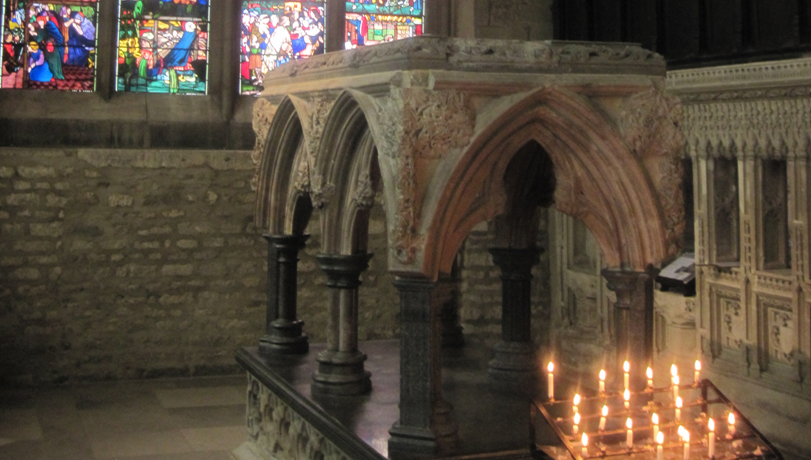
Blaise is a martyr, for in 316 he was captured by the Roman governor, recognized as a Christian bishop, and sentenced to death. Blaise was tortured with wool-combs before being beheaded, which is why he was patronized by the 19th century English wool industry. And like all martyrs, Blaise's example shows us how in the face of exclusion, mockery and accusation, we should never hide our faith in Christ from others, to follow and preach what we know is right unto death.
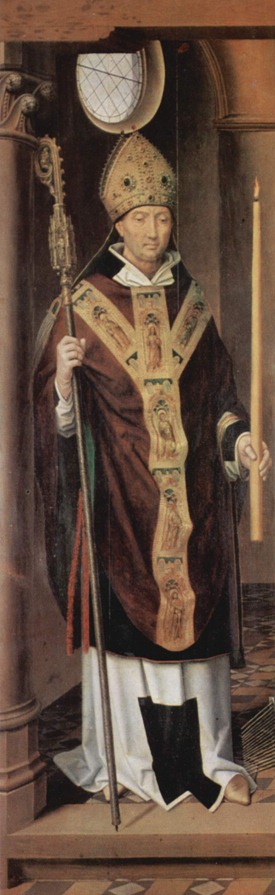
His cult in the middle ages spread all over Europe as he was among the 'Fourteen Holy Helpers,' a cult of several saints, mostly martyrs, associated with healing qualities which arose after the disastrous black death in the 1340s. Churches as far as Canterbury claimed relics (although Canterbury claimed a great variety of relics) and there is a pilgrimage church in Bavaria, Germany, Basilica Vierzehnheiligen, where the saints appeared to a young monastic. Blaise continues to be venerated as a saint in the Anglican, Orthodox, Armenian, and Roman churches, where thousands of throats are yearly blessed in his remembrance. Today the Church of Dubrovnik, in Croatia, claims his relics and holds a pilgrimage each year on this day. He is usually depicted in episcopal vestments with candles and a wool comb.
Collect (From the Anglican Missal):
Almighty God, who didst call Blase to be a faithful pastor and servant of thy people, and to lay down his life in witness to thy Son: Grant that we, strengthened by his example and aided by his prayers, may in times of trial and persecution remain steadfast in faith and endurance, for the sake of him who laid down his life for us all, Jesus Christ our Savior; who liveth and reigneth with thee and the Holy Spirit, one God, for ever and ever. Amen.

You have a very interesting blog. There is much to explore.
ReplyDeleteWould you like to follow my blog?
Luís Henriques
Best wishes,