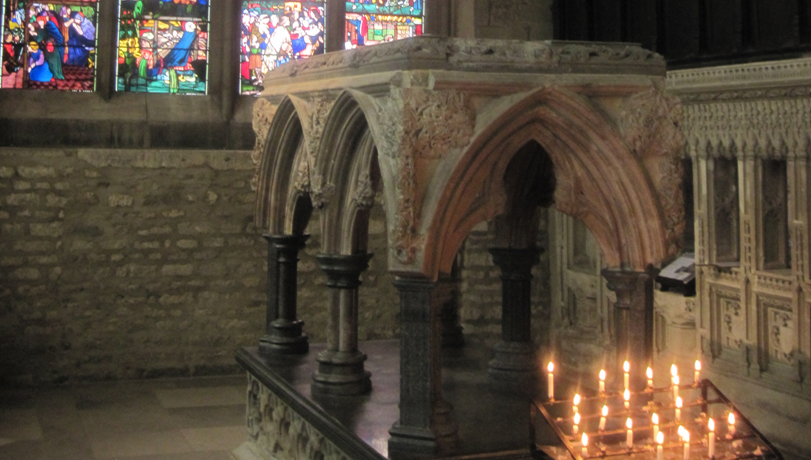
Shrine of St. Frideswide, Christ Church Cathedral Oxford.

Wednesday, August 1, 2012

A Pilgrimage for St. Cuthbert and the Northumbrian Saints.

St. Cuthbert window at Durham Cathedral.

     The lands north of the Humber river have always had a rich association with its ancient Anglo-Saxon saints. The cathedrals at Durham, Ripon and Carlisle a long with many parish churches best express Northumberland's and County Durham's love for bishops, abbesses, and monks who first brought the light of Christ to Northern England. Holy wells where the sick where healed pocketed at the edges of villages, Holy islands where hermits lived scattered along the coast, and battlefields where Holy martyrs died scar the countryside: only Jerusalem is home to more hallowed sites...
     I was able to visit many of these places on a recent trip to Northern England and was happy to find that these saints are not mere historical artifacts but remembered and venerated as ancient mothers and fathers of a living Church.

Durham Cathedral.
      Durham Cathedral, which was the first "Northumbrian" Church I visited maintained an aura of holiness that no other Cathedral in Europe can compete with. There were three offices during the day: morning prayer, noon mass, and evensong. The bells in the towers that dominated the whole city and country for miles around rang for each service. The church houses the tomb of St. Cuthbert, who is strongly appreciated in Durham Cathedral simultaneously known as "The Shrine of St. Cuthbert" a name which fully marks the cathedral as a lasting monument to the most beloved saint of the northern Church. The cathedral is architecturally remarkable as the only completely Norman cathedral in England made of a dark reddish stone and the interior pillars, clerestory and vaulted arches can only be described as massive. All around the cathedral are memorials and altars dedicated to the Northumbrian saints: the tomb and altar of St. Bede in the Galilee Chapel, altars, altarpieces and icons of St. Hilda, St. Aidan, and St. Margret and behind the high altar the simple marble slab that reads "Cuthbertus" surrounded by candles and flowers left by the countless modern pilgrims and banners and icons depicting the exemplary bishop and christian who dedicated his life to Christ.

^ Church of St. Mary the Virgin with  reredos of Lindisfarne saints and carpet from gospels.
< The Pilgrims way across the sands. 
    From Durham I went to the Holy Island of Lindisfarne which lies just north of Bamburgh and south of Berwick. The island is accessible only part of the day as the tide covers the causeway that is built on the sand on the bottom of the tidal bay. Holy Island is home to a population of only 162 people who live mainly off of sheep farming, fishing, lobstering, and tourism. The parish church of St. Mary the Virgin, which stands on just off of the town cross near the beach, was built in the 13th century and incorporates Saxon elements. It is packed with beautiful memorials to St. Cuthbert and St. Aidan, the Lindisfarne Gospels, the viking raids and St. Olaf, and the local fishing industry. Stained glass windows, carved sculptures, paintings, and textiles all conjure up the holiness of this tiny church. The church stands on the site of St. Aidan's abbey, built in A.D. 635, and embodies St. Cuthbert's life of faith and simplicity. Like Durham, there is morning prayer, mass, and evening prayer each day. Pilgrimage groups come to the island every week and often these pilgrims have come from Cuthbert's first abbey, Melrose, in the lowlands of Scotland and cross the pilgrims way across the Lindisfarne sands barefooted. I spent much of my time on the island searching for the "St. Cuthbert's beads" which are tiny fossils found on the beach in between St. Cuthbert's isle and the church that are said to be forged by St. Cuthbert on his hermitage at night and were made into rosaries by medieval pilgrims.

Ruined chapel on St. Cuthbert's Isle off of Lindisfarne.


Shrine on the spot where St. Aidan died.

     After Lindisfarne I journeyed to the parish church of St. Aidan in Bamburgh. St. Aidan first came to Bamburgh when King Oswald sent to Iona for a bishop to bring Christianity. The castle there remains associated with St. Oswald and a stone crucifix has been erected below its walls to commemorate the wooden cross the Oswald erected when Christianity first came to Northumbria. The church itself marks the spot where St. Aidan died and retains the timber which he leaned on as he took his last breaths. The timber remains suspended over the font. The church is rather large and has a reredos that incorporates many of Northumbria's saints into the witnesses of the Eucharistic sacrifice.

St. Aidan and St. Oswald
icon at Bamburgh.
Altarpiece at Ripon with the Northumbrian  Saints.
     Finally I stopped at Ripon Cathedral established by St. Wilfrid in 672. The stone choir screen features saints and kings associated with Ripon and the pulpit and Ninian Comper altarpiece features the most famous saints of Northumbria. The church also retains a crypts from the first building that was built here.
     The Church in Northern England maintains the holiness of her ancient saints to this day: they are examples to all Christians of how we can find a role in the Church to dedicate our own lives to Christ, for, as St. Julian of Norwich puts it, "all the help that we receive from the blessed saints, is by Christ's goodness."
    The holiness of St. Cuthbert, the Northumbrian saints and all the saints is help to us to find Christ's love and likewise spread it to the rest of the world.

Tuesday, July 24, 2012

The Church is in Need of Her Saints.

     Saints have an undefined place within the Anglican Church. They are present everywhere in art or music, but the Church does not actively promote the veneration of saints in liturgy or in private devotion. Many Churches of the Anglican Communion have books for the Lesser Feasts of saints, but their use is again, undefined. Although many of the cults of saints have been suppressed since the reformation in the 16th century, the Anglican Church has had a definite place for Saints for longer than it hasn't...for one thousand years before the reformation of the 16th century. In the last thirty or forty years, several cathedrals in the Church of England and elsewhere in the British Isles have restored the shrines of the Saints whose pilgrims provided the money for the magnificent churches that still stand today.


     Most notably, the shrines restored are at St. Alban's Cathedral of St. Alban the protomartyr of Britain, Durham Cathedral of St. Cuthbert, Oxford Cathedral of St. Frideswide, St. David's Cathedral in Wales, Chichester Cathedral of St. Richard, the shrine of Our Lady at Walsingham, Hereford Cathedral of St. Thomas, the shrine at Pennant Melangell in Wales, and York Minster Cathedral of St. William. The saints of those churches sustained their presence across the country even through the iconoclastic trials of the Edwardian reign in the 1540s. Their images survive in sculpture and stained glass, and their stories in cathedral libraries and local legends. A revival of the veneration of saints would echo all of human's need to first mourn for their dead and second to look to those who have died as role models...especially of the Christian Faith.

     A pronounced return to the cults of Saints, both ancient and modern, would provide a stronger foundation for both congregational and personal devotion for members of the Church as well as providing another path to bring persons into the Body of Christ.

     So how would saints be included in our everyday lives or worship? Many parishes have set up small altars dedicated to their patron or an image somewhere in the church where people can contemplate the actions and life of such a saint. Although images and relics have an historically awkward place in the Anglican Church as their veneration was banned in the 39 articles, the practice of placing candles before and image of a saint is not much different from placing flowers on the graves or by the images of our own dead.

     Saints are those holy men and women who have led an exemplary Christian life. They were never seen as persons with divine status by any part of the medieval church. Rather, saints were venerated because they were seen as examples of how dedicated a Christian should be to Christ whether they were a pauper martyred as they "took up the cross" and refused to renounce Christ even unto death or a bishop who dedicated the whole of his episcopate to humbly serving the dispossessed of his diocese while his lordly colleagues enjoyed their episcopal palaces.

     The Church owes much of her existence to these men and women who died for the faith or kept clean the Church of corruption. Today by placing a candle before the image or relic of a saint we are both thanking our mortal ancestors for giving us the Church and praying that we as Christians might be able to imitate the extreme dedication to Christ that these saints exercised.

     Reviving the cults of saints also means that the Church should look for the saints who may not have been historically recognized as such. Samuel Seabury has made his way into the U.S. Episcopal Church's  "Lesser Feasts and Fasts" book. But many lesser known priests and laypeople might deserve to be recognised as saints locally. After all, many of the saints of the middle ages were local religious or laypeople who were locally seen as holy people in their dedication to Christ for the variety of acts that they performed. Saints don't have to make miracles, at least not the kind of miracle where people are healed by touching the holy person's cloak or where a spring appears on the spot where the saint died. But men and women who dedicate their life to Christ replicate in our own power various acts of Christ. These acts are the miracles that we have to look for and aim to imitate ourselves. As St. David of Wales said on his deathbed "remember the little things that I did"...St. David, the 6th century bishop of Menevia, became the most venerated saint in all of Wales and remains so today.

     Besides the devotion to saints within parishes, the saints are a way to bring parishes and dioceses to become more intimate with each other as One Holy Catholic and Apostolic Church though pilgrimage. Pilgrimage to particular churches or the cathedral of the diocese not only encourages a constant religious use of the church buildings but also associates churches with the holiness of a particular saint. The Greek Orthodox Church in my area of northern New Jersey brings bishops, priests, and lay people alike together on various saints feast days at churches dedicated to that saint. The Anglican Church can create a similar aura of diocesan unity through gathering for example at a church dedicated to St. Andrew on St. Andrew's day or by having an annual pilgrimage to the diocesan cathedral or to another parish church from the parishes of the diocese on the diocese's or cathedral's patronal feast day.


     Parishes should encourage devotion to saints because saints provide examples of how a Christian life should look. The saints devoted their lives to Christ; their every action was based on Christ's own actions and commandments. The Church should encourage her flock to replicate the actions of those who have supported her in the past...so that she can flourish and continue to proclaim the risen Christ in the future.


Dedication of the rebuilt shrine of St. David, St. David's Cathedral, Wales.
"Remember the little things that I did."

Sunday, July 22, 2012

Feast of St. Mary Magdalene... The Apostle of Apostles, July 22.

St. Mary Magdalene by El Greco.
St. Mary Magdalene is a peculiar figure in the New Testament, and yet was one of the most faithful disciple to Jesus. What is truly remarkable about Mary Magdalene is that although she was a sinner, she is the most important women in the bible following Mary the Blessed Virgin as one of the first human beings to see Christ after the Resurrection.

Mary Magdalene first appears as one of the many whom Jesus healed of an illness in Luke described as to have come from Galilee. The illness is described as seven demons which are really sins. And a sinner, she became very intimate with the  12 disciples and with Jesus and is present at the most important events that Christians now celebrate as Triduum. Since the Middle Ages she has been identified as one the prostitutes that was saved by Jesus and as the women who anointed the feet of Jesus at the Last supper with perfume, Mary of Bethany. She was present at the Crucifixion where she is often depicted as one of the mourning women beneath the cross. After the Crucifixion she is among those who brought ointment to bury Jesus after She, Mary the Mother, and Joseph of Arimathea took Jesus off the cross. For this reason she is often depicted holding a jar of perfume and is known to the Orthodox Churches as one of the Myrrhbearers the feast of whom is celebrated on the third Sunday after Easter. Finally Mary Magdalene is one of the first to meet Jesus after the Resurrection when she and Mary the Mother of James go revisit the tomb and find that the stone had been removed. Mary has been know as the "Apostle of Apostles" or the "first Apostle" because she was the first to speak with Jesus at the Resurrection when he told her "Go and tell the others that I am risen." And later "I is I who appeared to these women and who wanted to send them to you as apostles." Mary Magdalene is the first person to spread the good news of the resurrection of Christ.

After the Pentecost there is some controversy over what became of Mary Magdalene. The Orthodox Churches maintain that she retired with Mary the Mother of Jesus to Ephesus where she died and from which her relics were translated to Constantinople where they remain to this day.

The Western tradition holds that she came to a came to France with other Christians and worked as an apostle in what is now Provence. She then retired to a cave in "St. Baume" where she died.

The cave at St. Baume is still an important place of pilgrimage even though many know of the opposing stories. National Geographic recently cited the response of local of St. Baume when questioned on this, saying "There was a priest who lived here at the cave for many decades. He said that while it's impossible to know if Mary Magdalene truly came here in the first century, that certainly was of less importance. She's here now."

St. Mary Magdalene, as the first Apostle, is important to us today both because she is the first to proclaim the risen Christ and because she shows us how sinners and outcasts can be reconciled by the love of Christ.
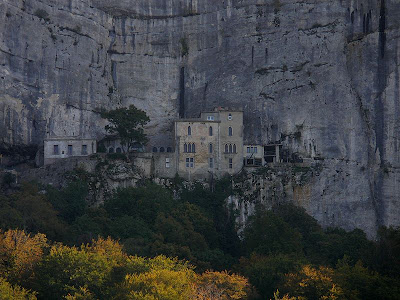
The monastery at the cave of St. Baume, France.

Litany to St. Mary Magdalene

Lord, have mercy on us. 
Christ, have mercy on us. 
Lord, have mercy on us.
Christ, hear us.
Christ, graciously hear us. 
Holy Mary, Mother of God, Pray for us.
Saint Mary Magdalene, Pray for us.
Sister of Martha and Lazarus, Pray for us. 
Who didst enter the Pharisee's house to anoint the feet of Jesus, Pray for us. 
Who didst wash His feet with thy tears, Pray for us. 
Who didst dry them with thy hair, Pray for us. 
Who didst cover them with kisses, Pray for us. 
Who wast vindicated by Jesus before the proud Pharisee, Pray for us. 
Who from Jesus received the pardon of thy sins, Pray for us. 
Who before darkness wast restored to light, Pray for us.
Mirror of penance, Pray for us.
 Disciple of Our Lord, Pray for us. 
Wounded with the love of Christ, Pray for us. 
Most dear to the Heart of Jesus, Pray for us. 
Constant woman, Pray for us.
Last at the Cross of Jesus, first at His tomb, Pray for us. 
Thou who wast the first to see Jesus risen, Pray for us. 
Whose forehead was sanctified by the touch of thy risen Master, Pray for us.
 Apostle of apostles, Pray for us. 
Who didst choose the "better part," Pray for us. 
Who lived for many years in solitude being miraculously fed, Pray for us. 
Who wast visited by angels seven times a day, Pray for us. 
Sweet advocate of sinners, Pray for us. 
Spouse of the King of Glory, Pray for us.

V. Saint Mary Magdalene, earnestly intercede for us with thy Divine Master
R. That we may share thy happiness in heaven.

Let us pray. May the glorious merits of blessed Mary Magdalene, we beseech Thee, O Lord, make our offerings acceptable to Thee: for Thine only-begotten Son vouchsafed graciously to accept the humble service she rendered. Who livest and reignest with Thee and the Holy Ghost, God for ever and ever. R. Amen.

May the prayers of blessed Mary Magdalene help us, O Lord : for it was in answer to them that Thou didst call her brother Lazarus, four days after death, back from the grave to life. Who livest and reignest with the Father and the Holy Ghost, Unity in Trinity, world without end. R. Amen.


Prayer Source: Kyrie Eleison — Two Hundred Litanies by Benjamin Francis Musser O.F.M., The Magnificat Press, 1944
Thursday, June 21, 2012

Feast of St. Alban the Martyr, 22 June.

Martyrdom of St. Alban from Trinity Dublin Library. The eyes of the executioner were said to have fallen out  when he struck off the head of the Martyr.
Very little is actually known about the life of Alban, but as the first martyr in Britain the little that we do know about him and the cult that surrounds him remains important to the nearly two-thousand-year story of the Church in England. Alban was a Roman soldier living in Roman controlled city Verulamium in either the 3rd or early 4th century, for several ancient sources give different dates. Alban sheltered a priest in his house during an early persecution of Christians and was eventually baptized. When Roman soldiers came looking for the priest, Alban took on the priests clothes, allowing the priest to escape and revealing his faith to the Romans. Alban was taken before a judge who condemned him to death. On 22 June, Alban was dragged up  a hill outside the city and beheaded. When he was being taken to his martyrdom, the waters of a river that he and the roman soldiers had to cross are said to have parted so that he did not get wet. A well that is believed to have sprung from the earth at his death has been venerated since the Middle Ages. Both early medieval chroniclers Bede and Gildas mention that there has been a church on the site of his martyrdom since the 4th century and that that church contained the relics of Britain's protomartyr, and since the reign of William I, a Benedictine abbey dedicated to St. Alban has occupied the site. The abbey, now a cathedral houses the restored shrine of St. Alban which contains some of his relics, a holy space for the Church of England and the entire Anglican Church that is still filled daily with candles lit by today's pilgrims. 

Jesus ordered us to "take the way of the cross" and not to resist the faith because of persecution. Alban is Britain's first saint to die for his faith and because of St. Alban and the many other martyrs who died to preserve the faith, the Church has been able to show to billions of people Christ's saving love. Yet although Christianity is no longer persecuted in many countries, the Church must encourage Christians everywhere to take up the cross whether it is to help the dispossessed or to die or suffer for the faith. St. Alban's example shows us the importance of taking the way of the cross.

http://www.stalbanscathedral.org/visit/pilgrimage/pilgrimage-at-st-albans
Link for the "Albantide" pilgrimage held at the cathedral every year.
The Shrine of St. Alban behind the high altar in St. Alban's Cathedral.  To the right is the chantry chapel of Humphrey, Duke of Gloucester suspended in the arch. He had the chapel elevated because he did not want to obstruct the view of the shrine from pilgrims passing through the ambulatory.

Tuesday, June 12, 2012

Feast of St. Anthony of Padua, June 13.

Above and below: the Life and Miracles of St. Anthony. C.1515,  at the  monastery of Brou, Bourg-en- Bresse
Anthony was born into a wealthy family in Lisbon, Portugal in 1195. As a child of a noble household he was sent to the Cathedral school in Lisbon and later joined the Augustinian Canons first of the Abbey of St. Vincent and then the more scholarly community of Santa Cruz in Coimbra. He was ordained but in 1221 he joined the Franciscans after seeing the bodies of several Christians martyred in Morocco. In was when he joined the Franciscan hermitage that he took the name of Anthony, after St. Anthony the Great (Bishop of Alexandria). Anthony left Portugal for Morocco but was driven to Italy in a storm where he joined a convent in Tuscany, living in deep prayer, study and contemplation. It was at this convent that he came to be known for his great preaching and later left the convent to preach the gospel throughout Tuscany. After meeting with the founder of his order he taught in Provence, France for the Church. He returned to Italy and in 1231 retired to a hermitage after falling ill. He died on this day, 1231 at a Poor Clare convent near Padua. He was canonized less than a yer after his death and a cult grew around the Church in Padua dedicated to him. The Church, begun in 1232, is now a basilica and houses the shrine of St. Anthony. In art St. Anthony is depicted reading a book where Christ is appearing to him, emphasizing the presence of Christ in the study and preaching of the Gospels.

     St. Anthony provides an example of how the Church should appear to the community. As a Franciscan an a scholar, he was vowed to apostolic poverty, living humbly like Christ and his disciples with the poor and oppressed and was dedicated to preaching the Gospels to bring comfort to the poor in spirit, to those who mourn, to the meek, to those who hunger for righteousness, to the merciful, to the pure in heart, to the peacemakers, and to those who are persecuted for their righteousness, all of whom Christ first spoke words of comfort. The Church must remember St. Anthony those like him for his Christ-like life so that it can best address the needs of all people as Christ would have. 


Friday, June 8, 2012

Feast of St. Columba of Iona, 9 June.

Iona Abbey, founded by St. Columba in 565.
Columba was born into a branch of one of the royal clans of Ireland in 521 and joined a monastery at an early age. It was a custom of Irish noblemen to send one of their children into the monastic life, which was of a higher status and importance in the Celtic Church than in the early 'Roman Church.' Although the various churches under the Roman Patriarch were for most of the middle ages only loosely connected to Rome, the Celtic Church, although sharing the same faith, had no ties with the Roman Church, and operated itself independently as all the Patriarchates did. Columba rose quickly to the rank of abbot, which in the Celtic Church was higher that the rank of bishop. While he remained in Ireland he founded the great monasteries of Durrow and Kells, both of which would produce illuminated gospel-books. In 565, after getting into a quarrel with other abbots and initiating a war between opposing royal clans he forced himself, as penance, to travel to the kingdom of Dal-Riata and convert all of the Scottish kingdoms. He was given the isle of Iona where he built a monastery that would later become the center of Celtic Christianity. He traveled all over Scotland converting the rest of the land to Christianity and establishing the new church. When he came to the King Bruide of the Picts, or the 'Redshanks' as the Venerable Bede calls them, he was barred from the castle, but according to the detailed "Life of St. Columba" by Adomnan, a later abbot, the Gates them opened themselves upon Columba's command, letting his missionaries in, where King Bruide would convert to Christianity. Columba spent the rest of his life in Scotland where his actions were key to a firm foundation of Christianity among the Scots. He was such an important figure that several Anglo-Saxon histories include him in their accounts of ecclesiastical history.

The Scottish Episcopal Church, which was forced into hiding in the 17th and 18th centuries, is partially descended from Columba's Church. St. Ninian converted the southern Picts and so the Scottish Episcopal Church is also descended Ninian's Church. Like all missionaries, Columba is important because he is a good example of the work that Christ asked us to do, and that became so revered in the office of bishop. The duty of the Church is to continue spreading the faith and love of Christ, and our modern Church must continue to spread the faith that St. Columba and others worked so hard to save and nurture. When Columba came to Scotland, he was amongst pagans; now we confront doubt and suspicion of the faith, but we must also work hard for the faith that so many dedicated their life to.

O God, who by the preaching of thy blessed servant Columba didst cause the light of the Gospel to shine in Scotland: Grant, we beseech thee, that, having his life and labors in remembrance, we may show forth the our thankfulness to thee by following the example of his zeal and patience; through Jesus Christ our Lord, who liveth and reigneth with thee and the Holy Spirit, one God, for ever and ever. Amen.

Sources: Lesser Feasts and Fasts (of the Episcopal Church).

Thursday, June 7, 2012

Feast of St. William of York, 8 June.

A proccesion carrying the relics of St. William from the St. William window at York  Minster.

St. William FitzHerbert was born into a noble family possibly during the  reign of King Henry I. He became chaplain to King Stephen in the 1130s when he also became the treasurer of the Chapter of York minster. After Archbishop Thurstan died in 1140, William was elected to the see by the canons of York with royal backing. But before William was consecrated, he was accused of several ecclesiastical sins that, as his Cistercian accusers insisted, should prevent his consecration. The matter was taken to the Pope the grounds being not only Williams morality but also that religious houses were allowed to be involved in diocesan elections since the Second Vatican Council, and that the Yorkshire Cistercians had been excluded from William's election. William swore an oath that cleared him of all charges of simony and bribery, and was consecrated Archbishop of York on 26 September of 1143. The next Pope, Eugene III, however, was himself a Cistercian and was persuaded to reopen the case by Bernard of Clairvaux. Eugene deposed William, who then retired to Winchester taking the Benedictine habit. After Eugene and the replacement archbishop died, William and King Stephen asked the new Pope, Anastasius IV, to restore his arch-episcopate. William was made Archbishop again and received the pallium. But not long after he returned to York he was poisoned by tainted wine at mass and died. He was buried at York and immediately venerated as a saint. In 1227, after several miracles were recorded at his tomb, he was canonized by Pope Honorius III, his body was elevated, and a shrine was built. At the time of his death, York Minster had no saint's shrine, as most of the saintly Archbishops of York were buried at surrounding monasteries so the shrine of St. William became very important to the life of the minster and subsequently became second largest shrine in the north of England by the early 16th century (surpassed by that of St. Cuthbert at Durham). In 1960 his relics were discovered in the crypt of the Cathedral and re-enshrined for modern day pilgrims.

The restored Shrine of St. William in York Minster...the mosaic in the back depicts William with the pallium.

Friday, May 25, 2012

Feast of the Venerable St. Bede, May 26.

St. Bede writing in a scriptorium, and the shrine of St. Bede.

Bede entered into the monastery of Monkwearmouth, Northumbria as a young boy. He was educated from early on in the Benedictine, monastic tradition by the Abbot Benedict Biscop, so called for his patronage of the rule and lifestyle of St. Benedict, and later by Abbot Ceolfrith. He narrowly escaped death with Ceolfrith, as the only literate survivors of a plague that killed monks at his monastery in the late 7th century. Bede was ordained in A.D. 703 at age 30, as was the tradition (therefore he was born in 673). Bede is best known for his many written works, many of which are the soul sources for their time that have survived until now. His Lives of the Abbots follows the works of the abbots of Monkwearmouth, namely Benedict and Ceolfrith. He also wrote the Vita Sancti Cuthberti, which is a biography of St. Cuthbert and reveals much about the growing Northumbrian cult. The best known work is the Historia Ecclesiatica Gentis Anglorum, or the Ecclesiastical History of the English Peoples, which covers the geography of the island, and traces Christianity in Britain through St. Columba, St. Ninian and the Scottish and Welsh Churches, and the history of the Church among the Anglo-Saxons going all the way back to St. Augustine and Pope Gregory. Bede best covers the Anglo-Saxon Church, recounting the lives of many saints including St. Etheldreda, St. Chad, St. Hilda, St. Wilfrid, St. Theodore, St. Cuthbert, St. Aidan, St. Oswald and many others, as well as ecclesiastical events such as the synods of Hertford, and Whitby. He was so devoted to his writing and to his other monastic duties that he died singing the 'Gloria Patri.' His relics were enshrined at Jarrow, where he died, but later taken to Durham, where they lie still in the Galilee chapel. Bede is venerated as one of the great lights of the ancient Church of England, St. Boniface himself said "The candle of the Church, lit by the Holy Spirit, was extinguished."

Heavenly Father, who dist call thy servant Bede, while still a child, to devote his life to thy service in the disciplines of religion and scholarship; Grant that as he labored in the Spirit to bring riches of thy truth to his generations, so we, in our various vocations, may strive to make thee known in all the world; through Jesus Christ our Lord, who liveth and reigneth with thee and the Holy Spirit, one God, for ever and ever. Amen.


Sources...Oxford Dictionary of Saints, and 1979 BCP

Feast of St. Augustine of Canterbury, first Archbishop of Canterbury, May 26.

Icon from Canterbury Cathedral with Pope Gregory presenting the pall to St. Augustine. And the 11th century Chair of St. Augustine, the throne of the Archbishops of Canterbury behind the high altar of the cathedral.

St. Augustine is best remembered as one of the Fathers of the Anglican Church as the founder of the Archbishopric of Canterbury. Although there were many other bishops in Britain, Augustine would be the first among the Anglo-Saxons. Augustine was originality the prior of St. Andrew's Abbey in Rome and a close friend of Pope Gregory the Great. At one time before Gregory had been elected to the papacy, he was in a Roman slave market where he encountered three Angle slaves from Britain. Noting that the slaves were pagans, Gregory would later send St. Augustine to Britain to convert the Anglo-Saxons. In 596 Augustine left Rome, arriving in Kent in 597. He went first to the King of Kent, Ethelbert and his wife, Bertha who was already a christian, baptized at Paris. Ethelbert was impressed with Augustine, but still took 3 years to decide weather or not to accept the Christian faith. Finally in 601, Ethelbert was baptized and allowed for many of his subjects to also be baptized. Augustine sent for more priests and monks from Rome, and built the first Cathedral at Canterbury. In the following few years he would establish St. Augustine's Abbey, outside the Canterbury city walls, an abbey at Reculver, and the dioceses of Rochester and London. Due to Ethelbert's overlordship of southern England and the strong and fast-growing presence of the archbishopric in Canterbury and the other bishoprics, Christianity never lapsed in that area and the city would be used as a base for all of the future missions to convert the Anglo-Saxons of neighboring kingdoms in the following century. Augustine died in 604 at the end of a short bu successful episcopate. His relics were the most prized of the many saints whose bones lay in the abbey of St. Augustine outside of Canterbury. As the apostle to the Anglo-Saxons, Augustine is rightly considered the 'church father' of all Anglicans, and is still widely venerated in all provinces of the Anglican Communion. It is right, as Anglicans that we thank God for giving Augustine the strength and perseverance to bring the faith to the English.

Holy God, who sent forth thy servant Augustine as the first Archbishop of Canterbury to bring the Gospels of thy Son Jesus Christ to the English people: strengthen all the bishops of our own time, to remember their holy gifts, and strengthen the Holy Church which has sprung from the chair of Augustine to righteously extend the same Gospels to all the world. Amen.

Wednesday, May 23, 2012

Feast of St. William of Rochester (or Perth), May 23.

Stained glass from Rochester Cathedral depicting St. William as a Pilgrim. 
William grew up in Perth, Scotland in the 12th century. A pious man, he attended masses daily and as a fisherman and a baker and gave much of what he produced and earned to the poor of Perth. He was additionally involved in helping orphans, adopting the boy, David, as his son, and saving an infant, who had left at the door of a church, from the cold. In 1201 he set out from Scotland with his adopted son, David, to go on a pilgrimage to the Holy Land, taking with him enough for he and his companion to survive and the rest to give to the poor along the way. But while in Rochester, David turned on him and murdered him for what little he had. A madwomen later found his body and adorned it with flowers and herbs, and who upon touching the body was healed of her madness. The monks of Rochester later brought the body to the Cathedral where it would attract pilgrims by the thousands until the Reformation. William was venerated for his charity, piety, pilgrimage, and martyrdom, and is typically depicted as a pilgrim with the scallop shell. His tomb survives Rochester and he has been re-incorporated into the chain of saints associated with Rochester.
     What is important to remember about St. William of Rochester is that he was a laymen. Most saints are ecclesiastics: bishops, monks and nuns, and the few saints who were laypeople are often monarchs who established great churches. St. William is a lay-saint, and it is not his death which did not make him one, but his charitable life, abruptly ended on a devotional and humble journey. He may, for many, by a more approachable saint because of this. Though there is little known about him and his cult was never very large in England, he may remain with other saintly laypeople an enduring example of how anyone, not just bishops or religious, can attain such holiness.
Rochester Cathedral west window. The gothic additions to the originally Norman Church were probably funded by donations from pilgrims who stopped at the shrine of St. William. 

Tuesday, May 15, 2012

Feast of St. Isidore the Farmer, May 15

Iglesia San Isidro el Real en Madrid

St. Isidore was born in Madrid in around 1070. Known for his piety, he was constantly attending masses at his local parish church in Madrid and late to work in the fields because of his deep and persistent prayer. It was often said that as he ploughed there were angels accompanying him on either side so that his work equaled that of three men. Upon the ground where he farmed the crops grew with ease and water welled up from the ground upon his command. His wife, St. Maria Torriba, was also known for miracles involving water, which would have been especially precious in the semi-arid landscape that surrounds Madrid. St. Isidore is a patron saint of farmers and of the city of Madrid as his relics are enshrined within the Church of San Isidro el Real. Both he and his wife were invoked in times of famine or drought.

Friday, May 11, 2012

Lady Julian of Norwich, 8 May... "All shall be well"


Little is known of the Lady Julian. But she was about 30 in 1373 when she experience a series of 16 visions all portraying a theme of Divine Love. Soon after her visions, she was miraculously healed of the deathly illness for which a priest had delivered last rites to her just a few days before. She later attached herself to the parish church of St. Julian of Le Mans in Norwich (where she gets her name) as an anchoress where she spent the rest of her live blessing pilgrims and writing her account and interpretation of the visions called The Revelations of Divine Love. Julian is notable for her book because of the low literacy rate and her stance on the theology of Divine Love as a women. Today the Church of St. Julian of Le Mans in Norwich is the site of the restored Anglican shrine of the Lady Julian, where her cell has been rebuilt as a chapel for modern day pilgrims. The Lady Julian in demonstrates, to the Anglican Church, the Divine Love that was and is extended to all people through the Passion. The persistence of the Lady Julian to show to us the intensity of Jesus' love sets the example for Anglican Church to be inspired by the love of Christ demonstrated in his sacrifice and to proclaim that love to all in the world who need it.

Some Quotes from Revelations of Divine Love...

"I desired in many ways to know what was our Lord's meaning. And fifteen years after and more, I was answered in spiritual understanding, and it was said: What, do you wish to know your Lord's meaning in this thing? Know it well, love was his meaning. Who reveals it to you? Love. What did he reveal to you? Love. Why does he reveal it to you? For love. Remain in this, and you will know more of the same. But you will never know different, without end."


"There were times when I wanted to look away from the Cross, but I dared not. For I knew that while I gazed on the Cross I was safe and sound, and I was not willingly going to imperil my soul."


"It behoved that there should be sin; but all shall be well, and all shall be well, and all manner of thing shall be well."

Website for the Shrine of the Lady Julian. 

Saturday, March 24, 2012

Feast of the Annunciation, March 25

The Annunciation (by myself). The iPod replaces the more traditional book which Mary holds for a modern twist.

The Feast of the Annunciation celebrates the visitation of the Angel Gabriel to tell the Blessed Virgin Mary that she would bear the son of God and was to name him Jesus, meaning Savior. The feast is celebrated exactly nine months before Christmas illustrating the perfection of Christ even in birth. It was St. Luke the Evangelist who after the Resurrection and Pentecost interviewed Mary and recorded the Annunciation, the Nativity and the birth of John the Baptist in his Gospel. The Angelus,which goes over the Annunciation as a prayer is as follows:
V. The angel of the Lord declared unto Mary.
R. And she conceived by the power of Holy Spirit.
Hail Mary, full of grace, the Lord is with thee. Blessed art thou among women, and blessed is the fruit of thy womb, Jesus. Holy Mary, Mother of God, pray for us sinners, now and at the hour of our death. Amen.
V. Behold the handmaid of the Lord.
R. Be it done unto me according to your Word.
Hail Mary...
V. And the Word was made flesh.
R. And dwelt among us.
Hail Mary...
V. Pray for us, O Holy Mother of God.
R. That we may be made worthy of the promises of Christ.
Let us pray: Pour forth, we beseech thee, O Lord, Thy grace into our hearts, that we to whom the incarnation of Christ Thy Son was made known by the message of an angel, may by His Passion and Cross be brought to the glory of His resurrection; through the same Christ our Lord. Amen.

And my favorite Annunciation hymn. Medieval Basque tune and words.

The angel Gabriel from Heaven came,
His wings as drifted snow, his eyes as flame;
“All hail,” said he, “thou lowly maiden Mary,
Most highly favored lady,” Gloria!

“For know a blessèd mother thou shalt be,
All generations laud and honor thee,
Thy Son shall be Emmanuel, by seers foretold,
Most highly favored lady,” Gloria!

Then gentle Mary meekly bowed her head,
“To me be as it pleaseth God,” she said,
“My soul shall laud and magnify His holy Name.”
Most highly favored lady, Gloria!

Of her, Emmanuel, the Christ, was born
In Bethlehem, all on a Christmas morn,
And Christian folk throughout the world will ever say—
“Most highly favored lady,” Gloria!

http://www.youtube.com/watch?v=xKQIomtXXkc 

Friday, March 23, 2012

Restored Shrine of St. David of Wales


Here are the pictures from the dedication of the Shrine of St. David in his Welsh Cathedral. The procession began at the city cross, where the bishop blessed the City of St. Davids. The procession then moved to the Cathedral where a choral Eucharist was celebrated and the Shrine was dedicated. Celebrations continued for the next 5 days with shrine prayers and choral Eucharists everyday. The Cathedral also celebrated the feast of St. Non, St. David's mother, on Sunday, March 3.

Below is a link to the diocesan website with more pictures of the Shrine and celebrations, and the sermon delivered by the Canon Chancellor and Guardian of the Shrine, Dr. Patrick Thomas on St. Non's Day.
http://www.churchinwales.org.uk/david/std_english.php


Sunday, March 18, 2012

The Pope of Alexandria, Shenouda III, died on Saturday.

Patriarch of Egypt and All Africa since 1971, Shenouda has lead the Coptic Church for 4 decades. He supported his people, about 10% of the population in Egypt, through several periods of sectarian violence, the latest being the burning of Coptic churches and military attacks on Coptic protesters. Shenouda died at age 88 on Saturday, March 17, and hundreds of Christians gathered in and around the Cathedral of St. Mark in Alexandria to mourn his death.

Saturday, March 17, 2012

St. Cuthbert of Lindisfarne; 20 March

St. Cuthbert of Lindisfarne at Durham Cathedral.
     St. Cuthbert is certainly one of Britain's, if not of all Anglicanism's, greatest bishops. The humility, love and compassion that he shared with his community, along with the many centuries of devotion paid to him after his death mark him both as one of the most loving and most loved leaders of English Christianity. Love is a reflexive act; the compassion, and trust shown to him by the Northern community is equally important to the care that he held for the people of his bishopric in the 7th century. His cult has survived war and peace; the Viking invasions beginning in 793, the danish invasions of the 10th century, the Norman Invasion, and it has even survived the impious destruction during the Reformation. His bones still lie at Durham where on March 19, 2012 a restored Banner of St. Cuthbert, a copy of a the medieval relic of his shroud and a symbol of northern England and the latest addition to the treasures of his tomb, will be dedicated.
St. Cuthbert's Shrine at Durham Cathedral.

Cuthbert was born in 634, near Melrose. He was a shepherd until he saw a vision as a boy. It is one of the early chapters in the Vita Sancti Cuthberti by the Venerable Bede that is dedicated to this vision called Quomondo cum pastoribus positius animam Sancti Aidiani Episcopi ad coelum ab angelis ferri aspexerit (literally, how while he was posted with the shepherds, he witnessed the soul of the Holy Bishop Aidan being carried to heaven by angels). This is what prompted him to enter into the monastery of Melrose at an early age. Cuthbert did well as a monk in the eyes of the abbot, Boisil. He came to accept the Roman customs after the Synod of Whitby and was made prior of Melrose. When his new abbot, Eata, went to Lindisfarne, Cuthbert followed and became prior of Lindisfarne where he pursued missionary work in Northumberland and southern Scotland.  In 676 he decided to take monastic life a step further and live as a hermit on the Farne islands of the Northumbrian coast. there he remained for 9 years, living on a simple diet of onions and fish. He built himself an oratory and practiced the Celtic rite of saying the psalms in the cold sea water. It is recorded that when he came out from the water, the otters dried his feet and the birds brought him fish out of their own admiration. And while on the island he would bless those who came to seek his comfort.
Cuthbert leaves Farne to become bishop

In 685 Cuthbert was appointed the Bishop of Hexham, (which he swapped for Lindisfarne) by the Archbishop of Canterbury, Theodore of Tarsus. He left the Farne with King Ecgfrith and Bishop Trumwine and returned to his missionary work in the bishopric. During his short episcopate, he traveled through his diocese on foot, ministering to the rural and urban poor alike and performing miracles for their relief. He lived first to extol and praise God and to worship him by living like him and to extend the good news of Christ's love to all people in his flock so that we might be comforted and learn to comfort others.

The site of Cuthbert's first hermitage.
His humility, his sanctity, and his high love for his people make him a model bishop. He died on 20 March, 687 on the Farne islands, where he returned after he predicted his death two months before. He was buried in the church at Lindisfarne, and when the Vikings attacked in 793 and later in 875, the monks carried his body from the island, and embarked on a 120-year journey that brought them to Durham in 995. There, when the ox-cart could no longer move, they laid his body in a tomb where it rests today, still retaining the head of St. Oswald, vestments presented by King Ecgfrith, and his own pectoral cross and portable altar. He was the most popular saint in Northern England as his shrine attracted pilgrims from all over the British isles, and continues to do so.
St. Cuthbert in the Galilee Chapel at Durham.

     Hopefully the Anglican Church, and all Churches will continue to honor St. Cuthbert as one apostle of Christ in England, and a bearer of Christ's love in the same land. The bishops of today's Church have the job of preserving the faith that Cuthbert brought to the people of Northumbria, and extending the love of Christ that he extended to his people. More importantly, the Church needs to continue St. Cuthbert, it needs bishops, priests and laypeople who will dedicate their lives to the extension of Christ's comfort through and in Christ's saving message. It is essential that the Church holds on to the traditions, to the image of Christ and his love in people, and the images and relics of those who spread his love, so that we never forget what our duty is: to spread the words of love of Christ. Only through our perseverance can the "Fire in the North," as he was called by Fr. David Adam of Bamburgh, and us like him, spread to set the whole world ablaze with the light of Christ.

Collect (from the Church of St. Mary the Virgin, Holy Island):
We thank you Father for the life of St. Cuthbert of Lindisfarne: his reverence for all living creatures, his observance of a dedicated life under rule, his missionary zeal, his kindness to all who came  to him for comfort-and all for love of you. So in our pilgrimage of life strengthen us to walk with care in these ways that he observed through the study of prayer and personal example, that we may bring peace and integrity to your world in the name of Jesus Christ our Lord. Amen.

Durham window with the miracles in Cuthbert's life and death.

Monday, March 5, 2012

St. Chad of Lichfield, March 2


March 2nd was the feast day of the early English bishop Chad. Chad or Cedda lived in the seventh century before the middle angles of the Mercian kingdom had been converted. He was a student of St. Aidan of Lindisfarne, who has appeared in this blog so many times, and traveled to Ireland as a monk before returning, with Egbert, Finan, and Colman, to convert the Mercians. Practicing the Celtic version of monasticism, he lived a life with the people while strictly keeping to the rules of prayer and discipline. Bede is very careful to note his devotion repeatedly. While in Ireland his brother, Cedd founded the monastery of Lastingham in Northumbria under King Oswiu. The abbey was a success and Chad took over as abbot at his brother's death.
The Synod of Whitby in 663-664 had caused Northumbria's Celtic bishops to return into Scotland, leaving the North without episcopal oversight. After Tuda, Wilfrid, one of the supporters for the Roman Customs in the Synod, was appointed as bishop, but went to France to seek consecration because of a shortage of bishops in Britain and did not return for 2 years. Chad in the mean time was appointed bishop because it seemed that Wilfrid was going to stay in Gaul. But he returned and at this time Theodoric of Tarsus had been appointed Archbishop of Canterbury by the Patriarch of Rome. Theodoric traveled to Northumbria quickly to settle the dispute between Wilfrid and his new Roman rites and observances and the Celtic, more orthodox ways of Chad and Oswiu. Chad was ordered to step down, which he did, but soon after, the king of a still pagan Mercia, Wulfhere asked for a bishop and Chad was appointed. He established his episcopal seat in Lichfield where he built a monastery dedicated to St. Mary. He spent the rest of his life establishing monasteries and churches all over Mercia until his death on 2 March 672. Chad was venerated as a saint immediately following his death, and a cult centered in Lichfield flourished through the Middle Ages.  The Cathedral at Lichfield marks his shrine with an Icon and continues to remember his feast.

Friday, March 2, 2012

Feast of St. David of Wales; 1 March

This print refers to one of David's miracles. When he was preaching to a crowd who could not hear him, the earth underneath his rose up into a hill and a dove landed on his shoulder...a sign of the Holy Spirit

Saint David is one of the greatest and best remembered bishops in Wales. Living in the sixth century he preached all over Wales and southern England (which at that time was heavily Welsh also) establishing many churches and monasteries. It is claimed that he founded the monastery of Glastonbury by his 11th century biographer, Rhygyfarch. But he certainly founded  a monastery at St. Davids in Pembrokeshire, Wales, choosing a patch of earth that was sunken among the coastal hills in order to hide any church buildings from raiders. Even as an abbot and a bishop, David lived an austere lifestyle in prayer, diet and general modesty, without the seclusion that other ascetetics. Instead of hermitage, a common Christian Celtic practice,  David emphasized the importance of the community. He made a pilgrimage to both Rome and Jerusalem and was made an archbishop by patriarch (pope) of Jerusalem (this is the basis for the claims of later medieval bishops of St. Davids that they should have archiepiscopal status, when Canterbury's power was extended over Wales after the Norman invasion). David held great influence in the Celtic church in Wales and abroad, a renowned scholar for his travels and elevation as archbishop, David also called together many synods to keep tight order within the church. He was always among the people, disregarding rank or any social or civil status, which was probably one of the main reasons for his popularity and veneration as a saint immediately following his death. The exact year of his death is disputed, traditionally believed to be in 589, though we do know that he died on march first, leaving his people with words “Be joyful, and keep your faith and your creed. Do the little things that you have seen me do and heard about. I will wall the path that our fathers have trod before us.” Just this past March 1st , St. David’s Cathedral in Wales dedicated his restored shrine, moving his relics from the trinity chapel, where they were discovered about a century ago, to the redecorated medieval shrine in the chancel. Celebrations are continuing until March 5th with daily prayers at the shrine, Choral Eucharist’s and medieval monastic chants. The rebuilding of his shrine is a big step in restoring devotion to saints in the Anglican Church as a diocesan objective. His tomb will become once again the greatest center of pilgrimage in Wales. Hopefully, other churches and cathedrals will follow in the footsteps of the people of St. David’s in retaining an important and beautiful piece of the Anglican tradition.