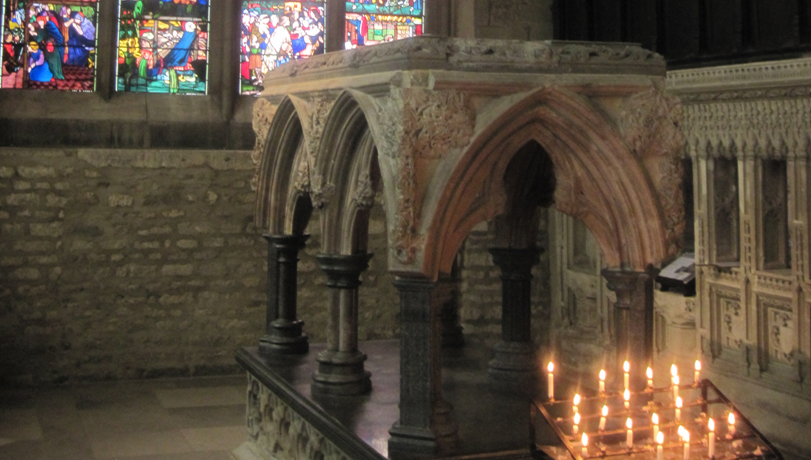
Shrine of St. Frideswide, Christ Church Cathedral Oxford.
Showing posts with label Anglo-Saxon. Show all posts

Tuesday, March 19, 2013

St. Cuthbert of Lindisfarne, March 20.

St. Cuthbert with the head of St. Oswald in 15th century glass at York Minster. 
     St. Cuthbert is certainly one of Britain's, if not of all Anglicanism's, greatest bishops. The humility, love and compassion that he shared with his community, along with the many centuries of devotion paid to him after his death mark him both as one of the most loving and most loved leaders of English Christianity. Love is a reflexive act; the compassion, and trust shown to him by the Northern community is equally important to the care that he held for the people of his bishopric in the 7th century. The memory he left for his followers has survived right down to our generation and continues to act as a rock for the Church in Britain. His cult has survived war and peace; the Viking invasions beginning in 793, the danish invasions of the 10th century, the Norman Invasion, and it has even survived the impious destruction of the Reformation. His bones still lie at Durham, 1326 years later, where he is visited daily by pilgrims.
St. Cuthbert from the Vita by Bede.

Cuthbert was born in 634, near Melrose. He was a shepherd until he saw a vision as a boy. It is one of the early chapters in the Vita Sancti Cuthberti by the Venerable Bede, the primary source for the life of St. Cuthbert, that is dedicated to this vision called Quomondo cum pastoribus positius animam Sancti Aidiani Episcopi ad coelum ab angelis ferri aspexerit (literally, how while he was posted with the shepherds, he witnessed the soul of the Holy Bishop Aidan being carried to heaven by angels). This is what prompted him to enter into the monastery of Melrose at an early age. Cuthbert did well as a monk in the eyes of the abbot, Boisil. He came to accept the Roman customs after the Synod of Whitby and was made prior of Melrose. When his new abbot, Eata, went to Lindisfarne, Cuthbert followed and became prior of Lindisfarne where he pursued missionary work in Northumbria and southern Scotland. As prior, and later as bishop, he was confronted with near schism in the aftermath of the Synod of Whitby (663-4). The Synod had decided to adopt the Roman Rite in place of the Celtic Rite, which it had been using since St. Aidan brought Christianity to Northumbria in 631. Cuthbert, in accordance with his monastic vows of obedience  required that the abbey use only the new rite because it was what the Church had decided in council. Cuthbert was not a supporter of the Roman or Celtic right....he was a supporter only of the Church. In 676 he decided to take monastic life a step further and live as a hermit on the Farne islands of the Northumbrian coast. there he remained for 9 years, living on a simple diet of onions and fish. He built himself an oratory and practiced the Celtic rite of saying the psalms in the cold sea water. It is recorded that when he came out from the water, the otters dried his feet and the birds brought him fish out of their own admiration. And while on the island he would bless those who came to seek his comfort.
St. Cuthbert in my own book of hours. 

In 685 Cuthbert was appointed the Bishop of Hexham, (which he swapped for Lindisfarne) by the Archbishop of Canterbury, Theodore of Tarsus. He left the Farne with King Ecgfrith and Bishop Trumwine and returned to his missionary work in the bishopric. During his short episcopate, he traveled through his diocese on foot, ministering to the rural and urban poor alike and performing miracles for their relief. Her returned to his hermitage 687 where he died two months later with the words "Always keep Peace and Divine Charity amongst yourselves," stressing the importance of a united Church. He lived first to extol and praise God and to worship him by living like him and to extend the good news of Christ's love to all people in his flock so that we might be comforted and learn to comfort others.
Monks use torches to tell of Cuthbert's death.

     The Saint left an impression on Northern England that never wore away. In 875, the community on Lindisfarne, where the Saint was first buried, was forced to move after a Viking attack. In an account of the event, the bishop at the time, Eardulf, required that he the monks leave the island before the attack. They took the precious relics of St. Cuthbert and of Lindisfarne's many other saints west, away from the sea while some of the monks stayed and died trying to save the Church at Lindisfarne from the Vikings. The community traveled all over the north of England for 7 years, collecting treasures donated to the shrine by neighboring kings, including the stole pictured below, and even attempting to go to Ireland -but were prevented by a storm which is believed to have been caused by the Saint. In 882, the community settled at Chester-le-Street, where they remained until the Danish incursions and in 995 relocated to Durham. By the time William the Conqueror came to England, Cuthbert was so important that he knew he would have to demonstrate his loyalty to their saint which he did during the Harrying of the North, when he visited Durham. Cuthbert's last miracle, so some claim, was shrouding the city of Durham in fog while the Luftwaffe passed overhead during the Second World War.
Durham Cathedral on its hilltop bend in the river Wear. 

     The cult of St. Cuthbert that continued to grow in England was never overtaken by another saint in the North, and perhaps only in all of England by St. Thomas Becket. In fact,Thomas death in 1170, caused the next few decades, under the leadership of the Norman bishop, Huge de Puiset, to be dedicated to a renaissance in art, architecture and liturgy for the promotion of his cult. The City of Durham and the people of the Durham diocese  became the city and people of St. Cuthbert. Their dedication was so strong to him as their protector and Christian example that they were called the people of the saint, or in Old-English the Haliwerfolc. The Bishops of Durham were given princely status as the successors of St. Cuthbert, and their lands became an autonomous 'Palatine' state within the Kingdom of England sometime referred to as the "Patrimony of St. Cuthbert." St. Cuthbert fostered a Christian community during his life by his example but established a Christian community on his memory that has lasted for centuries.
Feast of St. Cuthbert in the Codlingham Breviary.

     The monastic and the daily life of the community of the Cathedral was so focused on St. Cuthbert that the liturgy offered in Durham also came to revolve around its patron. All the offices and masses for the feast and translation feast of St. Cuthbert (September 4) were specially written to include the themes of Cuthbert's life and the example imprinted on the community. The antiphons, versicles, sequences and of course collects all recalled miracles from the history of St. Cuthbert. A Lenten Vespers antiphon follows -commemorating Cuthbert as an apostle to the English of Christ:

Oriens sol iustitiae dignatus est illustrare
Per ministros lucis suare cunctos fines orbis terrae
Ipsi laus qui dedi Anglis lucernam suae salutis
Cuthbertum bonum doctorem ac pro huis untercessorem

The rising sun of Justice deigned to illuminate
through the ministers of his light all the boundaries of the earth
Praise to Him who gave the English the lamp of His salvation,
Cuthbert the good Doctor, and praise Him for his intercession

And the antiphon for Matins recalls an early miracle where Cuthbert calls back the monk's rafts to land by prayer:

Dum iactantur puppes salo: sanctus orans heret solo
Mox ventorum vis mutate: naves vertit ad litora.

When the ship was cast about in the sea, the praying saint remained alone.
At once the force of the winds changes and the ship turned to the coast.

Several other miracles are recalled including his vision of St. Aidan's soul rising to heaven and Cuthbert's prophecy of his own death.

Cuthbert's stole.
The cult took a blow at the Reformation when the Calvinist wife of the new dean of the cathedral ordered many of relics associated with Cuthbert, but not the relics of the saint himself, to be destroyed along with the stained glass windows that depicted his miracles and the shrines built in other parts of the church where the saint had previously rested. But Calvinism has never defined Anglican Christianity, only invaded it, and the cult of St. Cuthbert at Durham, with the presence of his tomb, never really disappeared and has been greatly revived since the episcopate of Bishop Cosin in the 17th century.

Today Cuthbert remains the most venerated saint in the north of England, if not in its entirety. There is an endless stream of pilgrims to the sites associated with him including Melrose Abbey, the Holy Island of Lindisfarne, his chapel on the inner Farne Island and, most of all, to his tomb-shrine at Durham Cathedral. St. Cuthbert has regained a spot as an example and the 'lamp to salvation' in the devotion of Anglicans around the world. It remains, however, more important that the leaders of the Church look to people like St. Cuthbert in the times of Schisms and a shrinking Church. St. Cuthbert himself confronted these problems, dealt with them and strengthened the Church of Northumbria. The same can be done today in his example. The Church must remember that its purpose is to spread the words of Christ's love around the world as one Church, with one faith under one head; Christ. This is why schism remains one of the most urgent of the Church's -including Anglican, Orthodox and Roman- problems. Discord in the Church prevents it from its duty. Cuthbert recognized this and forgot his personal opinions on the Roman versus Celtic rite issues for the sake of the Church. By being righteous, the Church is neglecting its duty; its duty to Christ and its duty to his people. Hopefully people, priests and most importantly bishops will look to Cuthbert and those like him as examples of where the Church needs to return. When we invoke the names of saints in our prayers, this is what we are doing.
St. Cuthbert's Isle, Lindisfarne. The cross stands on the site of his first hermitage.

Collect (from the Church of St. Mary the Virgin, Holy Island):
We thank you Father for the life of St. Cuthbert of Lindisfarne: his reverence for all living creatures, his observance of a dedicated life under rule, his missionary zeal, his kindness to all who came  to him for comfort-and all for love of you. So in our pilgrimage of life strengthen us to walk with care in these ways that he observed through the study of prayer and personal example, that we may bring peace and integrity to your world in the name of Jesus Christ our Lord. Amen.


Saturday, January 19, 2013

Saint Wulfstan, Bishop of Worcester, 19 January.

St. Wulfstan of Worcester (watercolor of stained glass by myself)
Saint Wulfstan was a Saxon bishop of Worcester in the late 11th century who recognized the unimportance of the secular ruler in the context of his duties: to be spiritual shepherd  and whole comforter of the people entrusted to him as bishop. Wulfstan witnessed an ugly transition in the history of England: the transition from Saxon rule to the rough, oppressive Norman rule begun by William the Conqueror in 1066.

Born in 1008, Wulfstan began his career at Worcester as a monk in 1038 and then Prior of the Benedictine Cathedral Priory. When the bishop of Worcester, Ealdred, became Archbishop of York, Wulfstan was appointed the position which he reluctantly accepted like so many other saintly bishops (namely Sts. Cuthbert, Hugh and Peter of Tarentaise). After the conquest, Wulfstan submitted to William I and to his new Archbishop of Canterbury, Lanfranc, rather that risk his position (most other Saxon bishops were deposed) and thus his relationship to the people he led with great devotion and efficiency. Wulfstan incorporated the rules of his previous monastic life into his role as bishop, running his diocese, and sometimes others when they were vacant, as if he were following a rule. He designed a system for episcopal visitations (while many of his episcopal colleagues enjoyed their palaces), rebuilt Worcester Cathedral, consecrated numerous churches encouraged to be patronized by local lords, and was notorious for his charity and ministry to the poor and dispossessed. It was towards the end of his career that he cooperated with Lanfranc to end the capture and sale of English slaves at Bristol by Vikings. For his submission to the new regime and his passionate undertaking of the bishopric, he was trusted and valued by the first two Norman kings even though the court claimed he was unfit for his position as he could neither speak French and was "unlearned." Whether the latter was true or not (it probably wasn't as the Saxon Benedictines, like most others, were patrons of learning) his leadership, charity and devotion are ample evidence of his holiness. He died in 1095 while washing the feet of the local poor. He was the last surviving Saxon bishop when he died and was immediately venerated as a saint.

St. Wulfstan reminds us of the tentativeness, weakness and inhumanity of all human governments and regimes. For St. Wulfstan, a Saxon or a Norman king was of little importance though of great consequence, to his duty as shepherd and caretaker his people. Christ is the only perfect, just and eternal government, all others are stained by humanity's innate sin and fleeting. Before Wulfstan passed the government of his country from one ruler to another. He chose not to side with one or the other but with Christ, the real and only King, and continued his duties as laid out under his rules.
     In another sense, bishops and priests of today should look to St. Wulfstan as a model of administration. Wulfstan followed a kind of "episcopal rule" (a phrase I am making up) which allowed him to fully integrate his life with his duties as bishop. Such a rule for today's bishops and priests, whether it was one of evangelism, visitation, or ministry in particular, or each combined, would recast a much holier light on the episcopal office as it is and was once was regarded-the office of today's apostles and heralds of the risen Christ.

Collect: (From the Episcopal Church)
Almighty God, whose only-begotten Son hath led captivity captive and given gifts to thy people: Multiply among us faithful pastors, who, like thy holy bishop Wulfstan, will give courage to those who are oppressed and held in bondage; and bring us all, we pray, into the true freedom of thy kingdom; through Jesus Christ our Lord, who liveth and reigneth with thee and the Holy Spirit, one God, for ever and ever. Amen.

Wednesday, November 7, 2012

Feast of St. Willibrord, Apostle to Frisia, 7 November and the Dancing Procession of Echternach

St. Willibrord: Apostle to Frisia, first Archbishop of Utrecht.
     St. Willibrord was one of the earliest of the Anglo-Saxon missionaries to the Germanic peoples. His mission to the pagans of what are now the Netherlands sparked a century of English sponsored missions to bring the Gospel to Frisia and Germany. Many saints would follow this first Archbishop of Utrecht, penetrating deep into barbaric lands and placing their lives in jeopardy. Willibrord was born near York in Northumbria A.D. 658 and was educated in the abbey of St. Peter at Ripon by St. Wilfrid. When he returned to England in 690, he organized a mission with twelve other monks to bring Christ to Frisia. He gained support for his mission from Pippin II of the Franks and Pope Sergius who consecrated him a bishop. Willibrord soon established a cathedral at Utrecht and a flourishing monastery at Echternach, now Luxembourg, in much the same fashion that St. Augustine established the Church in Kent a century before. He was repelled once and his churches burned, but he returned and rebuilt everything and even sent further missions into Denmark and Germany. He died in 739 and his body was enshrined at the Abbey at Echternach where it remains.

    Willibrord's life is important to the modern Church as an example of missionary perseverance. The Church has lost members all over the world, and it is in need of leaders like St. Willibrord to penetrate into each and every community, even, and especially where there are church congregations already. The setbacks that Willibrord experienced to his work was much more forceful and damaging than the silent yet quick declination that the Church today is experiencing, and so a reformulated interest in his example and thanksgiving in the his work and the work of the many saints like him is important to the revitalization to the Church where she exists and to spread the love of Christ where it has yet to thrive.


     The Dancing Procession of Echternach
     The cult of St. Willibrord became very strong in Luxembourg, Belgium, and in the Netherlands, where, to this day, Europe's only dancing procession is held every year on St. Willibrord's day. The procession begins with the chanting of the Litany of St. Willibrord and then the procession dances through the city, into the abbey and right down into the crypt to pass the shrine of St. Willibrord, while the bishop sits over the entrance to the crypt, blessing pilgrims as they pass beneath him.

This video, though a bit dramatic in presentation, captures both older and more recent films of the St. Willibrord Dance. 
And this, from last year:

Collect:
     O Lord our God, who dost call whom thou willest and send them whither thou choosest: We thank thee for sending thy servant Willibrord to be an apostle to the Low Countries, to turn them from the worship of idols to serve thee, the living God; and we entreat thee to preserve us from the temptation to exchange the perfect freedom of thy service for servitude to false gods and to idols of our own devising; through Jesus Christ our Lord, who liveth and reigneth with thee and the Holy Spirit, one God, for ever and ever. Amen.

Heavenly Father, we ask you especially on this day when a new Archbishop of Canterbury has been chosen to give him the strength and perseverance of St. Willibrord and all thy saints, that he may help to heal the Church and extend its mission to all corners of the earth; we ask this through your Son Jesus Christ. Amen

Shrine of St. Willibrord at Echternach Abbey.
The Litany of St. Willibrord:

Lord, have mercy,
Christ, have mercy,
Christ, hear our prayer.
Christ, hear our prayer!
God the Father in heaven, Have mercy on us.
God the Son, Redeemer of the world, have mercy on us.
God the Holy Spirit, Have mercy on us.
God the Holy Trinity, Have mercy on us.
Blessed Mary, pray for us.
Blessed Mother of God, pray for us.
Blessed Virgin of all virgins, pray for us.
St Willibrord, pray for us!
St Willibrord, Guiding Light of the Church,*
*pray for us, St Willibrord
St Willibrord, Bright-shining star of our country,*
St Willibrord, Missionary to our homeland,*
St Willibrord, special protector of this our land,*
St Willibrord, first apostle of the Netherlands.*
St Willibrord, founder of monasteries and churches,*
St Willibrord, promotor of progress and knowledge,*
St Willibrord, teacher of truth,
St Willibrord, passionate interpreter of the teaching of Christ,*
St Willibrord, ceaseless proclaimer of the Holy Gospel,*
St Willibrord, teacher of true faith,*
St Willibrord, founder of peace and justice,*
St Willibrord, model of hope and reconciliation,*
St Willibrord, conqueror of injustice and discord,*
St. Willibrord, Architect of Community and Unity,*
St Willibrord, Destroyer of idols,*
St Willibrord, Patron Saint of children,*
St Willibrord Gentle guide of the lost,*
St Willibrord , Support of the homeless,*
St Willibrord, Friend of the persecuted,*
St Willibrord, Light of the blind,*
St. Willibrord, Refuge for the sick,*
St Willibrord, Gentle father of the poor,*
St Willibrord, Comforter of the afflicted and sorrowful,*
St Willibrord, Helper to the suffering,*
St Willibrord, True voice of God,*
St Willibrord, Humble servant of Jesus Christ,*
St Willibrord, Mighty advocate in heaven,*
St Willibrord, Miraculous healer,*
St Willibrord, True witness and confessor of Christ,*
St Willibrord, Saviour of those who doubt their faith,*
St Willibrord, Supporter of the carer and educator,*
St Willibrord, Hope of those who pray,*
St Willibrord, Model of patience and gentleness,*
St Willibrord, Example of active love,*
St Willibrord, Master of joy and life,*
St Willibrord, Disciple of Christ,*
Lamb of God, you take away the sins of the world,
Lord, have mercy on us!
Lamb of God, you take away the sins of the world.
Lord, hear our prayer!
Lamb of God, you take away the sins of the world.
Lord, have mercy on us!

Sunday, October 21, 2012

St. Frideswide, October 19 (also called St. Frithuswith).

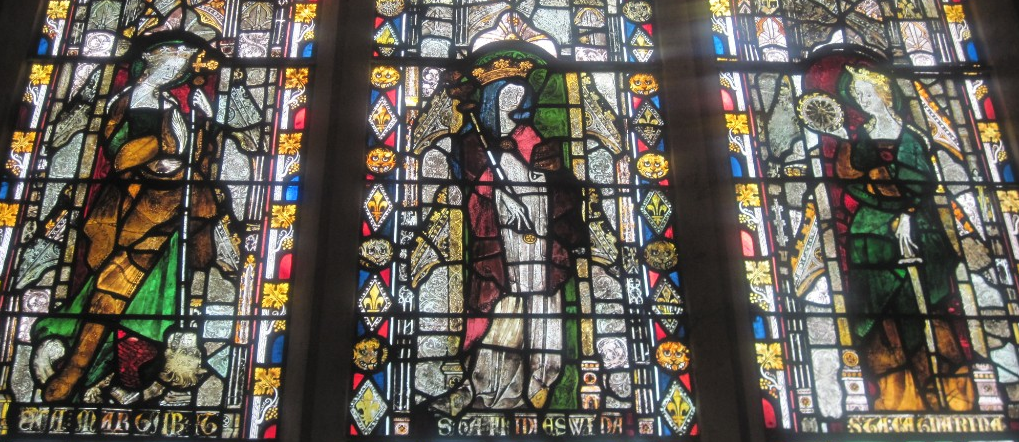
Medieval stained glass in the chapel of St. Frideswide, Christ Church Cathedral. St. Frideswide is in the middle.
Frideswide was born in the late seventh century to King Didan and Queen Selfrida, rulers of a Mercian (the Anglo-Saxon kingdom of the Midlands) sub-kingdom. At an early age, Frideswide showed interest in becoming a nun and requested that her father give money for her to establish a nunnery in Oxford, then the capital of Didan's little kingdom. She was successful in establishing and nurturing a prominent nunnery, and her reputation as a miracle worker and a holy woman in general contributed to the hallowed story that surrounds her. The legend, from a twelfth century life, is told as such: Frideswide established her community of nuns on the edge of Oxford when the King Algar of Leicester demanded that she marry him. Frideswide refused Algar's request but was sized by Algar's men, who were stuck blind upon touching her. Algar then decided to find her himself, but Frideswide was warned and escaped to the river Thames where she was transported in a boat by an Angel to Bampton, where she took cover with some of her companions in the house of a swineherd in the forest. There she stayed for several years, after establishing a community and gathering a reputation as a miracle worker. Algar was struck blind in his pursuit upon entering the city. Frideswide moved back to her Oxford nunnery from her community at Bampton where she ruled as abbess and where her fervent prayers yield still more miracles until her death in 727. Frideswide is associated with a particular well at Binsey where she hid for a time founding a chapel and working miracles and a cult grew around her simple grave. By the twelfth century, however, the monastery at Oxford had become a house of secular canons and so the Augustinians, whose special purpose, they believed was to establish centers of learning for priests hospitals for the poor and to revive shrines of saints who had fallen out of popularity. St. Frideswide's became an Augustinian monastery and in approximately 1180 after much fasting and keeping of vigils the canons were revealed her grave by miracles. The bones were translated into a shrine on 12 February 1180 and again in 1289 were they remained until the reformation when they were interred with the body of Catherine Martyr.
The Shrine of St. Frideswide at Oxford has recently been rebuilt and dominates a chapel to the north side of the high altar in Christ Church Cathedral. Frideswide is an example, as the first among the people of Oxford to give up the '"inordinate love of things of this world," for us to follow Christ by throwing away all the treasures of this world and dedicate our lives to his work. We can do this in little ways, by sacrificing small, everyday distractions so that we can focus more on Christ, what he gave to us and what we can do to spread his love. Frideswide, like many other saintly monastics, is a model for how we can do this, give up earthly distractions. Not everybody is supposed to be exactly like Frideswide, not everybody should hide themselves in the cloister, rather Frideswide's many works show us how we can do what she did on our own terms.

Heavenly Father, who inspired thy servant Frideswide to give up earthly desires for a life of prayerful dedication to the work of your son, Jesus Christ; inspire us also to cast off earthly distraction and clothe ourselves in a life in the footsteps of our savior, through the same thy Son, our Lord, who lives and reigns with you in the unity of the Holy Spirit, one God, now and for ever. Amen.
Shrine of St. Frideswide. The widow tells her legend.

Thursday, August 30, 2012

St. Aidan of Lindisfarne; a father of the Anglican Church

St. Aidan by the Church of St. Mary on Lindisfarne; the site of his abbey.
St. Aidan of Lindisfarne can be treated equally as a father of the Church in England with Augustine of Canterbury and likewise of the whole Anglican Church. It was Aidan, who in A. D. 635 brought the light of Christ into the Kingdom of Northumbria, which then extended from the firth of Forth to the river Humber, and established the monastery of Lindisfarne as his episcopal seat. Aidan came on invitation of Oswald from the church of Iona, which was not under the bishop of Rome until the eleventh century, and evangelized in England as far south as London often travelling by foot. 
Bede later recorded of him "He neither sought nor loved anything of this world, but delighted in distributing immediately to the poor whatever was giver to him by kings or rich men of this world. He traversed both town and country on foot, never on horseback, unless compelled by some urgent necessity. Whenever on his way he saw any, either rich or poor, he invited them, if pagans, to embrace the mystery of the faith; or if they were believers, he sought to strengthen them in their faith and stir them up by words and actions to alms and good works."
St. Aidan died on August 31 in 651 and the Church in Bamburgh is built over the site of his death. He was buried on Lindisfarne but his bones were taken with the body of St. Cuthbert to Durham were they remain to this day. The altar in the center of the chapel of the nine altar is dedicated to his memory.
Aidan, as bishop, proved  wholly dedicated to Christ in his work as a missionary and in his effort to give to the poor. He is important to the Anglican Church not only as a father but also as model for bishops today and for what the church should look for in choosing bishops. Our codes of conduct in modern society has changed since the seventh century, but poverty has not gone away and not everyone has been fairly invited to "embrace the mystery of the faith." Words are powerful tools, but as Aidan shows us it is more than just preaching that Christians must do to follow in Jesus' footsteps. Aidan, his episcopal colleges and successors dedicated their lives to give Christ to the Father's children, it is our duty, as Christians, whether we are lay-people, priests or bishops, to make sure that the Anglican Church gives the faith of Christ, preserved and unviolated, to our own brothers, sisters and children. 

Heavenly Father, we thank you for your holy servant Aidan and his strength and commitment to bringing the light of your son to the Northumbrians and we pray that that we may muster the same strength and commitment to extend his mission, his kindness and our faith to all corners of the Earth. Amen


Icon of St. Aidan presenting the gospel to King Oswald at the Church of St. Aidan, Bamburgh. 

St. Aidan altar at Durham Cathedral.

Saturday, March 17, 2012

St. Cuthbert of Lindisfarne; 20 March

St. Cuthbert of Lindisfarne at Durham Cathedral.
     St. Cuthbert is certainly one of Britain's, if not of all Anglicanism's, greatest bishops. The humility, love and compassion that he shared with his community, along with the many centuries of devotion paid to him after his death mark him both as one of the most loving and most loved leaders of English Christianity. Love is a reflexive act; the compassion, and trust shown to him by the Northern community is equally important to the care that he held for the people of his bishopric in the 7th century. His cult has survived war and peace; the Viking invasions beginning in 793, the danish invasions of the 10th century, the Norman Invasion, and it has even survived the impious destruction during the Reformation. His bones still lie at Durham where on March 19, 2012 a restored Banner of St. Cuthbert, a copy of a the medieval relic of his shroud and a symbol of northern England and the latest addition to the treasures of his tomb, will be dedicated.
St. Cuthbert's Shrine at Durham Cathedral.

Cuthbert was born in 634, near Melrose. He was a shepherd until he saw a vision as a boy. It is one of the early chapters in the Vita Sancti Cuthberti by the Venerable Bede that is dedicated to this vision called Quomondo cum pastoribus positius animam Sancti Aidiani Episcopi ad coelum ab angelis ferri aspexerit (literally, how while he was posted with the shepherds, he witnessed the soul of the Holy Bishop Aidan being carried to heaven by angels). This is what prompted him to enter into the monastery of Melrose at an early age. Cuthbert did well as a monk in the eyes of the abbot, Boisil. He came to accept the Roman customs after the Synod of Whitby and was made prior of Melrose. When his new abbot, Eata, went to Lindisfarne, Cuthbert followed and became prior of Lindisfarne where he pursued missionary work in Northumberland and southern Scotland.  In 676 he decided to take monastic life a step further and live as a hermit on the Farne islands of the Northumbrian coast. there he remained for 9 years, living on a simple diet of onions and fish. He built himself an oratory and practiced the Celtic rite of saying the psalms in the cold sea water. It is recorded that when he came out from the water, the otters dried his feet and the birds brought him fish out of their own admiration. And while on the island he would bless those who came to seek his comfort.
Cuthbert leaves Farne to become bishop

In 685 Cuthbert was appointed the Bishop of Hexham, (which he swapped for Lindisfarne) by the Archbishop of Canterbury, Theodore of Tarsus. He left the Farne with King Ecgfrith and Bishop Trumwine and returned to his missionary work in the bishopric. During his short episcopate, he traveled through his diocese on foot, ministering to the rural and urban poor alike and performing miracles for their relief. He lived first to extol and praise God and to worship him by living like him and to extend the good news of Christ's love to all people in his flock so that we might be comforted and learn to comfort others.

The site of Cuthbert's first hermitage.
His humility, his sanctity, and his high love for his people make him a model bishop. He died on 20 March, 687 on the Farne islands, where he returned after he predicted his death two months before. He was buried in the church at Lindisfarne, and when the Vikings attacked in 793 and later in 875, the monks carried his body from the island, and embarked on a 120-year journey that brought them to Durham in 995. There, when the ox-cart could no longer move, they laid his body in a tomb where it rests today, still retaining the head of St. Oswald, vestments presented by King Ecgfrith, and his own pectoral cross and portable altar. He was the most popular saint in Northern England as his shrine attracted pilgrims from all over the British isles, and continues to do so.
St. Cuthbert in the Galilee Chapel at Durham.

     Hopefully the Anglican Church, and all Churches will continue to honor St. Cuthbert as one apostle of Christ in England, and a bearer of Christ's love in the same land. The bishops of today's Church have the job of preserving the faith that Cuthbert brought to the people of Northumbria, and extending the love of Christ that he extended to his people. More importantly, the Church needs to continue St. Cuthbert, it needs bishops, priests and laypeople who will dedicate their lives to the extension of Christ's comfort through and in Christ's saving message. It is essential that the Church holds on to the traditions, to the image of Christ and his love in people, and the images and relics of those who spread his love, so that we never forget what our duty is: to spread the words of love of Christ. Only through our perseverance can the "Fire in the North," as he was called by Fr. David Adam of Bamburgh, and us like him, spread to set the whole world ablaze with the light of Christ.

Collect (from the Church of St. Mary the Virgin, Holy Island):
We thank you Father for the life of St. Cuthbert of Lindisfarne: his reverence for all living creatures, his observance of a dedicated life under rule, his missionary zeal, his kindness to all who came  to him for comfort-and all for love of you. So in our pilgrimage of life strengthen us to walk with care in these ways that he observed through the study of prayer and personal example, that we may bring peace and integrity to your world in the name of Jesus Christ our Lord. Amen.

Durham window with the miracles in Cuthbert's life and death.