 |
| St. Patrick at Croagh Patrick, where he had an oratory. |
Patrick was born on the Northwest coast of Britain in 390 to a noble family. His father was a Roman official and a deacon while his mother was probably a native Briton. The story is too well known: at 16 Patrick was captured by Irish raiders (at the time, the Irish were called the 'Soctians' by the Romans, which means pirates) and brought to Ireland to work as a slave-shepherd. He later paid for his freedom with a gold coin he found and escaped back to Briton. But his time as a shepherd in Ireland was far from over. He became a priest and then a bishop, perhaps in Gaul. In 432 he had a dream telling him to return to Ireland to reestablish the Church (there had been one mission before him by Bishop Palladius who was sent by the Pope but failed in Ireland and pursued missionary work in Scotland).
Patrick landed at what is now called Downpatrick, where he began his mission. He quickly spread Christianity by appealing first to the Irish kings and then to the tribes. He built upon the ruin of the old religion and so many of Ireland's holy wells and hills now associated with Patrick and other saints were once pagan sanctuaries. To each king he assigned what became archbishops and to each tribe a bishop. Patrick did not establish monasteries, these were brought later by St. Cairnach, who was trained in Whithorn by St. Ninian, but colleges of bishops which provided for select centers of Christianity that served as 'bases' for the evangelization of the whole country.
Patrick established his principal seat at Armagh, where his successors, the Archbishops of Armagh, remain the 'Primate of All Ireland.' He died in 461 and is buried outside the Church of Ireland Cathedral at Downpatrick. His work was a catalyst of a golden age of Christianity enshrined by the Celtic peoples of Wales, Ireland and Scotland. He began a process, but did not Christianize Ireland entirely, and his disciples and successors, also among Ireland's greatest saints, are due, therefore, much veneration also.
There are many saintly bishops like St. Patrick but we must reserve him some credit because of the singularity with which he fulfilled his mission. It is not recorded that Patrick took very many companions with him, so Ireland's conversion is almost wholly due to Patrick's work. Patrick confessed that he hated the Irish, and with good reason since they enslaved him, but here we see how Patrick followed Christ's commandment: "Love thine enemies" and brought the thing that he loved most to the people he hated.
 |
| Downpatrick Cathedral. |
Collect: (From the Episcopal Church)
Almighty God, who in your providence chose your servant Patrick to be the apostle of the Irish people, to bring those who were wandering in darkness and error to the true light and knowledge of you: Grant us so to walk in that light, that we may come at last to the light of everlasting life; through Jesus Christ our Lord, who lives and reigns with you and the Holy Spirit, one God, now and ever. Amen.
 |
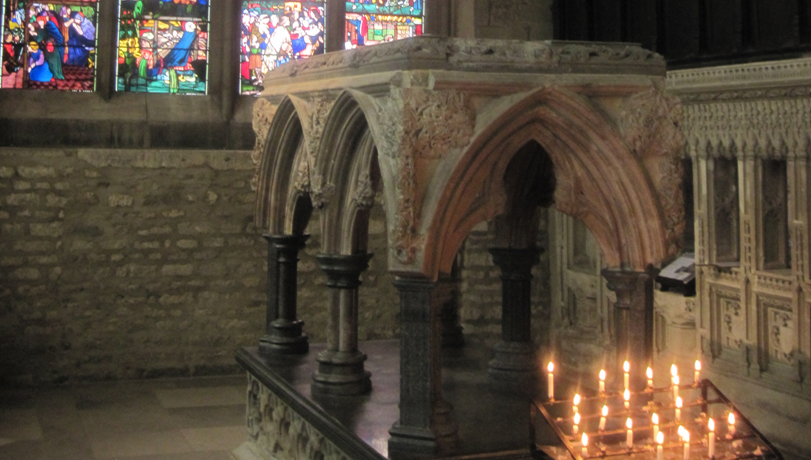
| Tomb of St. Patrick at Downpatrick Church of Ireland Cathedral. The (Anglican) Church of Ireland is the Church directly descended from the Church established by St. Patrick. This is why it has all of the old churches and Cathedrals of Ireland. It is a catholic Church, though no longer under the pope. It is, literally, The Church of Ireland. |
Christ be with me,
Christ behind me,
Christ before me,
Christ beside me,
Christ to win me,
Christ to comfort
and restore me.
Christ beneath me,
Christ above me,
Christ in quiet,
Christ in danger,
Christ in hearts of
all that love me,
Christ in mouth of
friend and stranger.
I bind unto myself today
the strong Name of the Trinity,
by invocation of the same,
the Three in One, and One in Three.
Of whom all nature hath creation,
eternal Father, Spirit, Word:
praise to the Lord of my salvation,
salvation is of Christ the Lord.


