|
| St. Cuthbert window at Durham Cathedral. |
The lands north of the Humber river have always had a rich association with its ancient Anglo-Saxon saints. The cathedrals at Durham, Ripon and Carlisle a long with many parish churches best express Northumberland's and County Durham's love for bishops, abbesses, and monks who first brought the light of Christ to Northern England. Holy wells where the sick where healed pocketed at the edges of villages, Holy islands where hermits lived scattered along the coast, and battlefields where Holy martyrs died scar the countryside: only Jerusalem is home to more hallowed sites...
I was able to visit many of these places on a recent trip to Northern England and was happy to find that these saints are not mere historical artifacts but remembered and venerated as ancient mothers and fathers of a living Church.
 |
| Durham Cathedral. |
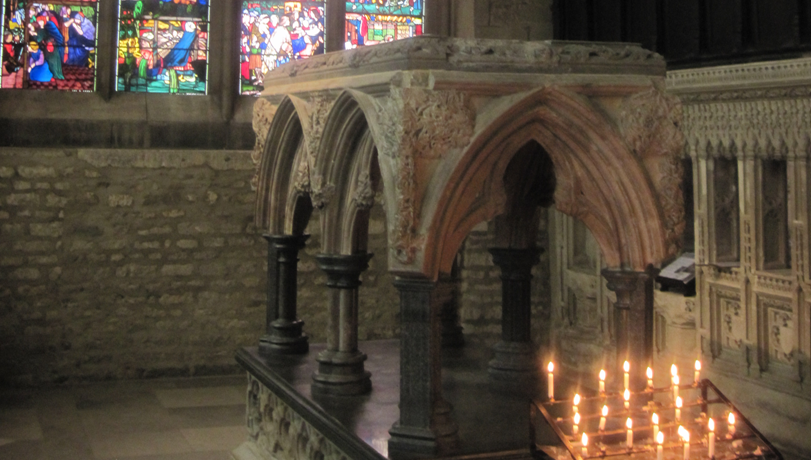
Durham Cathedral, which was the first "Northumbrian" Church I visited maintained an aura of holiness that no other Cathedral in Europe can compete with. There were three offices during the day: morning prayer, noon mass, and evensong. The bells in the towers that dominated the whole city and country for miles around rang for each service. The church houses the tomb of St. Cuthbert, who is strongly appreciated in Durham Cathedral simultaneously known as "The Shrine of St. Cuthbert" a name which fully marks the cathedral as a lasting monument to the most beloved saint of the northern Church. The cathedral is architecturally remarkable as the only completely Norman cathedral in England made of a dark reddish stone and the interior pillars, clerestory and vaulted arches can only be described as massive. All around the cathedral are memorials and altars dedicated to the Northumbrian saints: the tomb and altar of St. Bede in the Galilee Chapel, altars, altarpieces and icons of St. Hilda, St. Aidan, and St. Margret and behind the high altar the simple marble slab that reads "Cuthbertus" surrounded by candles and flowers left by the countless modern pilgrims and banners and icons depicting the exemplary bishop and christian who dedicated his life to Christ.

 |
^ Church of St. Mary the Virgin with reredos of Lindisfarne saints and carpet from gospels.
< The Pilgrims way across the sands. |
From Durham I went to the Holy Island of Lindisfarne which lies just north of Bamburgh and south of Berwick. The island is accessible only part of the day as the tide covers the causeway that is built on the sand on the bottom of the tidal bay. Holy Island is home to a population of only 162 people who live mainly off of sheep farming, fishing, lobstering, and tourism. The parish church of St. Mary the Virgin, which stands on just off of the town cross near the beach, was built in the 13th century and incorporates Saxon elements. It is packed with beautiful memorials to St. Cuthbert and St. Aidan, the Lindisfarne Gospels, the viking raids and St. Olaf, and the local fishing industry. Stained glass windows, carved sculptures, paintings, and textiles all conjure up the holiness of this tiny church. The church stands on the site of St. Aidan's abbey, built in A.D. 635, and embodies St. Cuthbert's life of faith and simplicity. Like Durham, there is morning prayer, mass, and evening prayer each day. Pilgrimage groups come to the island every week and often these pilgrims have come from Cuthbert's first abbey, Melrose, in the lowlands of Scotland and cross the pilgrims way across the Lindisfarne sands barefooted. I spent much of my time on the island searching for the "St. Cuthbert's beads" which are tiny fossils found on the beach in between St. Cuthbert's isle and the church that are said to be forged by St. Cuthbert on his hermitage at night and were made into rosaries by medieval pilgrims.
 |
| Ruined chapel on St. Cuthbert's Isle off of Lindisfarne. |
 |
| Shrine on the spot where St. Aidan died. |
After Lindisfarne I journeyed to the parish church of St. Aidan in Bamburgh. St. Aidan first came to Bamburgh when King Oswald sent to Iona for a bishop to bring Christianity. The castle there remains associated with St. Oswald and a stone crucifix has been erected below its walls to commemorate the wooden cross the Oswald erected when Christianity first came to Northumbria. The church itself marks the spot where St. Aidan died and retains the timber which he leaned on as he took his last breaths. The timber remains suspended over the font. The church is rather large and has a reredos that incorporates many of Northumbria's saints into the witnesses of the Eucharistic sacrifice.
 |
St. Aidan and St. Oswald
icon at Bamburgh. |
 |
| Altarpiece at Ripon with the Northumbrian Saints. |
Finally I stopped at Ripon Cathedral established by St. Wilfrid in 672. The stone choir screen features saints and kings associated with Ripon and the pulpit and Ninian Comper altarpiece features the most famous saints of Northumbria. The church also retains a crypts from the first building that was built here.
The Church in Northern England maintains the holiness of her ancient saints to this day: they are examples to all Christians of how we can find a role in the Church to dedicate our own lives to Christ, for, as St. Julian of Norwich puts it, "all the help that we receive from the blessed saints, is by Christ's goodness."
The holiness of St. Cuthbert, the Northumbrian saints and all the saints is help to us to find Christ's love and likewise spread it to the rest of the world.