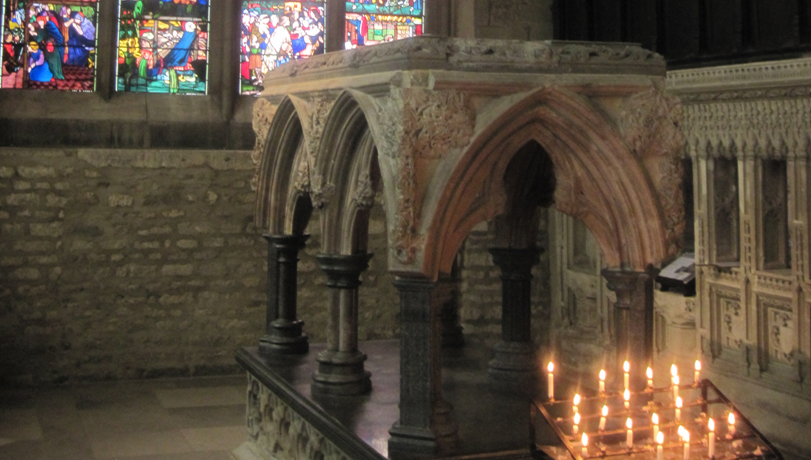
Shrine of St. Frideswide, Christ Church Cathedral Oxford.
Showing posts with label Chant. Show all posts

Thursday, February 7, 2013

Liturgical Tropes: Medieval Filler or Helpful Interpretations?

Ecce Homo: 'Behold the Man.' Sarum gradual chant.
I've been looking at the definitions and use of tropes and sequences particularly in the Sarum Mass. In this Post, I will discuss the function and history of sequences and tropes and how the latter could be , in a modified form, useful in our own, modern liturgies.
     Both sequences and tropes were 'discontinued' in the Book of Common Prayer of the Anglican Church and completely abolished in the Roman Church's Council of Trent, save the Victimae Pascale of Easter, the Veni Sancte Spiritus of Pentecost, the Lauda Sion Salvatorem and the Dies Irae of the Requiem. The Sarum Rite and other ancient rites contained many more sequences than these, one for most of the numerous feasts of the medieval liturgical calendar. 
     Sequences are very similar to hymns, but were sung just before the chanted Gospel Alleluia which had grown so long as to permit each of the clergy to kiss the Gospel book. Sequences are typically joyful and always hymns of praise and awe -fitting with the last syllable of the Alleluia which had evolved into a joyful melisma. 
     Tropes were insertions of text and/or pieces of chant to lengthen or interpret the text being sung. For example, at Salisbury, home of the Sarum Rite, tropes containing just adding the name of the Blessed Virgin Mary, the patron of the cathedral, were inserted into the Gloria in important feasts to embellish the liturgy. Here is an excerpt from the Sarum Gloria where the tropes (italicized) act similarly to clauses.

Sarum Gloria:
"For thou art only holy, sanctifying Mary;
Thou only art the Lord, ruling Mary;
Thou only, crowning Mary, Jesus Christ with the Holy Spirit...."

The Sarum Kyries also use tropes.Instead of addressing just "Lord" and "Christ," a petition for the Holy Spirit is added to emphasized the doctrine of the Trinity. Additionally, tropes are added into each petition to embellish the Kyrie. The well-known "Orbis Factor is one of the Sarum Kyries, though this one addresses the Holy Spirit only at the very end, and is mainly made up of tropes. 

Orbis Factor:
Orbis factor rex aeterne, eleison
Pietatis fons immense, eleison

Noxas omnes nostras pelle, eleison
Christe qui lux es mundi dator vitae, eleison
Arte laesos daemonis intuere, eleison
Conservans te credentes confirmansque, eleison
Patrem tuum teque flamen utrorumque, eleison
Deum scimus unum atque trinum esse, eleison
Clemens nobis adsis paraclite ut vivamus in te, eleison.


Maker of the world, King eternal, have mercy upon us.
O immense source of pity, have mercy upon us.
Drive off all our evils, have mercy upon us.
Christ who art the light of the world and giver of life, have mercy upon us.
Consider the wounds produced by the devil's art, have mercy upon us.
Keeping and confirming thy believers, have mercy upon us.
Thou and thy Father, an equal light, have mercy upon us.
We know that God is one and three, have mercy upon us.
Thou, merciful unto us, art present with the Holy Spirit that we might live in thee, have mercy upon us.


Compare this with the origional, untroped, much simpler, three-fold
Lord have mercy
Christ have mercy
Lord have mercy.
...and now you can see just how much the tropes add.
below in the Orbis Factor, troped Kyrie as chanted from the Gradual of Eleanor of Brittany. 

Additionally, The Catholic Encyclopedia uses an French Sanctus as an example of troping:

Sanctus: ex quo sunt omnia                 Holy: from whom all are all things
Sanctus: per quem sunt omnia             Holy: through whom all are things
Sanctus: in quo sunt omnia, Dominus...Holy: In whom are all things, Lord...


Tropes could have a function in modern Liturgy.
Sarum Gloria: "Sanctifying Mary"
     Tropes could be found in many chanted texts to expand on the praise of God or of his saints or to explain Theology. While tropes were often added to the liturgy just as an extra filler in the liturgical stew, I see tropes as an opportunity to clarify and explain parts of our complex liturgies to the laity. Reviving tropes in prayers which are well known, perhaps too well known, could be particularly useful for the explanation of meaning which is otherwise overlooked because of the commonness of that prayer. 
     I am specifically referring to the Lord's Prayer. While reading former Bishop of Durham, N.T. Wright's "The Lord and his Prayer," which thoroughly explores the meaning and implications of each line of the Pater Noster, I thought, before I knew about troping, that it would be useful to add short clauses into the chanted prayer which concisely explain the meaning or add petition to the line. In reading about tropes, I found a precedent for this idea. While I don't know if the Pater Noster was ever troped, although the chant from the Abbey of Santo Domingo de Silos includes an Amen sung by the choir after each verse, the deep meanings of each line of so important a prayer should be relayed to the faithful during the service -and tropes are a perfect opportunity. The Lord's Prayer is, as Wright mentions, one of those prayers we recite without really reflecting on its meaning, and each verse is stacked with, as Wright explains, important implications for the mission of Christianity. Wright's "The Lord and his Praye" is an excellent book that all Christians should read...so I will not spoil it. 
     By adding a short trope to the end of each verse in the Our Father, the meaning of each line would be concisecly explained and the general importance of the prayer emphasized. After the  Our Fath, other parts of the mass, which many of us may participate in without much thought, such as the creeds ould also be troped not for the sake of embellishing the mass or restoring medieval customs, but for explaining the complex and important meanings behind the words in our liturgies. 


-Some more on the function and history of Tropes from "Oxford Bibliographies." 
Tropes
"Liturgical poetry, in the form of additional lyrics inserted into all the chants of the medieval Mass, flourished in the 9th through the 12th centuries. In a medieval Latin culture marked by intense interest in hermeneutics, even the Gregorian chants became a field open to extensive use of glosses and added verses performed together with the chant. The authors provided interpretations of the base texts in metaphors, images, or tropes, with the result that the grammatical term “trope” (Greek tropos, in Latin conversio or versus) came to be the name of the genre. Sung between the segments of a chant, the tropes could comment on and meditate over the preceding words of the chant, but they could also prepare for the performance of the words that followed. By means of these insertions, the chantor or compilator could vary the performance of a chant in endless ways while still maintaining the authorized form of the liturgical base chant. Extensive repertories were collected in manuscripts all over Europe. At first written on loose leaves or in the margins, they came to be inscribed into graduals and missals, and then gathered in individual manuscripts labeled “troparium” or “troparium-prosarium.” Because these manuscripts are the earliest witnesses of Western musical notation, or “neumes,” they have attracted many musical scholars as well. The oldest tropes must have been created well before the division of the Carolingian Empire in 843, because they are found in similar form both in East Frankish and West Frankish regions and in Lotharingia. In the following centuries, the repertories came to be divided into more or less separate regional traditions."

Thursday, December 20, 2012

St. Dominic of Silos, 20 December. (Santo Domingo de Silos)

St. Dominic depicted in the robes of a mitered abbot. 
     Santo Domingo de Silos, as he is called in the Spanish language, was born in the rural town of Canas in Castille around the beginning of the 11th century. He was a shepherd for much his childhood and his family was part of the Spanish peasant class, which endured some of the worst conditions of all of Europe's lower classes. His career is all the more remarkable in light of his humble birth. While still young, he entered the benedictine abbey at La Rioja, called San Millan. There he eventually became Prior but was deposed by the King of Navarre, Garcia III, when he refused to allow the confiscation of some of the Priory's land. A refugee of that northern Spanish kingdom, Dominic won the patronage of King Ferdinand I of Leon, who placed him as the Abbot of the Abbey at Silos, where only six brothers lived in its ruinous state. Dominic gradually rebuilt the monastery, increasing the number of brothers, and establishing a library and scriptorium and thus, increasing its reputation, especially as a center for the Mozarabic Liturgy, the rite of the ancient Visigoth Church. Remembering his humble origins, much of the new wealth of the Abbey at Silos was used to free Christian slaves from the Muslim Moors, who occupied almost the entire southern half of Spain in the 11th century, territory which, previous to Moorish control, was Christian. Dominic died on this day in 1073. Three years later, his relics were translated into the Abbey Church where they became the center of his cult and where, in 1170, Joan of Aza, prayed for a child, promising to name him Dominic-who would became the famous Spanish saint and founder of the Dominican Order of Preachers. Dominic of Silos is venerated in both the Roman and Anglican Churches.

     Dominic became the head of a dying church. But with a combination of liturgical and historical studies, charity for Christian neighbors and the insistence of the importance of the monastery's involvement and prominence, and that of the greater Church in general, in secular society. His life and works remain significant to the  modern church as a model to rebuild redundant churches and establish new ones as centers of ecclesiastical liturgy and study, and as dispensers of charity might which could bring the church back to its position as a center of public devotion and relief.

The romanesque, 'double decker' cloister of the Abbey. 

The Abbey, in Leon, Spain, actually dates to the Visigothic Church of the 7th century. The Abbey remained a center of the Mozarabic Rite after the death of St. Dominic although, like rest of the Church, except for the Archdiocese of Milan, it eventually switched to the  Latin Rite. As monasticism has had little part in the core of the Roman Catholic Church for sometime, Silos seems to have begun to disintegrate again in the 19th century, when it sold many of the manuscripts from its library. Since then, the monastery has rejuvenated itself as a center of Gregorian Chant, for which it is known world wide....St. Dominic's mission continues.

Chant from the Mozarabic Antiphonary of the Abbey.

One of the Abbey's many recordings of Gregorian Chant: Puer Natus in Bethlehem.
 

Thursday, December 6, 2012

St. Ambrose of Milan, 7 December, and the Ambrosian Rite and Liturgy.


St. Ambrose, Archbishop of Milan.
     St. Ambrose lived in the 4th century A.D. and was, before he became Archbishop of Milan, the Roman Governor of Aemilia and Liguria, a province of what is now Lombardy with the capitol at Milan. Upon the death of the Arian bishop of Milan, Ambrose went to the council of bishops who were to elect the new archbishop to prevent conflict but found himself instead as elected to take that office, which he humbly accepted. Ambrose allotted all his wealth to the poor except for some which he reserved for his sister, as did St. Anthony the Great when he entered the desert of Egypt to become a hermit. He is similar to St. Hugh of Lincoln in his lifestyle as bishop where he practiced humility and asceticism in one of the highest and most public offices in the Roman empire. Also as a precursor for later medieval saint-bishops such as Hugh or Thomas Becket, he came into great conflict with the Roman Emperors and other secular authorities through his suppression of the Arian heresy. The Arians were still at large in the 4th century and demanded the right to worship in some of Milan's greatest Churches, which Ambrose refused, incurring the anger of the Emperor Valentinian, whose wife was an acclaimed Arian. He also excommunicated the Emperor Theodosius after massacres in Greece. Throughout his episcopate, Ambrose was staunch in maintaining the true faith of the Nicene Creed and the practice of Christian Charity and mercy. He died in 395 and is buried in the Basilica of St. Ambrogio in Milan.
As one of the first 'Doctors of the Church,' Ambrose is remembered as a great hymnist, liturgist, and theologian as St. Augustine of Hippo was his greatest student. Many of his works survive and among his most prevalent focuses are human sin, ethics,  and divine grace, but his writings also influenced the growing importance of the sacraments of of specific doctrines of the Church. He influenced liturgy through music and through the composition of the rite. As a hymnist, he composed a form of chant now honored to him as Ambrosian Chant which involves a chanted dialogue between the officiant of the office and the congregation and is still used in the Archdiocese of Milan. He, like the writers and composers St. Jerome or Gregory the Great, is often depicted in a scriptorium. At one point as Archbishop, Ambrose got into an argument with Churchmen in Rome about Milan's distinct liturgy from the Roman Rite. He resolved that when ever he went to Rome he would use their customes but in Milan he would keep practicine the Ambrosian Rite. His decision is purpetuated in a common saying which survive today when he wrote in a letter "When in Rome, do as the Romans do."
     The example of Ambrose as a Church figure involved in every aspect of the Church's and its members lives is important in a world that is constantly growing more secular. Although many believe that no religion should have any official place in government this does not mean that archbishops, bishops, and priests should remain un-involved and unspoken. They should by no means attach themselves to a political party...but the Church should make itself known through public outcry and involvement that it is a body of citizens whose beliefs will not allow for certain trespasses of the state to be acceptable. Ambrose's deep influence in regional liturgy and music also shows that priests and bishops should look towards the perfection of a liturgy that will best satisfy the devotion of the Church's members.
     Most importantly, the careful guardianship of the faith by Ambrose against rogue bishops in the church who upheld the Arian heresy, shows us the importance of preserving the faith, especially when it is assaulted by our own bishops, our successors to the apostles, and other forces from within the Church. The faith in Christ-of the one holy Catholic and Apostolic Church- is the only real treasure. It must be protected from people in the church who deny the faith and its leaders and members must continue to fulfill its eternal duty...to bring Christ, to bring the Church, to as many people in the world for their comfort from the knowlage that Christ is Our Savior...from everything that could challenge our happiness in this world and the next.

The Ambrosian Rite and Liturgy.
     The Ambrosian Rite is the only non-Roman Rite liturgy that is allowed to be used in any diocese of the Roman Catholic Church except for the Gallician Rite, which can only be used in the Cathedral of Santiago de Compostela in Spain on the Feast fo St. James, 25 July, who is buried there. It is the main use of the parishes in the Archdioces of Milan, where Ambrose was bishop. The rite could be described as more byzantine than the roman rite in its arrangement of the Mass and the Divine Offices  and even the liturgical calendar. Perhaps most remarkably, the services of Holy Week are distincly different from any other latin rite, and both the seasons of Lent and Advent are longer than the ususal Roman observance. Ambrosian Chant, which is distinct from Gregorian Chant, is Gallo-Roman in nature, more similar to the Mozarabic Chant of Spain or the chant used in Gaul. The Ambrosian Chant often calls for a treble (boys choir) section. The chant also includes  a part for the congregation, who is supposed to join in the chant both at Mass and at daily offices, esspecially in the singing of the psalms. The Basilica of St. Ambrogio in Milan is known to use the Ambrosian Chants and Rite regularly.

Collect:
O God, who gave your servant Ambrose grace eloquently to proclaim your righteousness in the great congregation, and fearlessly to bear reproach for the honor of your Name: Mercifully grant to all bishops and pastors such excellence in preaching and faithfulness in ministering your Word, that your people may be partakers with them of the glory that shall be revealed; through Jesus Christ our Lord, who lives and reigns with you and the Holy Spirit, one God, now and for ever.

Ambrosian chant - Alleluia. Hodie in Bethlehem puer natus est.


The Gospel Alleluia from the Ambrosian Rite in Milan Cathedral.

Preces and responses in the Ambrosian Rite in the Basilica of S. Ambrogio, Milan, where St. Ambrose is buried. The church seems to be the most well known for its use of the rite.


Tuesday, September 18, 2012

St. Hildegard of Bingen, 17 September.

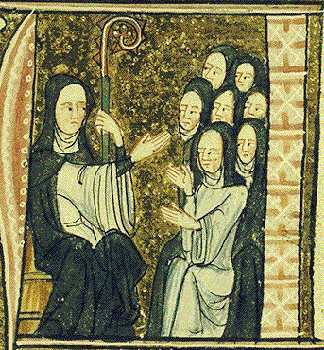
St. Hildegard instructs her nuns.

St. Hildegard is one of the most interesting writters from the twelfth century. Her many works of philosophy, music and her acount of her revelations are remarakable as the writtings of a benedictine nun. Women had written through the early middle ages but by the twelfth and thirteenth centuries most surviving works are written by males. Hildegards work, however, should not be judged either positively or negitively based on her gender; her writtings are magnificent and important as the work of any human being and her message is key to the mission of the Holy Church. Hildegard was born in 1098 A.D. It was at the age of three when she began to experience visions which continued throughout the rest of her life. At a young age went to a forest to be educated by the visionary and hermit, Jutta. It was with Jutta that she learned to read, write and read and play music. In 1136, after several years of study, Hildegard became the Abbess of the Benedictine Abbey of Diessenberg. In 1147, Hildegard received approval from the Archbishop of Mainz and from Pope Eugenius III to document her visions. In 1150, she moved her growing community to an abbey at Rupertsberg near the city of Bingen. There she founded and reformed several abbeys, including the Abbey at Eibingen, where her community and relics survive to this day. Her works were many; she wrote three books on her visions which were widely celebrated during the middle ages. She wrote several books in the sciences  including those of natural cures and several on theology and music. Hildegard's music is liturgical but she also composed poems and a morality play. Hildegard identified herself as a theologian for her commentaries on the Gospels and creeds and on the lives of saints. Towards the end of her reign as Abbess, she allowed an excommunicated man to be buried in consecrated ground. When priests ordered the body to be removed, she told them that this would be a sin because the man had reconciled himself with the Church. For this, Hildegard and her community were placed under an interdict until the Archbishop heard her argument. After her death on September 17 in 1179 miracles were reported at her tomb; she has been venerated at Eibingen ever since.
Hildegard's message resides in monasticism or at least in the principles of monastic life. Monasticism is not common in the Anglican Communion but it is more common that most people think. Hildegard led a life of life of contemplation devoted to Christ, work, and Christ's work. You do not have to be a monk or nun to live the message of Hildegard: that the important thing in your life is to be devoted to Christ, to see him in your work, and to do his work. Some of us see work only as the job; the work that "keeps a roof on the house" or "food in the refrigerator" or maybe just something to keep us distracted. The work of a religious is restricting; it keeps us from many human things and what some might see as 'normal life.' But a work that is meaningful; that instead of keeping us distracted, keeps us always looking towards Christ; that keeps us doing Christ's hard work; and that keeps us involved, attached and in love with his flock the Church is a work and life that can bring us out of our own holes and into a real relationship with Christ for humanity. St. Hildegard's revelation, study, and contemplation is just one form of this lifestyle that nurtures the Church, ourselves, and our world.
O Clarissima Mater, Hildegard von Bingen