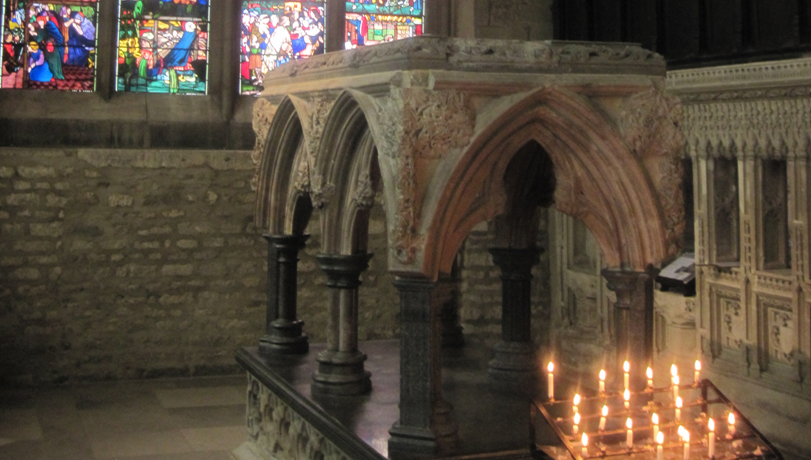
Shrine of St. Frideswide, Christ Church Cathedral Oxford.
Showing posts with label Missionaries. Show all posts

Sunday, March 17, 2013

St. Patrick, Patron Saint of Ireland, March 17

St. Patrick at Croagh Patrick, where he had an oratory. 
     Patrick is perhaps the most famous saint after St. Francis of Assisi and the Blessed Virgin Mary. And because the Church he founded is the Church of Ireland, he is very important in both the Roman and Anglican Churches.
     Patrick was born on the Northwest coast of Britain in 390 to a noble family. His father was a Roman official and a deacon while his mother was probably a native Briton. The story is too well known: at 16 Patrick was captured by Irish raiders (at the time, the Irish were called the 'Soctians' by the Romans, which means pirates) and brought to Ireland to work as a slave-shepherd. He later paid for his freedom with a gold coin he found and escaped back to Briton. But his time as a shepherd in Ireland was far from over. He became a priest and then a bishop, perhaps in Gaul. In 432 he had a dream telling him to return to Ireland to reestablish the Church (there had been one mission before him by Bishop Palladius who was sent by the Pope but failed in Ireland and pursued missionary work in Scotland).
     Patrick landed at what is now called Downpatrick, where he began his mission. He quickly spread Christianity by appealing first to the Irish kings and then to the tribes. He built upon the ruin of the old religion and so many of Ireland's holy wells and hills now associated with Patrick and other saints were once pagan sanctuaries. To each king he assigned what became archbishops and to each tribe a bishop. Patrick did not establish monasteries, these were brought later by St. Cairnach, who was trained in Whithorn by St. Ninian, but colleges of bishops which provided for select centers of Christianity that served as 'bases' for the evangelization of the whole country.
Patrick established his principal seat at Armagh, where his successors, the Archbishops of Armagh, remain the 'Primate of All Ireland.' He died in 461 and is buried outside the Church of  Ireland Cathedral at Downpatrick. His work was a catalyst of a golden age of Christianity enshrined by the Celtic peoples of Wales, Ireland and Scotland. He began a process, but did not Christianize Ireland entirely, and his disciples and successors, also among Ireland's greatest saints, are due, therefore, much veneration also.


There are many saintly bishops like St. Patrick but we must reserve him some credit because of the singularity with which he fulfilled his mission. It is not recorded that Patrick took very many companions with him, so Ireland's conversion is almost wholly due to Patrick's work. Patrick confessed that he hated the Irish, and with good reason since they enslaved him, but here we see how Patrick followed Christ's commandment: "Love thine enemies" and brought the thing that he loved most to the people he hated.
Downpatrick Cathedral.
     St. Patrick relevance in the Church is not overdone, though perhaps a different part of his life and work needs to be emphasized for its benefit. The Church is desperately in need of people, priests and most importantly bishops like St. Patrick. I am afraid to say that many of  the Church's leaders are unimaginative and though the Church was many times smaller in Patrick's Day, its community was many times more healthy than it is today. The Church needs bishops who are willing to dedicate their lives to establishing more bishoprics, priests and religious communities. Missionary areas are no longer on the edges of the world. We have been off of our guard and now each diocese around the world is a shell, including thousands of people who do not know Christ. We must invoke the example of St. Patrick and his successors for the future of our Church.

Collect: (From the Episcopal Church)
Almighty God, who in your providence chose your servant Patrick to be the apostle of the Irish people, to bring those who were wandering in darkness and error to the true light and knowledge of you: Grant us so to walk in that light, that we may come at last to the light of everlasting life; through Jesus Christ our Lord, who lives and reigns with you and the Holy Spirit, one God, now and ever. Amen.


Tomb of St. Patrick at Downpatrick Church of Ireland Cathedral. The (Anglican) Church of Ireland is the Church directly descended from the Church established by St. Patrick. This is why it has all of the old churches and Cathedrals of Ireland. It is a catholic Church, though no longer under the pope. It is, literally, The Church of Ireland. 
"St. Patrick's Breastplate." There is some debate over whether Patrick wrote it but it still remains important to his memory and message.


Christ be with me, 

Christ within me,
Christ behind me,
Christ before me,
Christ beside me,
Christ to win me,
Christ to comfort
and restore me.
Christ beneath me,
Christ above me,
Christ in quiet,
Christ in danger,
Christ in hearts of
all that love me,
Christ in mouth of
friend and stranger.

I bind unto myself today
the strong Name of the Trinity,
by invocation of the same,
the Three in One, and One in Three.
Of whom all nature hath creation,
eternal Father, Spirit, Word:
praise to the Lord of my salvation,

salvation is of Christ the Lord.

Friday, December 14, 2012

St. Drostan of Deer, 15 December


Speaking of monastic saints...

St. Drostan was a disciple of St. Columba on his missions through the Kingdom of the Picts in the 6th century. He established a monastery at Deer, which is now called by the related name Aberdour (or Inchcolm), which became the most important Church in that part of Scotland where it secured Christianity. Of this monastery, which fell into decay in periods but held religious communities until the Reformation in the 1500s, Drostan was abbot and perhaps also bishop, as many Celtic abbots were, and probably received a lot of royal support for it because of its proximity to the Pictish capital of Craig Phadrig, near Inverness. Towards the end of his life he left his abbey in the hands of the next abbot and became a hermit in the Scottish Highlands where he continued to preach to and give relief to the poor.

Anyhow, Drostan's abbey at Deer was instrumental in establishing churches and securing Christianity in the Moray-Grampians area. Thus, Drostan's Abbey, which was the mother of so many Christian churches in Eastern Scotland, was itself a daughter of Iona, the mother-house of all Scottish Churches (except for Whithorn), and of Iona it could be said, since it was established by St. Columba, was daughter to Clonard Abbey in Ireland and so forth. The seeds of missionary monasticism grew quickly and spread Gospel in the British Isles quickly once they were planted. It is the same today. With modern St. Finnians (teacher to Columba), we can have more St. Columbas. And with more St. Columbas we can have many more St. Drostans: many more churches and cathedrals filled: many more people comforted by the presence of Christ.


Above: St. John the Evangelist and the first chapter of his Gospel "In Principia erat Verbum" from the Book of Deer, a Celtic gospel book illuminated at St. Drostan's monastery.

Thursday, November 15, 2012

Feast of the Consecration of St. Samuel Seabury: the Bestowal of the American Episcopate: The first Bishop in the United States of America.


This feast annually marks the official establishment of the Anglican Church in the United States and is therefore as important to Episcopalians as the arrival of St. Augustine in Kent is to the Church of England, and the whole Anglican Communion. Samuel Seabury is to the U.S. what St. Aidan was to Northumbria, what St. Columba was to the Picts, what St. Patrick was to the Irish, and, as said before, what St. Augustine was to the English. He was the missionary who finally secured the Apostolic line on America. And for this reason he is a man of 'blessed memory,' as St. Bede would have said it, to the Church in the United States. 

     Seabury grew up in the Colony of Connecticut and was ordained by the Bishop of London in 1753. He became a member of a missionary group in the colonies and successively served as Rector to the parishes of Christ Church New Brunswick, NJ, Grace Church Jamaica, NY, and St. Peter's Westchester County, NY. Both before and after the Revolutionary War, Seabury remained loyal to the Church of England and advocated for the establishment of a bishopric in the colonies. After the war, he was elected in a meeting of the Church in Connecticut to seek Episcopal consecration in England. He was denied consecration by the Archbishop of Canterbury because Church of England Bishops had to swear an oath to the king, which was problematic for the now American Seabury. So he sought consecration by the non-juror bishops of Scotland, who were in hiding because they refused to recognize the Hanoverian dynasty and, as Episcopalian in structure and catholic in worship, were suppressed by the Presbyterian Church of Scotland. The Scots agreed to consecrate Seabury on the conditions that they call themselves the 'Episcopal' Church, to get back at the Hanoverians in England, and that the Americans included the Epiclesis after the words of institution in the rite for Holy Communion. Seabury was consecrated on this day in 1784 by the bishop and suffragan of Aberdeen, and the bishop of Ross and Caithness in Aberdeen. He went on the establish the Church in Connecticut and Rhode Island, participated in the first consecration of a bishop in America, Claggett of Maryland, and served as the second Presiding Bishop of the Episcopal Church. He died in 1796 and in buried in St. James Church, New London. 


Consecration of St. Samuel Seabury from St. Paul's Edinburgh.
     St. Samuel Seabury is an important example for the Episcopal Church, and all Churches of the Anglican Communion, as an enthusiastic missionary, supporter of the faith, and father of the Church. Both diocesan and missionary bishops can look up to him when they work to penetrate their own diocese with the Gospel or to bring it to new places and establish new Churches. As I said in my post The Church is in Need of Her Saints, "the Church owes much of her existence to these men and women who died for the faith or kept clean the Church of corruption. Today by placing a candle before the image or relic of a saint we are both thanking our mortal ancestors for giving us the Church and praying that we as Christians might be able to imitate the extreme dedication to Christ that these saints exercised." Samuel Seabury is saint, father, and missionary of the Anglican Church, whose work, as a mortal follower and herald of Christ, we members of the modern Church, should hope to emulate. When we say a prayer remembering St. Samuel Seabury we are thanking Christ for his sacrifice, and for our salvation; for all the comfort that we get from him because holy men and women like Samuel Seabury secured the faith for us. 

Collect:
Eternal God, you blessed your servant Samuel Seabury with the gift of perseverance to renew the Anglican inheritance in North America: Grant that, joined together in unity with our bishops and nourished by your holy Sacraments, we may proclaim the Gospel of redemption with apostolic zeal; through Jesus Christ, who lives and reigns with you and the Holy Spirit, one God, for ever and ever. Amen.


The miter of St. Samuel Seabury.
Because Samuel Seabury was the first of any bishop in America, there is some literature surrounding his miter, (which I think should be treated as a relic). It is kept by the Diocese of Connecticut in Hartford. The following poem is by A. Cleveland Coxe.

THE rod that from Jerusalem
  Went forth so strong of yore;
That rod of David's royal stem,
  Whose hand the farthest bore?
St. Paul to seek the setting sun,
  They say, to Britain prest:
St. Andrew to old Caledon;
  But who still further West?


Go ask!--a thousand tongues shall tell
  His name and dear renown,
Where altar, font, and holy bell,
  Are gifts he handed down:
A thousand hearts keep warm the name,
  Which share those gifts so blest;
Yet even this may tell the same,
  First mitre of the West!


This mitre with its crown of thorn,
  Its cross upon the front;
Not for a proud adorning worn,
  But for the battle's brunt:
This helmet--with Salvation's sign,
  Of one whose shield was faith;
This crown--of him, for right divine
  Who battled unto death!


Oh! keep it--till the moth shall wear
  Its comeliness to dust,
Type of a crown that's laid up where
  There is nor moth nor rust;
Type of the LORD'S commission given
  To this, our Western shore;
The rod of CHRIST--the keys of heaven,
  Through one, to thousands more.


They tell how Scotia keeps with awe
  Her old Regalia bright,
Sign of her independent law,
  And proud imperial right;
But keep this too for Scotland's boast;
  'Twill tell of better things,
When long old Scotia shall have lost
  Those gewgaws of her kings.


And keep it for this mighty West
  Till truth shall glorious be,
And good old Samuel's is confest
  Columbia's primal see.
'Tis better than a diadem,
  The crown that bishop wore,
Whose hand the rod of David's stem
  The furthest Westward bore.


Wednesday, November 7, 2012

Feast of St. Willibrord, Apostle to Frisia, 7 November and the Dancing Procession of Echternach

St. Willibrord: Apostle to Frisia, first Archbishop of Utrecht.
     St. Willibrord was one of the earliest of the Anglo-Saxon missionaries to the Germanic peoples. His mission to the pagans of what are now the Netherlands sparked a century of English sponsored missions to bring the Gospel to Frisia and Germany. Many saints would follow this first Archbishop of Utrecht, penetrating deep into barbaric lands and placing their lives in jeopardy. Willibrord was born near York in Northumbria A.D. 658 and was educated in the abbey of St. Peter at Ripon by St. Wilfrid. When he returned to England in 690, he organized a mission with twelve other monks to bring Christ to Frisia. He gained support for his mission from Pippin II of the Franks and Pope Sergius who consecrated him a bishop. Willibrord soon established a cathedral at Utrecht and a flourishing monastery at Echternach, now Luxembourg, in much the same fashion that St. Augustine established the Church in Kent a century before. He was repelled once and his churches burned, but he returned and rebuilt everything and even sent further missions into Denmark and Germany. He died in 739 and his body was enshrined at the Abbey at Echternach where it remains.

    Willibrord's life is important to the modern Church as an example of missionary perseverance. The Church has lost members all over the world, and it is in need of leaders like St. Willibrord to penetrate into each and every community, even, and especially where there are church congregations already. The setbacks that Willibrord experienced to his work was much more forceful and damaging than the silent yet quick declination that the Church today is experiencing, and so a reformulated interest in his example and thanksgiving in the his work and the work of the many saints like him is important to the revitalization to the Church where she exists and to spread the love of Christ where it has yet to thrive.


     The Dancing Procession of Echternach
     The cult of St. Willibrord became very strong in Luxembourg, Belgium, and in the Netherlands, where, to this day, Europe's only dancing procession is held every year on St. Willibrord's day. The procession begins with the chanting of the Litany of St. Willibrord and then the procession dances through the city, into the abbey and right down into the crypt to pass the shrine of St. Willibrord, while the bishop sits over the entrance to the crypt, blessing pilgrims as they pass beneath him.

This video, though a bit dramatic in presentation, captures both older and more recent films of the St. Willibrord Dance. 
And this, from last year:

Collect:
     O Lord our God, who dost call whom thou willest and send them whither thou choosest: We thank thee for sending thy servant Willibrord to be an apostle to the Low Countries, to turn them from the worship of idols to serve thee, the living God; and we entreat thee to preserve us from the temptation to exchange the perfect freedom of thy service for servitude to false gods and to idols of our own devising; through Jesus Christ our Lord, who liveth and reigneth with thee and the Holy Spirit, one God, for ever and ever. Amen.

Heavenly Father, we ask you especially on this day when a new Archbishop of Canterbury has been chosen to give him the strength and perseverance of St. Willibrord and all thy saints, that he may help to heal the Church and extend its mission to all corners of the earth; we ask this through your Son Jesus Christ. Amen

Shrine of St. Willibrord at Echternach Abbey.
The Litany of St. Willibrord:

Lord, have mercy,
Christ, have mercy,
Christ, hear our prayer.
Christ, hear our prayer!
God the Father in heaven, Have mercy on us.
God the Son, Redeemer of the world, have mercy on us.
God the Holy Spirit, Have mercy on us.
God the Holy Trinity, Have mercy on us.
Blessed Mary, pray for us.
Blessed Mother of God, pray for us.
Blessed Virgin of all virgins, pray for us.
St Willibrord, pray for us!
St Willibrord, Guiding Light of the Church,*
*pray for us, St Willibrord
St Willibrord, Bright-shining star of our country,*
St Willibrord, Missionary to our homeland,*
St Willibrord, special protector of this our land,*
St Willibrord, first apostle of the Netherlands.*
St Willibrord, founder of monasteries and churches,*
St Willibrord, promotor of progress and knowledge,*
St Willibrord, teacher of truth,
St Willibrord, passionate interpreter of the teaching of Christ,*
St Willibrord, ceaseless proclaimer of the Holy Gospel,*
St Willibrord, teacher of true faith,*
St Willibrord, founder of peace and justice,*
St Willibrord, model of hope and reconciliation,*
St Willibrord, conqueror of injustice and discord,*
St. Willibrord, Architect of Community and Unity,*
St Willibrord, Destroyer of idols,*
St Willibrord, Patron Saint of children,*
St Willibrord Gentle guide of the lost,*
St Willibrord , Support of the homeless,*
St Willibrord, Friend of the persecuted,*
St Willibrord, Light of the blind,*
St. Willibrord, Refuge for the sick,*
St Willibrord, Gentle father of the poor,*
St Willibrord, Comforter of the afflicted and sorrowful,*
St Willibrord, Helper to the suffering,*
St Willibrord, True voice of God,*
St Willibrord, Humble servant of Jesus Christ,*
St Willibrord, Mighty advocate in heaven,*
St Willibrord, Miraculous healer,*
St Willibrord, True witness and confessor of Christ,*
St Willibrord, Saviour of those who doubt their faith,*
St Willibrord, Supporter of the carer and educator,*
St Willibrord, Hope of those who pray,*
St Willibrord, Model of patience and gentleness,*
St Willibrord, Example of active love,*
St Willibrord, Master of joy and life,*
St Willibrord, Disciple of Christ,*
Lamb of God, you take away the sins of the world,
Lord, have mercy on us!
Lamb of God, you take away the sins of the world.
Lord, hear our prayer!
Lamb of God, you take away the sins of the world.
Lord, have mercy on us!

Thursday, August 30, 2012

St. Aidan of Lindisfarne; a father of the Anglican Church

St. Aidan by the Church of St. Mary on Lindisfarne; the site of his abbey.
St. Aidan of Lindisfarne can be treated equally as a father of the Church in England with Augustine of Canterbury and likewise of the whole Anglican Church. It was Aidan, who in A. D. 635 brought the light of Christ into the Kingdom of Northumbria, which then extended from the firth of Forth to the river Humber, and established the monastery of Lindisfarne as his episcopal seat. Aidan came on invitation of Oswald from the church of Iona, which was not under the bishop of Rome until the eleventh century, and evangelized in England as far south as London often travelling by foot. 
Bede later recorded of him "He neither sought nor loved anything of this world, but delighted in distributing immediately to the poor whatever was giver to him by kings or rich men of this world. He traversed both town and country on foot, never on horseback, unless compelled by some urgent necessity. Whenever on his way he saw any, either rich or poor, he invited them, if pagans, to embrace the mystery of the faith; or if they were believers, he sought to strengthen them in their faith and stir them up by words and actions to alms and good works."
St. Aidan died on August 31 in 651 and the Church in Bamburgh is built over the site of his death. He was buried on Lindisfarne but his bones were taken with the body of St. Cuthbert to Durham were they remain to this day. The altar in the center of the chapel of the nine altar is dedicated to his memory.
Aidan, as bishop, proved  wholly dedicated to Christ in his work as a missionary and in his effort to give to the poor. He is important to the Anglican Church not only as a father but also as model for bishops today and for what the church should look for in choosing bishops. Our codes of conduct in modern society has changed since the seventh century, but poverty has not gone away and not everyone has been fairly invited to "embrace the mystery of the faith." Words are powerful tools, but as Aidan shows us it is more than just preaching that Christians must do to follow in Jesus' footsteps. Aidan, his episcopal colleges and successors dedicated their lives to give Christ to the Father's children, it is our duty, as Christians, whether we are lay-people, priests or bishops, to make sure that the Anglican Church gives the faith of Christ, preserved and unviolated, to our own brothers, sisters and children. 

Heavenly Father, we thank you for your holy servant Aidan and his strength and commitment to bringing the light of your son to the Northumbrians and we pray that that we may muster the same strength and commitment to extend his mission, his kindness and our faith to all corners of the Earth. Amen


Icon of St. Aidan presenting the gospel to King Oswald at the Church of St. Aidan, Bamburgh. 

St. Aidan altar at Durham Cathedral.

Friday, June 8, 2012

Feast of St. Columba of Iona, 9 June.

Iona Abbey, founded by St. Columba in 565.
Columba was born into a branch of one of the royal clans of Ireland in 521 and joined a monastery at an early age. It was a custom of Irish noblemen to send one of their children into the monastic life, which was of a higher status and importance in the Celtic Church than in the early 'Roman Church.' Although the various churches under the Roman Patriarch were for most of the middle ages only loosely connected to Rome, the Celtic Church, although sharing the same faith, had no ties with the Roman Church, and operated itself independently as all the Patriarchates did. Columba rose quickly to the rank of abbot, which in the Celtic Church was higher that the rank of bishop. While he remained in Ireland he founded the great monasteries of Durrow and Kells, both of which would produce illuminated gospel-books. In 565, after getting into a quarrel with other abbots and initiating a war between opposing royal clans he forced himself, as penance, to travel to the kingdom of Dal-Riata and convert all of the Scottish kingdoms. He was given the isle of Iona where he built a monastery that would later become the center of Celtic Christianity. He traveled all over Scotland converting the rest of the land to Christianity and establishing the new church. When he came to the King Bruide of the Picts, or the 'Redshanks' as the Venerable Bede calls them, he was barred from the castle, but according to the detailed "Life of St. Columba" by Adomnan, a later abbot, the Gates them opened themselves upon Columba's command, letting his missionaries in, where King Bruide would convert to Christianity. Columba spent the rest of his life in Scotland where his actions were key to a firm foundation of Christianity among the Scots. He was such an important figure that several Anglo-Saxon histories include him in their accounts of ecclesiastical history.

The Scottish Episcopal Church, which was forced into hiding in the 17th and 18th centuries, is partially descended from Columba's Church. St. Ninian converted the southern Picts and so the Scottish Episcopal Church is also descended Ninian's Church. Like all missionaries, Columba is important because he is a good example of the work that Christ asked us to do, and that became so revered in the office of bishop. The duty of the Church is to continue spreading the faith and love of Christ, and our modern Church must continue to spread the faith that St. Columba and others worked so hard to save and nurture. When Columba came to Scotland, he was amongst pagans; now we confront doubt and suspicion of the faith, but we must also work hard for the faith that so many dedicated their life to.

O God, who by the preaching of thy blessed servant Columba didst cause the light of the Gospel to shine in Scotland: Grant, we beseech thee, that, having his life and labors in remembrance, we may show forth the our thankfulness to thee by following the example of his zeal and patience; through Jesus Christ our Lord, who liveth and reigneth with thee and the Holy Spirit, one God, for ever and ever. Amen.

Sources: Lesser Feasts and Fasts (of the Episcopal Church).