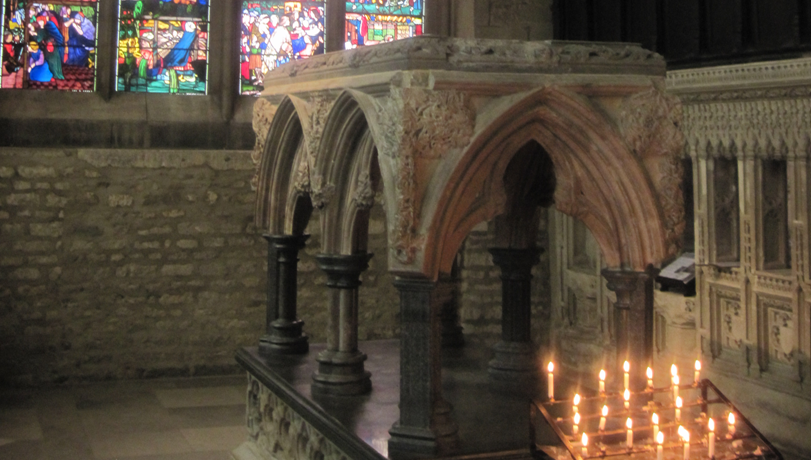
Shrine of St. Frideswide, Christ Church Cathedral Oxford.
Showing posts with label Church Fathers. Show all posts

Monday, March 18, 2013

St. Cyril of Jerusalem, March 18.

The Catecheses of St. Cyril. The Procatecheses is the prologue. 
     Cyril was born in Jerusalem around 315 and became a bishop in 349, so he was not among the 318 at Nicaea but was bishop during the high tide of the Arian heresy. As bishop of the diocese of Jerusalem which was growing in importance because of the steady stream of pilgrims, he was a direct challenge to the Metropolitan Bishop of Caesearea, Acacius, who was an Arian. Cyril strictly opposed Arianism and taught the faith as established at Nicaea which he also upheld in the First Council of Constantinople in 381. He was forced into exile several times by Acacius and later Arian Emperors but always returned to Jerusalem before he died in 386.
     He is remembered for his scholarship in liturgy, his charity and as one of the greatest theologians of the 4th century as a definer and defender of the faith. Sometime during his episcopate he wrote the Catecheses, eighteen lectures on the Christian faith to be preached to the catechumens, those waiting for baptism, and the five Mystagogical Catecheses, on the sacraments, for the newly baptized. For these works, Cyril earned his place among the early Church Fathers, and remains a source for those looking for definitions and explanations in Christianity as his works have survived and are widely known.
     As the Emperor Constantine had only made the world safe for Christians in 315, Christian laypeople were coming from their cities with their bishops now freely able to visit the tombs of martyrs being erected and more significantly to travel to Jerusalem itself. Cyril provided for probably increasing numbers of pilgrims the Holy Week liturgies that are still used everywhere today, including the procession with palms on Palm Sunday.
     The Episcopal Church cites the journal of a 4th century Spanish nun called Egeria, who came in contact with St. Cyril while in Jerusalem. Here is her account for the festivities on Palm Sunday:

 "Accordingly at the seventh hour all the people go up to the Mount of Olives, that is, to Eleona, and the bishop with them, to the church, where hymns and antiphons suitable to the day and to the place are said, and lessons in like manner. And when the ninth hour approaches they go up with hymns to the Imbomon, that is, to the place whence the Lord ascended into heaven, and there they sit down, for all the people are always bidden to sit when the bishop is present; the deacons alone always stand. Hymns and antiphons suitable to the day and to the place are said, interspersed with lections and prayers. And as the eleventh hour approaches, the passage from the Gospel is read, where the children, carrying branches and palms, met the Lord, saying; Blessed is He that cometh in the name of the Lord, and the bishop immediately rises, and all the people with him, and they all go on foot from the top of the Mount of Olives, all the people going before him with hymns and antiphons, answering one to another: Blessed is He that cometh in the Name of the Lord. And all the children in the neighborhood  even those who are too young to walk, are carried by their parents on their shoulders, all of them bearing branches, some of palms and some of olives,2 and thus the bishop is escorted in the same manner as the Lord was of old. For all, even those of rank, both matrons and men, accompany the bishop all the way on foot in this manner, making these responses, from the top of the mount to the city, and thence through the whole city to the Anastasis, going very slowly lest the poeple should be wearied; and thus they arrive at the Anastasis at a late hour. And on arriving, although it is late, lucernare takes place, with prayer at the Cross; after which the people are dismissed."

The Good Friday Veneration of the Cross is also recorded. In Jerusalem, this was celebrated of course in the part of the Church of the Holy Sepulcher (which Egeria refers to as "the Basilica") which stands right over Golgotha:

"Then a chair is placed for the bishop in Golgotha behind the Cross, which is now standing; the bishop duly takes his seat in the chair, and a table covered with a linen cloth is placed before him; the deacons stand round the table, and a silver-gilt casket is brought in which is the holy wood of the Cross. The casket is opened and (the wood) is taken out, and both the wood of the Cross and the title are placed upon the table. Now, when it has been put upon the table, the bishop, as he sits, holds the extremities of the sacred wood firmly in his hands, while the deacons who stand around guard it. It is guarded thus because the custom is that the people, both faithful and catechumens, come one by one and, bowing down at the table, kiss the sacred wood and pass through. And because, I know not when, some one is said to have bitten off and stolen a portion of the sacred wood, it is thus guarded by the deacons who stand around, lest any one approaching should venture to do so again. And as all the people pass by one by one, all bowing themselves, they touch the Cross and the title, first with their foreheads and then with their eyes; then they kiss the Cross and pass through, but none lays his hand upon it to touch it. "


Golgotha today.
Collect (From the Episcopal Church):
Strengthen, O Lord, the bishops of your Church in their special calling to be teachers and ministers of the Sacraments, so that they, like your servant Cyril of Jerusalem, may effectively instruct your people in Christian faith and practice; and that we, taught by them, may enter more fully into celebration of the Paschal mystery; through Jesus Christ our Lord, who lives and reigns with you and the Holy Spirit, one God, now and for ever. Amen.

Thursday, December 6, 2012

St. Ambrose of Milan, 7 December, and the Ambrosian Rite and Liturgy.


St. Ambrose, Archbishop of Milan.
     St. Ambrose lived in the 4th century A.D. and was, before he became Archbishop of Milan, the Roman Governor of Aemilia and Liguria, a province of what is now Lombardy with the capitol at Milan. Upon the death of the Arian bishop of Milan, Ambrose went to the council of bishops who were to elect the new archbishop to prevent conflict but found himself instead as elected to take that office, which he humbly accepted. Ambrose allotted all his wealth to the poor except for some which he reserved for his sister, as did St. Anthony the Great when he entered the desert of Egypt to become a hermit. He is similar to St. Hugh of Lincoln in his lifestyle as bishop where he practiced humility and asceticism in one of the highest and most public offices in the Roman empire. Also as a precursor for later medieval saint-bishops such as Hugh or Thomas Becket, he came into great conflict with the Roman Emperors and other secular authorities through his suppression of the Arian heresy. The Arians were still at large in the 4th century and demanded the right to worship in some of Milan's greatest Churches, which Ambrose refused, incurring the anger of the Emperor Valentinian, whose wife was an acclaimed Arian. He also excommunicated the Emperor Theodosius after massacres in Greece. Throughout his episcopate, Ambrose was staunch in maintaining the true faith of the Nicene Creed and the practice of Christian Charity and mercy. He died in 395 and is buried in the Basilica of St. Ambrogio in Milan.
As one of the first 'Doctors of the Church,' Ambrose is remembered as a great hymnist, liturgist, and theologian as St. Augustine of Hippo was his greatest student. Many of his works survive and among his most prevalent focuses are human sin, ethics,  and divine grace, but his writings also influenced the growing importance of the sacraments of of specific doctrines of the Church. He influenced liturgy through music and through the composition of the rite. As a hymnist, he composed a form of chant now honored to him as Ambrosian Chant which involves a chanted dialogue between the officiant of the office and the congregation and is still used in the Archdiocese of Milan. He, like the writers and composers St. Jerome or Gregory the Great, is often depicted in a scriptorium. At one point as Archbishop, Ambrose got into an argument with Churchmen in Rome about Milan's distinct liturgy from the Roman Rite. He resolved that when ever he went to Rome he would use their customes but in Milan he would keep practicine the Ambrosian Rite. His decision is purpetuated in a common saying which survive today when he wrote in a letter "When in Rome, do as the Romans do."
     The example of Ambrose as a Church figure involved in every aspect of the Church's and its members lives is important in a world that is constantly growing more secular. Although many believe that no religion should have any official place in government this does not mean that archbishops, bishops, and priests should remain un-involved and unspoken. They should by no means attach themselves to a political party...but the Church should make itself known through public outcry and involvement that it is a body of citizens whose beliefs will not allow for certain trespasses of the state to be acceptable. Ambrose's deep influence in regional liturgy and music also shows that priests and bishops should look towards the perfection of a liturgy that will best satisfy the devotion of the Church's members.
     Most importantly, the careful guardianship of the faith by Ambrose against rogue bishops in the church who upheld the Arian heresy, shows us the importance of preserving the faith, especially when it is assaulted by our own bishops, our successors to the apostles, and other forces from within the Church. The faith in Christ-of the one holy Catholic and Apostolic Church- is the only real treasure. It must be protected from people in the church who deny the faith and its leaders and members must continue to fulfill its eternal duty...to bring Christ, to bring the Church, to as many people in the world for their comfort from the knowlage that Christ is Our Savior...from everything that could challenge our happiness in this world and the next.

The Ambrosian Rite and Liturgy.
     The Ambrosian Rite is the only non-Roman Rite liturgy that is allowed to be used in any diocese of the Roman Catholic Church except for the Gallician Rite, which can only be used in the Cathedral of Santiago de Compostela in Spain on the Feast fo St. James, 25 July, who is buried there. It is the main use of the parishes in the Archdioces of Milan, where Ambrose was bishop. The rite could be described as more byzantine than the roman rite in its arrangement of the Mass and the Divine Offices  and even the liturgical calendar. Perhaps most remarkably, the services of Holy Week are distincly different from any other latin rite, and both the seasons of Lent and Advent are longer than the ususal Roman observance. Ambrosian Chant, which is distinct from Gregorian Chant, is Gallo-Roman in nature, more similar to the Mozarabic Chant of Spain or the chant used in Gaul. The Ambrosian Chant often calls for a treble (boys choir) section. The chant also includes  a part for the congregation, who is supposed to join in the chant both at Mass and at daily offices, esspecially in the singing of the psalms. The Basilica of St. Ambrogio in Milan is known to use the Ambrosian Chants and Rite regularly.

Collect:
O God, who gave your servant Ambrose grace eloquently to proclaim your righteousness in the great congregation, and fearlessly to bear reproach for the honor of your Name: Mercifully grant to all bishops and pastors such excellence in preaching and faithfulness in ministering your Word, that your people may be partakers with them of the glory that shall be revealed; through Jesus Christ our Lord, who lives and reigns with you and the Holy Spirit, one God, now and for ever.

Ambrosian chant - Alleluia. Hodie in Bethlehem puer natus est.


The Gospel Alleluia from the Ambrosian Rite in Milan Cathedral.

Preces and responses in the Ambrosian Rite in the Basilica of S. Ambrogio, Milan, where St. Ambrose is buried. The church seems to be the most well known for its use of the rite.