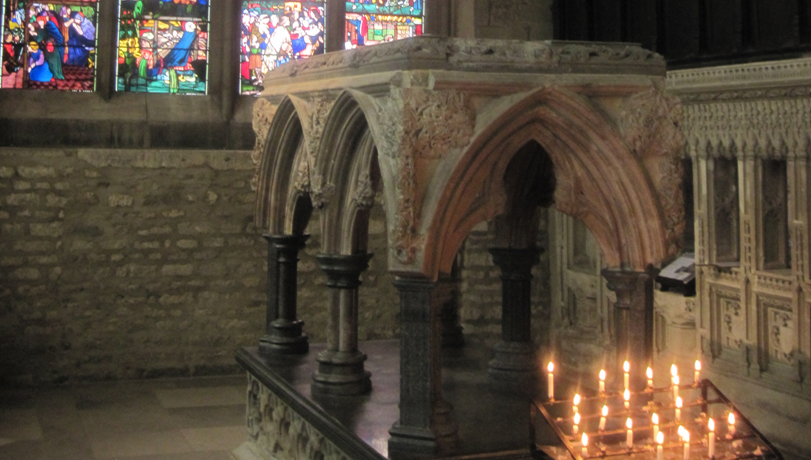
Shrine of St. Frideswide, Christ Church Cathedral Oxford.

Wednesday, May 23, 2012

Feast of St. William of Rochester (or Perth), May 23.

Stained glass from Rochester Cathedral depicting St. William as a Pilgrim. 
William grew up in Perth, Scotland in the 12th century. A pious man, he attended masses daily and as a fisherman and a baker and gave much of what he produced and earned to the poor of Perth. He was additionally involved in helping orphans, adopting the boy, David, as his son, and saving an infant, who had left at the door of a church, from the cold. In 1201 he set out from Scotland with his adopted son, David, to go on a pilgrimage to the Holy Land, taking with him enough for he and his companion to survive and the rest to give to the poor along the way. But while in Rochester, David turned on him and murdered him for what little he had. A madwomen later found his body and adorned it with flowers and herbs, and who upon touching the body was healed of her madness. The monks of Rochester later brought the body to the Cathedral where it would attract pilgrims by the thousands until the Reformation. William was venerated for his charity, piety, pilgrimage, and martyrdom, and is typically depicted as a pilgrim with the scallop shell. His tomb survives Rochester and he has been re-incorporated into the chain of saints associated with Rochester.
     What is important to remember about St. William of Rochester is that he was a laymen. Most saints are ecclesiastics: bishops, monks and nuns, and the few saints who were laypeople are often monarchs who established great churches. St. William is a lay-saint, and it is not his death which did not make him one, but his charitable life, abruptly ended on a devotional and humble journey. He may, for many, by a more approachable saint because of this. Though there is little known about him and his cult was never very large in England, he may remain with other saintly laypeople an enduring example of how anyone, not just bishops or religious, can attain such holiness.
Rochester Cathedral west window. The gothic additions to the originally Norman Church were probably funded by donations from pilgrims who stopped at the shrine of St. William. 

Tuesday, May 15, 2012

Feast of St. Isidore the Farmer, May 15

Iglesia San Isidro el Real en Madrid

St. Isidore was born in Madrid in around 1070. Known for his piety, he was constantly attending masses at his local parish church in Madrid and late to work in the fields because of his deep and persistent prayer. It was often said that as he ploughed there were angels accompanying him on either side so that his work equaled that of three men. Upon the ground where he farmed the crops grew with ease and water welled up from the ground upon his command. His wife, St. Maria Torriba, was also known for miracles involving water, which would have been especially precious in the semi-arid landscape that surrounds Madrid. St. Isidore is a patron saint of farmers and of the city of Madrid as his relics are enshrined within the Church of San Isidro el Real. Both he and his wife were invoked in times of famine or drought.

Friday, May 11, 2012

Lady Julian of Norwich, 8 May... "All shall be well"


Little is known of the Lady Julian. But she was about 30 in 1373 when she experience a series of 16 visions all portraying a theme of Divine Love. Soon after her visions, she was miraculously healed of the deathly illness for which a priest had delivered last rites to her just a few days before. She later attached herself to the parish church of St. Julian of Le Mans in Norwich (where she gets her name) as an anchoress where she spent the rest of her live blessing pilgrims and writing her account and interpretation of the visions called The Revelations of Divine Love. Julian is notable for her book because of the low literacy rate and her stance on the theology of Divine Love as a women. Today the Church of St. Julian of Le Mans in Norwich is the site of the restored Anglican shrine of the Lady Julian, where her cell has been rebuilt as a chapel for modern day pilgrims. The Lady Julian in demonstrates, to the Anglican Church, the Divine Love that was and is extended to all people through the Passion. The persistence of the Lady Julian to show to us the intensity of Jesus' love sets the example for Anglican Church to be inspired by the love of Christ demonstrated in his sacrifice and to proclaim that love to all in the world who need it.

Some Quotes from Revelations of Divine Love...

"I desired in many ways to know what was our Lord's meaning. And fifteen years after and more, I was answered in spiritual understanding, and it was said: What, do you wish to know your Lord's meaning in this thing? Know it well, love was his meaning. Who reveals it to you? Love. What did he reveal to you? Love. Why does he reveal it to you? For love. Remain in this, and you will know more of the same. But you will never know different, without end."


"There were times when I wanted to look away from the Cross, but I dared not. For I knew that while I gazed on the Cross I was safe and sound, and I was not willingly going to imperil my soul."


"It behoved that there should be sin; but all shall be well, and all shall be well, and all manner of thing shall be well."

Website for the Shrine of the Lady Julian. 

Saturday, March 24, 2012

Feast of the Annunciation, March 25

The Annunciation (by myself). The iPod replaces the more traditional book which Mary holds for a modern twist.

The Feast of the Annunciation celebrates the visitation of the Angel Gabriel to tell the Blessed Virgin Mary that she would bear the son of God and was to name him Jesus, meaning Savior. The feast is celebrated exactly nine months before Christmas illustrating the perfection of Christ even in birth. It was St. Luke the Evangelist who after the Resurrection and Pentecost interviewed Mary and recorded the Annunciation, the Nativity and the birth of John the Baptist in his Gospel. The Angelus,which goes over the Annunciation as a prayer is as follows:
V. The angel of the Lord declared unto Mary.
R. And she conceived by the power of Holy Spirit.
Hail Mary, full of grace, the Lord is with thee. Blessed art thou among women, and blessed is the fruit of thy womb, Jesus. Holy Mary, Mother of God, pray for us sinners, now and at the hour of our death. Amen.
V. Behold the handmaid of the Lord.
R. Be it done unto me according to your Word.
Hail Mary...
V. And the Word was made flesh.
R. And dwelt among us.
Hail Mary...
V. Pray for us, O Holy Mother of God.
R. That we may be made worthy of the promises of Christ.
Let us pray: Pour forth, we beseech thee, O Lord, Thy grace into our hearts, that we to whom the incarnation of Christ Thy Son was made known by the message of an angel, may by His Passion and Cross be brought to the glory of His resurrection; through the same Christ our Lord. Amen.

And my favorite Annunciation hymn. Medieval Basque tune and words.

The angel Gabriel from Heaven came,
His wings as drifted snow, his eyes as flame;
“All hail,” said he, “thou lowly maiden Mary,
Most highly favored lady,” Gloria!

“For know a blessèd mother thou shalt be,
All generations laud and honor thee,
Thy Son shall be Emmanuel, by seers foretold,
Most highly favored lady,” Gloria!

Then gentle Mary meekly bowed her head,
“To me be as it pleaseth God,” she said,
“My soul shall laud and magnify His holy Name.”
Most highly favored lady, Gloria!

Of her, Emmanuel, the Christ, was born
In Bethlehem, all on a Christmas morn,
And Christian folk throughout the world will ever say—
“Most highly favored lady,” Gloria!

http://www.youtube.com/watch?v=xKQIomtXXkc 

Friday, March 23, 2012

Restored Shrine of St. David of Wales


Here are the pictures from the dedication of the Shrine of St. David in his Welsh Cathedral. The procession began at the city cross, where the bishop blessed the City of St. Davids. The procession then moved to the Cathedral where a choral Eucharist was celebrated and the Shrine was dedicated. Celebrations continued for the next 5 days with shrine prayers and choral Eucharists everyday. The Cathedral also celebrated the feast of St. Non, St. David's mother, on Sunday, March 3.

Below is a link to the diocesan website with more pictures of the Shrine and celebrations, and the sermon delivered by the Canon Chancellor and Guardian of the Shrine, Dr. Patrick Thomas on St. Non's Day.
http://www.churchinwales.org.uk/david/std_english.php


Sunday, March 18, 2012

The Pope of Alexandria, Shenouda III, died on Saturday.

Patriarch of Egypt and All Africa since 1971, Shenouda has lead the Coptic Church for 4 decades. He supported his people, about 10% of the population in Egypt, through several periods of sectarian violence, the latest being the burning of Coptic churches and military attacks on Coptic protesters. Shenouda died at age 88 on Saturday, March 17, and hundreds of Christians gathered in and around the Cathedral of St. Mark in Alexandria to mourn his death.

Saturday, March 17, 2012

St. Cuthbert of Lindisfarne; 20 March

St. Cuthbert of Lindisfarne at Durham Cathedral.
     St. Cuthbert is certainly one of Britain's, if not of all Anglicanism's, greatest bishops. The humility, love and compassion that he shared with his community, along with the many centuries of devotion paid to him after his death mark him both as one of the most loving and most loved leaders of English Christianity. Love is a reflexive act; the compassion, and trust shown to him by the Northern community is equally important to the care that he held for the people of his bishopric in the 7th century. His cult has survived war and peace; the Viking invasions beginning in 793, the danish invasions of the 10th century, the Norman Invasion, and it has even survived the impious destruction during the Reformation. His bones still lie at Durham where on March 19, 2012 a restored Banner of St. Cuthbert, a copy of a the medieval relic of his shroud and a symbol of northern England and the latest addition to the treasures of his tomb, will be dedicated.
St. Cuthbert's Shrine at Durham Cathedral.

Cuthbert was born in 634, near Melrose. He was a shepherd until he saw a vision as a boy. It is one of the early chapters in the Vita Sancti Cuthberti by the Venerable Bede that is dedicated to this vision called Quomondo cum pastoribus positius animam Sancti Aidiani Episcopi ad coelum ab angelis ferri aspexerit (literally, how while he was posted with the shepherds, he witnessed the soul of the Holy Bishop Aidan being carried to heaven by angels). This is what prompted him to enter into the monastery of Melrose at an early age. Cuthbert did well as a monk in the eyes of the abbot, Boisil. He came to accept the Roman customs after the Synod of Whitby and was made prior of Melrose. When his new abbot, Eata, went to Lindisfarne, Cuthbert followed and became prior of Lindisfarne where he pursued missionary work in Northumberland and southern Scotland.  In 676 he decided to take monastic life a step further and live as a hermit on the Farne islands of the Northumbrian coast. there he remained for 9 years, living on a simple diet of onions and fish. He built himself an oratory and practiced the Celtic rite of saying the psalms in the cold sea water. It is recorded that when he came out from the water, the otters dried his feet and the birds brought him fish out of their own admiration. And while on the island he would bless those who came to seek his comfort.
Cuthbert leaves Farne to become bishop

In 685 Cuthbert was appointed the Bishop of Hexham, (which he swapped for Lindisfarne) by the Archbishop of Canterbury, Theodore of Tarsus. He left the Farne with King Ecgfrith and Bishop Trumwine and returned to his missionary work in the bishopric. During his short episcopate, he traveled through his diocese on foot, ministering to the rural and urban poor alike and performing miracles for their relief. He lived first to extol and praise God and to worship him by living like him and to extend the good news of Christ's love to all people in his flock so that we might be comforted and learn to comfort others.

The site of Cuthbert's first hermitage.
His humility, his sanctity, and his high love for his people make him a model bishop. He died on 20 March, 687 on the Farne islands, where he returned after he predicted his death two months before. He was buried in the church at Lindisfarne, and when the Vikings attacked in 793 and later in 875, the monks carried his body from the island, and embarked on a 120-year journey that brought them to Durham in 995. There, when the ox-cart could no longer move, they laid his body in a tomb where it rests today, still retaining the head of St. Oswald, vestments presented by King Ecgfrith, and his own pectoral cross and portable altar. He was the most popular saint in Northern England as his shrine attracted pilgrims from all over the British isles, and continues to do so.
St. Cuthbert in the Galilee Chapel at Durham.

     Hopefully the Anglican Church, and all Churches will continue to honor St. Cuthbert as one apostle of Christ in England, and a bearer of Christ's love in the same land. The bishops of today's Church have the job of preserving the faith that Cuthbert brought to the people of Northumbria, and extending the love of Christ that he extended to his people. More importantly, the Church needs to continue St. Cuthbert, it needs bishops, priests and laypeople who will dedicate their lives to the extension of Christ's comfort through and in Christ's saving message. It is essential that the Church holds on to the traditions, to the image of Christ and his love in people, and the images and relics of those who spread his love, so that we never forget what our duty is: to spread the words of love of Christ. Only through our perseverance can the "Fire in the North," as he was called by Fr. David Adam of Bamburgh, and us like him, spread to set the whole world ablaze with the light of Christ.

Collect (from the Church of St. Mary the Virgin, Holy Island):
We thank you Father for the life of St. Cuthbert of Lindisfarne: his reverence for all living creatures, his observance of a dedicated life under rule, his missionary zeal, his kindness to all who came  to him for comfort-and all for love of you. So in our pilgrimage of life strengthen us to walk with care in these ways that he observed through the study of prayer and personal example, that we may bring peace and integrity to your world in the name of Jesus Christ our Lord. Amen.

Durham window with the miracles in Cuthbert's life and death.

Monday, March 5, 2012

St. Chad of Lichfield, March 2


March 2nd was the feast day of the early English bishop Chad. Chad or Cedda lived in the seventh century before the middle angles of the Mercian kingdom had been converted. He was a student of St. Aidan of Lindisfarne, who has appeared in this blog so many times, and traveled to Ireland as a monk before returning, with Egbert, Finan, and Colman, to convert the Mercians. Practicing the Celtic version of monasticism, he lived a life with the people while strictly keeping to the rules of prayer and discipline. Bede is very careful to note his devotion repeatedly. While in Ireland his brother, Cedd founded the monastery of Lastingham in Northumbria under King Oswiu. The abbey was a success and Chad took over as abbot at his brother's death.
The Synod of Whitby in 663-664 had caused Northumbria's Celtic bishops to return into Scotland, leaving the North without episcopal oversight. After Tuda, Wilfrid, one of the supporters for the Roman Customs in the Synod, was appointed as bishop, but went to France to seek consecration because of a shortage of bishops in Britain and did not return for 2 years. Chad in the mean time was appointed bishop because it seemed that Wilfrid was going to stay in Gaul. But he returned and at this time Theodoric of Tarsus had been appointed Archbishop of Canterbury by the Patriarch of Rome. Theodoric traveled to Northumbria quickly to settle the dispute between Wilfrid and his new Roman rites and observances and the Celtic, more orthodox ways of Chad and Oswiu. Chad was ordered to step down, which he did, but soon after, the king of a still pagan Mercia, Wulfhere asked for a bishop and Chad was appointed. He established his episcopal seat in Lichfield where he built a monastery dedicated to St. Mary. He spent the rest of his life establishing monasteries and churches all over Mercia until his death on 2 March 672. Chad was venerated as a saint immediately following his death, and a cult centered in Lichfield flourished through the Middle Ages.  The Cathedral at Lichfield marks his shrine with an Icon and continues to remember his feast.

Friday, March 2, 2012

Feast of St. David of Wales; 1 March

This print refers to one of David's miracles. When he was preaching to a crowd who could not hear him, the earth underneath his rose up into a hill and a dove landed on his shoulder...a sign of the Holy Spirit

Saint David is one of the greatest and best remembered bishops in Wales. Living in the sixth century he preached all over Wales and southern England (which at that time was heavily Welsh also) establishing many churches and monasteries. It is claimed that he founded the monastery of Glastonbury by his 11th century biographer, Rhygyfarch. But he certainly founded  a monastery at St. Davids in Pembrokeshire, Wales, choosing a patch of earth that was sunken among the coastal hills in order to hide any church buildings from raiders. Even as an abbot and a bishop, David lived an austere lifestyle in prayer, diet and general modesty, without the seclusion that other ascetetics. Instead of hermitage, a common Christian Celtic practice,  David emphasized the importance of the community. He made a pilgrimage to both Rome and Jerusalem and was made an archbishop by patriarch (pope) of Jerusalem (this is the basis for the claims of later medieval bishops of St. Davids that they should have archiepiscopal status, when Canterbury's power was extended over Wales after the Norman invasion). David held great influence in the Celtic church in Wales and abroad, a renowned scholar for his travels and elevation as archbishop, David also called together many synods to keep tight order within the church. He was always among the people, disregarding rank or any social or civil status, which was probably one of the main reasons for his popularity and veneration as a saint immediately following his death. The exact year of his death is disputed, traditionally believed to be in 589, though we do know that he died on march first, leaving his people with words “Be joyful, and keep your faith and your creed. Do the little things that you have seen me do and heard about. I will wall the path that our fathers have trod before us.” Just this past March 1st , St. David’s Cathedral in Wales dedicated his restored shrine, moving his relics from the trinity chapel, where they were discovered about a century ago, to the redecorated medieval shrine in the chancel. Celebrations are continuing until March 5th with daily prayers at the shrine, Choral Eucharist’s and medieval monastic chants. The rebuilding of his shrine is a big step in restoring devotion to saints in the Anglican Church as a diocesan objective. His tomb will become once again the greatest center of pilgrimage in Wales. Hopefully, other churches and cathedrals will follow in the footsteps of the people of St. David’s in retaining an important and beautiful piece of the Anglican tradition.

Saturday, February 4, 2012

St. Blaise Day, 3 February.


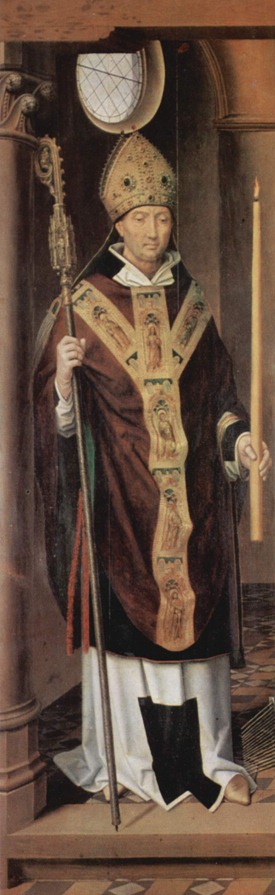
St. Blase was the bishop of Sebastea in Armenia, now Turkey, and a martyr of the early 4th century. Blaise was born into a wealthy family and was consecrated bishop a ta young age. Not long after his consecration, Christian persecutions reached Armenia, and Blaise was forced into the mountains with many other Christians to escape death. Very little is known of him, apart from the his Vita of the eighth or ninth century. He was known to Christians to have healed humans and animals alike; the most remembered cure being his healing of a boy with a fish-bone caught in his throat. After being healed, the boy often brought food and candles to the cave where Blaise was hiding and later to the jail where he would be held captive. This is why he is invoked against any kind of throat illnesses, and on St. Blaise's day, it is not uncommon for churches to bless peoples throats with two crossed candles.
     Blaise is a martyr, for in 316 he was captured by the Roman governor, recognized as a Christian bishop, and sentenced to death. Blaise was tortured with wool-combs before being beheaded, which is why he was patronized by the 19th century English wool industry. And like all martyrs, Blaise's example shows us how in the face of exclusion, mockery and accusation, we should never hide our faith in Christ from others, to follow and preach what we know is right unto death.
     His cult in the middle ages spread all over Europe as he was among the 'Fourteen Holy Helpers,' a cult of several saints, mostly martyrs, associated with healing qualities which arose after the disastrous black death in the 1340s. Churches as far as Canterbury claimed relics (although Canterbury claimed a great variety of relics) and there is a pilgrimage church in Bavaria, Germany, Basilica Vierzehnheiligen, where the saints appeared to a young monastic. Blaise continues to be venerated as a saint in the Anglican, Orthodox, Armenian, and Roman churches, where thousands of throats are yearly blessed in his remembrance. Today the Church of Dubrovnik, in Croatia, claims his relics and holds a pilgrimage each year on this day. He is usually depicted in episcopal vestments with candles and a wool comb.

Collect (From the Anglican Missal):
Almighty God, who didst call Blase to be a faithful pastor and servant of thy people, and to lay down his life in witness to thy Son: Grant that we, strengthened by his example and aided by his prayers, may in times of trial and persecution remain steadfast in faith and endurance, for the sake of him who laid down his life for us all, Jesus Christ our Savior; who liveth and reigneth with thee and the Holy Spirit, one God, for ever and ever. Amen.

Thursday, February 2, 2012

The Presentation of Our Lord in the Temple and the Purification of the Blessed Virgin Mary: Commonly called Candlemass, February 2.

Probably from as missal or Breviary for the Presentation. The Song of Simeon, Nunc  Dimittis, can be  read beneath the picture. 
Candlemass is a double feast and ranks with the Transfiguration and Ascension as a feast day. The feast celebrates the presentation of Jesus at the Temple in Jerusalem 40 days after we celebrate his birth. The tradition of blessing candles developed in the Middle Ages and collects for the blessing can be found in such sources as old as the Benedictional of St. Ethelwold, a book of episcopal blessings from Winchester, where Ethelwold was bishop in the 10th century. The Presentation celebrates when Mary and Joseph went to the Temple of Solomon at Jerusalem to have a common ritual in which Mary was purified after childbirth, and Jesus was subjected to the redemption of the first born in the form of a sacrifice of two pigeons or doves. Some Orthodox Jews still perform a similar ceremony, as it was a widespread tradition in Roman Judea. There were two special witnesses to the Presentation, one called Simeon, who had heard that he would not die until he saw the messiah, and the other Anna, a prophetess. Both spoke to the people in the Temple upon seeing Jesus on how he would bring about the redemption of Israel.


 The Song of Simeon, who was present at the Presentation, comes from Luke's gospel and is know as the Nunc Dimittis in Latin. Simeon said he would not die until he had seen the Messiah and so the Nunc is as follows from the Book of Common Prayer:

Lord, Now lettest thou thy servant depart in peace according to thy word.
For mine eyes have seen thy salvation,
Which thou has prepared before the face of all people 
To be a light to lighten the Gentils and to be the Glory of thy people, Israel.

Several Anglican/Episcopal Parishes use the Sarum Rite for the celebration of Candlemass. Here, the Church of St. Thomas of Canterbury, Toronto, uses the Sarum Rite for Candlemass. Notice the blessing of the candles near the beginning of the mass. The Sarum collect is as follows and is very similar to that of our Books of Common Prayer:

Almighty and Everlasting God, we humbly beseech Thy Majesty that, as Thy Only Begotten Son was this day presented in the Temple in the substance of flesh, so we may be presented to thee with pure heart. Through Jesus Christ Our Lord, who with Thee and the Holy Spirit, liveth and reigneth, One God, now and forever, Amen.

The actual blessing of the candles is very long (three pages of solid text in my missal, so I will not type it here. But of additional interest is the use of the 'Sarum bow' instead of genuflection. Even at the elevation of the host, the most important part of the Eucharist, the celebrant takes a deep bow after the words of institution.


The proper for Candlemass does not come from the bible, which is unusual, rather it comes from the writings of either Sts. Ambrose or Augustine, if not one of the other Church Fathers. This is not the proper from the Sarum Rite. Here's the text:

Senes Puerum Portabat            The old man was carrying the Child
puer autem senem regebat.       but it was the child who was guiding the man. 

And Tomas Luis de Victoria's beautiful rendition of it by the University of Malaga:
Candlemass, as it came to be called from the tradition of blessing candles, is the direct ancestor of Groundhog Day. Candlemass was a day for determining the weather for the coming months in several countries. Several Medieval poems link the patterns of the actual day of Candlemass to the coming weeks. According to this English poem;
"If Candlemass be fair and bright, 
Come, Winter, have another flight; 
If Candlemass brings clouds and rain, 
Go Winter, and come not again."
The situation is the same as Groundhog Day! If the day is sunny (so that the groundhog sees his shadow) then winter is not over, but if it is cloudy (so that he does not see his shadow) then spring is soon to come.


Church of St. Mary the Virgin, NYC, Candlemass 2012.


Sunday, January 29, 2012

King Charles the Martyr, 30 January.

St. Charles is often depicted rejecting his crown of state for a crown of thorns.
BCP Calendar with St. Charles
Charles I of England is known to many Anglicans, mostly in the Church of England, as a martyr because he protected the Church from being separated from its ancient roots. He died partially because, the Calvinist Puritans who captured him wanted him to remove episcopacy, the apostolic line of bishops, from the Church in England and completely cut it off from from the One Holy Catholic and Apostolic Church that it was. He refused to replace the ancient faith of the Church with a new version, the Calvinism advocated by Puritans even if it meant his death.
     Charles was born in 1600, son of King James VII of Scotland and Anne of Denmark. He became Prince of Wales in 1603 at the Union of the Crowns when James became James I of England also. It was during James's rein that the Church of England began to re-establish high-church elements within the Anglican tradition. But at the same time a low-church faction within the church, known as the Puritans. Succeeding Archbishops of Canterbury and other Church of England bishops re-emphasized liturgical ceremonies and the decorating of churches with religious iconography. Puritans however were opposed to any sort of decoration and even called for the re-organisation of the church hierarchy through dismissing the historic episcopate. Charles succeeded to the throne in 1625 and later appointed William Laud, previously a bishop of St. Davids, Wells and London, to the see of Canterbury. Laud was a firm supporter of the high-church argument in the Church and was opposed to Calvinism. Laud and Charles carried out a number of reforms in the Church based on retaining it's catholicity. Both men with much of England's support battled against Puritans and Presbyterians, insisting upon episcopacy, and the following of the Book of Common Prayer, which called for a high-church liturgy. The Puritan vs. Royalist debate turned into civil war in 1640s after Laud tried to impose a new Prayer Book on the rebellious Scottish Calvinists and England's Puritan's too feared that he would suppress their voice in the Church. When it came to an end, King Charles was captured and condemned to death by a Puritan parliament. He was offered his life, and even his throne if he would consent to the destruction of the historic episcopate but refused. Destroying the Episcopate would have made the Church of England into a sect, rather than a part of apostolic succession and of Christ's Church. On January 30, 1649 Charles was beheaded, and since recognized as a martyr as he died for the survival of the Church of England, canonized, and added to the Book of Common Prayer as a major feast after the restoration. His cult has survived since his death, known as the Society of King Charles the Martyr.

One of the many problems troubling the Church, including the Catholic, Anglican and Orthodox Churches, is unity. Unity is presented as crucial to Christ's Church because it wipes away the face of hatred or contempt within that holy institution. Charles the martyred king, though not the more typical, self humbling saint found on this blog, is a focal point for that unity and reminds us of the importance of the oneness of the Church descended from Christ's work while he visited us 2000 years ago and glued to him, to doing that work today. The one and ancient liturgy used by the Church, the one and ancient episcopal polity of the Church, the one and ancient faith of the Church should not contradict the one, ancient, ever-living and ever-saving savior, Christ, who is the Church. For the Church to spread the one true faith of the one God, we must be one, united body.

Collect (adapted from the "Festivals and Lesser Festivals of the Church of England").
King of kings and Lord of lords, whose faithful servant Charles prayed for those who persecuted him and died in the living hope of your eternal kingdom: grant us so to follow his example that we may love and bless our enemies and celebrate the and spread the one good news together, through the intercession of your Son, Jesus Christ, who is alive and reigns with you in the unity of the Holy Spirit, one God, now and forever. Amen.

Church Unity: The First Council of Nicaea. 

Saturday, January 14, 2012

Feast, January 12; St Aelred of Rievaulx

Cistercian power: Rievaulx Abbey

     Aelred was born the son of a priest in 1110, in the Northumbrian town of Hexham. He was for a while a high-ranking official in the court of King David I of Scotland. David endorsed several monasteries in Scotland during his reign and is himself considered a saint. Aelred left Scotland in 1134 to join the quickly growing Cistercian foundation at Rievaulx in northern Yorkshire, deeply inspired by their austerity and isolation. Rievaulx was one of the greatest Cistercian abbeys in England with many acres of farmland, used mainly for sheep grazing, and several hundred brothers and lay brothers. Aelred was Abbot at a Lincolnshire house before he was invited back to Rievaulx to be abbot there. He is known primarily as a historian of English saints, especially those from the north, and of certain royal lines. As a high-ranking ecclesiastic in the north of England, where the cult of saints had been ingrained in local culture since the 7th century, it is not surprising that he recognized the importance of having scholarly hagiographies where the exact details of their holy lives could be recorded and preserved before it was too late. We could perhaps say then that he is the "William of Malmsbury" of 12th century Northumbria. Among his books include "The Life of St. Ninian", "The Life of St. Edward the Confessor" (his most famous), and "The Lives of the Saints of the Church at Hexham." His equally devotional works, "The Mirror of Charity," "Pastoral Prayer," and "On Spiritual  Friendship," explore  Christian love as exemplified by Christ and the significance of maintaining a devoted and saturated relationship with God in a monastic community.
     St. Aelred died on 12 January 1167 and was buried in the chapter house of Rievaulx Abbey, from which his relics were later translated into the church. He was never formally canonized as the custom of Papal canonization was not yet clear in that part of the country (as it is in the Orthodox churches). But his cult was known in England and in French Cistercian communities as a saint.

Ruins of Rievaulx Abbey quire.
     St. Aelred still urges us to use fasting and self-denial as a form of religious devotion and as a way to grow closer to Christ. What better way than living and loving like he did? Local saints were very important to St. Aelred and the Church of his time; today, the significance of patron and local "saints" has increased because it they are a way for Christians to connect to Christ with a human example and leader who they can personally and physically reflect upon an consult. As for Aelred's thought's on the religious life, a life fully dedicated to the work of Christ can be lived both within and without of the cloister. Aelred discouraged the religious he instructed, which included monks, nuns and anchorites, from growing attached to certain objects or developing preferences for foods. Though I am certainly not suggesting to give up ice cream forever, a conscientiously more austere life with a focus on service and community points back in the direction of Christ's life and that of his disciples. The Church through its bishops and priests should encourage parishioners to follow variations of a "home-rule" which would include daily prayer and periodic fasting with food as well as with spending. Thus the intimacy of the Church's communities would increase with Christian observance that seeped into more than just the Sunday dimension of people's lives and experience of Christ.

Collect (From the Episcopal Church):
Almighty God, you endowed the abbot Aelred with the gift of Christian friendship and the wisdom to lead others in the way of holiness: Grant to your people that same spirit of mutual affection, that, in loving one another, we may know the love of Christ and rejoice in the gift of your eternal goodness; through the same Jesus Christ our Savior, who lives and reigns with you and the Holy Spirit, one God, now and for ever. Amen.

Wednesday, November 23, 2011

November 17; St. Hugh of Lincoln

Icon of St. Hugh in Lincoln Cathedral with the swan that was known to follow him around.

St. Hugh was born at Avalon, France around 1140. A son of the Lord of Avalon, Hugh entered a Carthusian abbey at an early age. He made his way up in the order, eventually becoming a priest and the procurator of the Grand Chartreuse, the mother house of the order. In 1179, Hugh traveled to Dorset to fill the post as Prior of the first Carthusian House in England. Upon arriving at the newly chartered abbey in Witham, he found the land given by the king, Henry II unimproved. Hugh worked to get the Henry II to support the establishment. His relationship with Henry caused him to unveil problems with the English church. Henry had been keeping diocese vacant to draw the diosesan income into the royal treasuries. Hugh pushed for reform and Henry agreed to let elections proceed to fill the vacant sees. In 1186 the chapter of Lincoln Cathedral twice elected Hugh to be Bishop. After his consecration in Westminster he quickly established his own power separate from the king. Hugh was know n to be charitable to all in his diocese of which he kept constant supervision. He raised the standard of education at his own cathedral and protected the Jews from persecution. He rebuilt Lincoln Cathedral in the gothic style. He died in 1200 and was buried in the cathedral. he was canonized only 20 years later.

Saturday, October 29, 2011

October 28, Feast of Sts. Simon and Jude

Le Martyre de Saint Simon et Saint Jude. French medieval illumination.

Jude, or Jude Thaddeus, was one of the original twelve apostles of Jesus. His mother, Mary, is known as as a sister of the Blessed Virgin Mary. After the Pentecost, Jude brought the gospel to the Armenians along with St. Bartholomew after preaching in Judea and Syria. Simon, to be distinguished from Simon-Peter, but also one of the twelve, evangelized in Egypt and in other parts of northern and eastern Africa, where he became known to the Berbers. He then made his way back to Judea and into Syria. In A.D. 65 both St. Simon and St. Jude were martyred in the roman city of Beirut.

Monday, October 17, 2011

October 17; Feast of St. Etheldreda, Abbes of Ely

Stained Glass of Etheldreda holding her church at Ely

St. Etheldreda was born around the Fenlands in of Mercia and East Anglia in 636. She married King Tondberct of the Fens early on but remained chaste. He presented Etheldreda with the Isle of Ely, to which she retired after hi death. She was, however, remarried to Ecgfrith, King of the Northumbrians but soon ran away to become a nun. Ecgfrith was not going to let her get away, so he pursued her. But when Etheldreda heard of his intent, she quickly fled back to the Isle of Ely where she established a double monastery. When King Ecgfrith finally arrived the sea became rough and a storm came off the North Sea so that he was unable to cross to the isle. Etheldreda was left in peace and continued to expand an build up the Monastery at Ely. When she died she was remembered as a holy person, and she was buried in a white marble tomb. Ely Cathedral became a great center of pilgrimage in the middle ages as hundreds flocked to her shrine. She still lies in Ely although the shrine was destroyed and Ely Cathedral remains a holy place for this purpose.

Friday, October 14, 2011

October 15; St. Teresa of Avila

Bernini's St. Teresa in Ecstasy. 
St. Teresa was a Carmelite nun born in 1515 outside the Castilian city of Avila. Her Grandfather was a Jew making her family converts. As a child Teresa was inspired by the faith of the saints particularly martyrs and at age seven, trying to escape to the Moorish lands, was eager to display the same faith along with her older brother. She quickly returned to Avila, however, and became a nun in a Carmelite convent. There she came down with an illness which increased her faith and she became penitent. What followed was a series of visions culminating in an appearance of Christ him self. She recorded the experience writing,

"I saw in his hand a long spear of gold, and at the iron’s point there seemed to be a little fire. He appeared to me to be thrusting it at times into my heart, and to pierce my very entrails; when he drew it out, he seemed to draw them out also, and to leave me all on fire with a great love of God. The pain was so great, that it made me moan; and yet so surpassing was the sweetness of this excessive pain, that I could not wish to be rid of it..."

Teresa spent much of the rest of her life writing several books on theological subjects, including prayer, aestheticism, mysticism, and the soul, all in reaction to her visions. Her new thinking lead her to push reform for the Carmelite Order in Spain. She began to establish new monasteries under a rule even more strict than the regular rule. The first of such monasteries was the convent of San Jose in Avila, its members taking a vow of absolute, apostolic poverty. They lived among and for the poor, and since they were shoe-less  they came to be known as the "Discalced Carmelites." Throughout the 1560s, Teresa was granted permission to spread her order, which was unpopular because of its renunciation of property, not only on an individual basis but on a communal basis. Teresa, joined by another mystic, St. John of the Cross, traveled all over Spain and established monasteries for both men and women. The last of her seventeen convents was the Convent of the Annunciation in Alba de Torres, where she also spent time on writing about her visions and revelations before her death. 

The example that St. Teresa has left for the Church is essential to the Church's mission; to its likeness to Christ. It is the willingness of people like Teresa to live to help other, dedicating their lives to do Christ's work, that helps carry the Church from generation to generation. The Church is the body of Christ, and therefore its actions must be as true to Christ's actions as the human condition permits. St. Teresa's mission embodies a reciprocal relationship: the Church's duty is to draw people under its protective wing, in doing so it must comfort them with the saving words of Christ, and in doing that it draws them into his body; the Church. 

Merciful God, who by your spirit raised up your servant Teresa of Avila to reveal to your Church the way of perfection: grant that her teaching may awaken in us a longing for holiness, until we attain to the perfect union of love in Jesus Christ your Son our Lord, who is alive and reigns with you in the unity of the Holy Spirit, one God, now and forever. Amen

-Festivals and Lesser Festivals of the Church of England. 

In just 2008, the first Carmelite convent in the Episcopal Church was established in Rising Sun Maryland. The Convent is dedicated as The Episcopal Carmel of St. Teresa of Avila. It is a growing community, and it serves as a first for a hopeful revival in the Anglican Church for the religious life, dedicated to the work of Christ and prayer for our Church and our world. 

October 13th; Feast of St. Edward the Confessor

Medieval manuscript showing pilgrims at St. Edward's shrine.

St. Edward lived from about 1005 to 1066 and was the last great Saxon King. He was the son of Ethelred Unread and Emma of Normandy distantly relating him to Duke William of Normandy. Growing up in the disruption of his father's turbulent reign and enduring the last stretch of viking attacks with the occupation by King Canute of Denmark, Edward grew up to be very faithful in belief and in his actions as king. He endowed and rebuilt an abbey at what was then called Thorny Island and called the church the "West Minster" because it was west of London. There are several miracles associated with Edward, the most famous being that he came across a beggar out side a church dedicated to St. John the Evangelist, Edward presented his ring to him after he asked for alms. Yet  later the ring was presented back to some pilgrims traveling in the Holy Land by a man claiming to be St. John. The man asked them to return the ring to Edward and to tell him that they would be meeting in 6-months time. Edward died 6 months later on January 5, 1066. He was buried in his church at Westminster where his relics remain enshrined in the medieval tomb.

St. Edward the Confessor reminds us, along with other pious kings such as St. Louis or St. Henry II, that no matter how well known we are, how high profile our lives or jobs may be it is important that we outwardly confess our faith just as much as we inwardly practice it. These kings lived in a society where a pious leader was admired, but their positions also tested their faith. We now live in a time where it can be, in some cases, 'unpopular' to be openly Christian, and that religion should be restrained to one's private life. But the Christian faith was not meant to be hidden or private, and it has certainly suffered times where it was 'unpopular' before. We must then, as St. Edward did, live our lives, both private and public, ever-mindful of Christ and our faith in him.

Thursday, October 13, 2011

October 12th, Feast of St. Wilfrid of York

Stained glass in Chichester Cathedral, depicting St. Wilfrid

St. Wilfrid was born in the kingdom of Northumbria in 633. After becoming a monk at Lindisfarne, he traveled around studying in different ecclesiastical centers in England and the continent. He returned to Northumbria establishing  a monastery Ripon, now a Cathedral, and argued for the Roman rites and calculations of Easter at the controversial Synod of Whitby causing much distress among the Celtic Church which had been taken on in the north of the Kingdom and accepted by the royal family. Eventually the roman side won, and many of the Celtic monks at Lindisfarne returned to Iona from whence they had been called by King Oswald. Wilfrid was rewarded for his argument at the synod and appointed to the episcopal see of York. As the premier bishop of Northumbria he had jurisdiction over the other northern bishoprics. Wilfrid left to be consecrated in Gaul but did not return for several years and as a result St. Cedda of Lichfield was installed as the Bishop. He was more concerned about the state of the diocese, but when Wilfrid returned Cedda was deposed and returned to be bishop of Lichfield. Be for Wilfrid's death in 709, he established another monastery at Hexham, which became a bishopric under the supervision of St. Theodore of Canterbury. The holiness of Wilfrid is often disputed, many think that his argument during the Synod of Whitby was not genuine; that his reason for canceling the rites of the Celtic Church was really an impetus for power, which he later revived as Bishop of York. Even as Bishop, however, Wilfrid seemed to neglect his diocese and recognize it only as a title.

Tuesday, September 20, 2011

Feast, September 19; Theodore of Tarsus

St. Theodore of Canterbury.
St. Theodore, also known as Theodoric of Canterbury, was born an Asiatic Greek in 602. He studied as a scholar for part of his life in Athens and was known well in the church even though he was only a sub-deacon.
After meeting with the patriarch Vitalian in Rome he was appointed Archbishop of Canterbury. Upon his arrival in 669 he made a whole tour of Anglo-Saxon England, after which he called together the synod of Hertford, one of the most important synods in English Church History. In this council the Church approved of particular reforms that applied to the division of diocese, the power of diocesan bishops, and the governing of the monastic settlements. Theodore greatly rearranged the Saxon church at this time adding, dividing, and defining diocese. He participated several other synods, including the controversial synod at Whitby. He established many monastic foundations and ecclisiastical schools, and died on 19 September, 690.

Friday, September 16, 2011

Feast, September 16; St. Ninian

     Pilgrim's cross, carved into rock inside St. Ninian's Cave.
Ninian often went there to pray alone in retreat.
   
     Saint Ninian, Known as the first apostle to the Picts, was born in the 360s in the Galloway area, just north of Hadrian's wall, and therefore outside of Roman jurisdiction. he was born the son of a minor British king, but devoted his time to reading and studying the scriptures, consistently educating himself. Christ's choosing of Peter as the "rock I will build my church" upon particularly grasped Ninian. and in an effort to continue his education he set out across Britain and Gaul where he came to Rome. There he pursued his education with the pope Damasus.
     But Damasus's successor to the papacy, Siricus after learning that Scotland had not yet been exposed to the gospel, consecrated Ninian, sending him to be their missionary and bishop. On his way back, Ninian stopped once again in Gaul where he met St. Martin of Tours. As he reached his missionary diocese he began building Scotland first stone church at Whithern. And upon the news of St. Martin's death, Ninian dedicated it in honor of Tours' great bishop. The Church was made of white stone and would be known as the Candida Casa or Whitehouse for centuries to come. It came to be the center of ecclesiastical training for Scotland, northern England, and Ninian missions in Ireland, and remained so for a few centuries. But it's importance dwindled as missions in Ireland and Scotland came after Ninian. Ninian is attributed for the conversion of the southern Picts, Scotland's Britons, and some of Irish. He set up dioceses, establishing monasteries and churches and turned Whithern into a great center of Christian learning. Ninian died in the fifth century, and his relics were kept enshrined in the Candida Casa at Whithern until the reformation, when cathedrals were pulled down and art destroyed by Christian pretenders. His cult has been restored in the Anglican Communion and many churches in the Scottish Episcopal Church have been dedicated to him, including the cathedral at Perth.

Ninian remains important to us today for his missionary zeal; his willingness to travel to some of Scotland's unforgiving peoples and joyfully bring them the good news of Christ. The Church must must continue today, Ninian's work to bring the faith to new lands and maybe more importantly to re-evangelize in lands like Scotland, or England, France, the United States and may other countries that have known Christ for a long time but that have lapsed in the faith.

OGOD, who by the preaching of thy blessed servant Saint Ninian didst cause the light of the Gospel to shine in Scotland; Grant, we beseech thee, that having his life and labours in remembrance, we may shew forth our thankfulness unto thee for the same by following the example of his zeal and patience in continuing to spread this light; through Jesus Christ our Lord.Amen.

References from St. Columba and Iona, the Early History of the Christian Church in Scotland, by Alphons Bellesheim.

Tuesday, September 13, 2011

Feast, September 14; Holy Cross Day

The feast of the Holy Cross is the designated day for the veneration of the True Cross. This feast was actually started because the consecration of the Emperor Constantine's great Jerusalem Church of the Resurrection (more widely known as the Church of the Holy Sepulcher) took place on this day in the year 335. The church is built over what is believed to be the Hill of Golgotha and the Holy Sepulcher. Both of which were uncovered when St. Helen, the mother of Constantine, lead an excavation in Jerusalem and also found large fragment of the True Cross. Above is the dome of the Church of the Holy Sepulcher in Jerusalem, the dome  houses the garden tomb and high altar.

Feast, September 13; Cyprian of Carthage

St. Cyprian of Carthage.
St. Cyprian was born in Carthage around the year 200. In his early life he was a known aristocrat, and taught rhetoric until 245 when he converted to Christianity. Just two years later he was elected as the bishop of Carthage writing several treatises, books while continuing to preach the gospel. Some of his subjects included the Lord's Prayer where he says that we say 'Hallowed be thy Name' because we desire that his name be made holy within us and that we may continue what we have been made through baptism (Lesser Feasts and Fasts). He also wrote on the importance of episcopacy, and many of his works survive. He went into hiding during the persecutions under the Emperor Decius, but continued to rule his church in secret. It was during the second persecution that he endured, when he was captured in Carthage an put to death on September 14th, 258.

Thursday, September 8, 2011

September 8th; Feasts of the Nativity of the Blessed Virgin Mary, and St. Ethelburga of Kent

The Nativity of the Blessed Virgin Mary has been celebrated on this day since Pope Sergius I introduced it to the calendar in the 7th century. Daughter to Sts. Anne and Jochim, Mary birth was an omen of the coming of Christ, though no one knew it at the time. All that is written of it is strictly apocryphal, but it was told by one of the 12 disciples - possibly St. James the Greater.

 Birth of the Virgin Mary.

St. Mary and St. Ethelburga's church at Lyminge.

St. Ethelburga, who's feast is also celebrated today, was the daughter of the converted Christian king, St. Ethelbert of Kent. She originally was married to St. Edwin, King of Northumbria, but after his death resulting from the Mercian pagan attacks she fled with Paulinus, Archbishop of York, back to Kent. She then founded a convent at Lyminge, where she, as abbes, dedicated the rest of her life to the work of the Lord. Her relics were venerated until the dissolution of the monasteries in Canterbury.

Feast, September 3rd; Gregory the Great

St. Gregory blessing St. Ethelbert, King of Kent.
(He is often depicted with the dove and the book)

Gregory was born in Rome in the 540s, and his first career was actually the prefect of Rome in573, after-which he took vows and became a monk. He worked for Pope Pelagius, and it was during this time that he came across some slaves in the markets at Marseilles and was told they were angles from Britain, and were not Christians. He bought the slaves, hoping to lead a mission their himself. Instead he was elected pope, succeeding Pelagius to the papacy in the year 590. Soon after he became pope, however, he sent Augustine, a monk of his own monastery, other monks, and the freed Angle slaves, to convert the Anglo-Saxons invading Christian Britain. In doing this Christianity would be restored to what is now England. Bede credits St. Gregory as he does Augustine as an Apostle to the English.