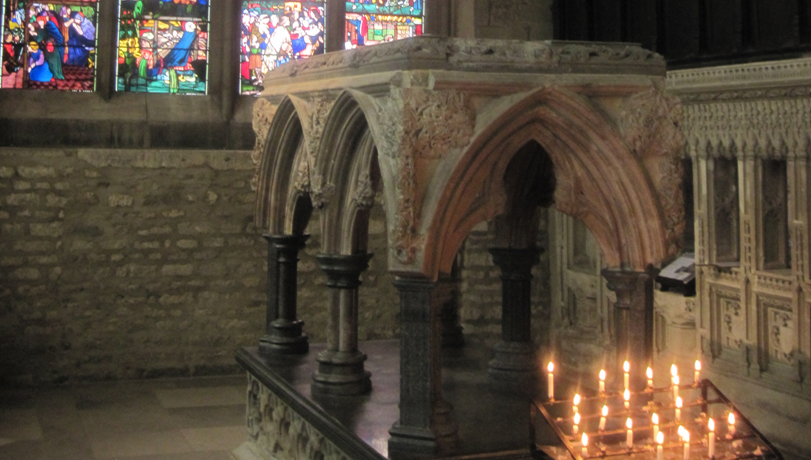
Shrine of St. Frideswide, Christ Church Cathedral Oxford.

Wednesday, February 13, 2013

Anglican Eucharistic Theology: Essentially Compliant with both High and Low-Church Traditions.


     A topic much discussed and argued over, this is more of a reflection on my struggle to find what the Eucharist is to me as a devoted, orthodox Anglican -I am glad if it helps others who are also looking for an explanation. I am not a theologian, trying to define Eucharistic theology, but a layman, trying to uncover it for my own beliefs. I must say that before I begin writing on this much debated subject that I am personally drawn to the Orthodox way of looking at the Eucharist as the 'Holy Mysteries' this solves a lot of problems the worst of which being that we quarrel over the Eucharist, a gift from Christ, at all. 
     What I have read over the past days and months has allowed me to view the celebration of the Eucharist in Christian worship as both a sacrifice of the Body and Blood of Christ and as a memorial. I will argue that there is discrepancy between the medieval, Roman Catholic term transubstantiation and the proud and unchristian followers of the destructive reformation in Switzerland and Germany, but that there should be no discrepancy between the high and low church visions of the Eucharist within the Anglican Church.
     First,  I will establish the Anglican Church's position within Christianity. The Anglican Church is different in many ways from other Protestants -it should not really be labeled as such. These included its organization, its initial intentions for reform and what little doctrine it does have. It's reformation, as Matthew Parker, Archbishop of Canterbury under Queen Elizabeth, expressed it, was more like the African or Oriental Orthodox Church, which split from the rest of the Church in its refusal to recognize the Council of Chalcedon in 451 in its attempt to become more like the primitive Church. This is why Anglicanism retains episcopacy, its succession from the apostles, and the Eucharist as its main worship unlike other protestant churches which protest even the primitive Church -and thus almost all of historical Christianity, by rejecting the Eucharist as main worship and by rejecting episcopacy. Anglicanism's attempt to stick to the Christianity of the early Church is reflected in its use of the creeds as its main, if not only universal source of doctrine outside the Bible and Book of Common Prayer.
     So the Anglican Church is one of the four ancient Christian Churches, the other three being the Roman Catholic, Eastern Orthodox and Oriental Orthodox churches. But what of it's worship?
     By the 14th and 15th centuries, the belief of the Church was of transubstantiation in the Eucharist -the chemical change of the bread and wine to the Body and Blood of Christ. But this was a misinterpretation of the use of the word transubstantiation by the so famous theologian and Doctor of the Church, St. Thomas Aquinas. It seems that the understanding of the word 'substance' in transubstantiation came to mean something other than that which was written by church doctors. Tyndale puts it this way:

"As concernyng the transsubstanciatyon I thinke that such a speche was among the olde doctours though they that came after vnderstode them amysse."
-From the OED definition of the word 'transubstantiation,'

     Anglicans wanted to restore the meaning and worship in the Eucharist back to its stance in the early middle ages, to clear out the 'superstition,' a favorite of   English reformers, from the worship of Christ. They were not like the iconoclasts in Switzerland who tore up and trampled upon the Blessed Sacrament- never among the English- but they did not want people to view the sacrament as a literal piece of Christ's flesh that, then, could heal and restore anyone or thing from a saint to an unrepentant sinner to livestock. Today we cannot see the Eucharist in these ways either. We cannot say that the bread and wine are chemically changed into Christ's Flesh. It all goes back to the misinterpretation of the word transubstantiation. 'Trans' of course mean 'change,' but substance is where things get confused. In Latin, it literally means below the surface, inwardly. In medieval literature, the word substantially is used to describe the togetherness of the Holy Trinity:

"He herd angels steuen And seiȝe Fader and Sone and Holi Gost In on substaunce, in on acost." 
-From the OED.

Just as the Trinity is not of one material but Three Persons of once substance or essence, the Blessed Sacrament is the Body of Christ in essence. This is how Cranmer, the first reformation Archbishop of Canterbury, explained the Blessed Sacrament:

"The true Body of Christ is present to those who truly receive him. Inwardly we eat Christ's body; outwardly we eat the Sacrament. Yet the Body of Christ is in the Sacrament both by substance and by efficacy."

This is the definition of the Church Fathers of the early Church so this is why Cranmer insists that this be the definition of the Eucharist for the continuing Anglican Church. Cranmer clearly states that Christ is present in the Eucharist. But he is trying to say that at the same time that the Eucharist is substantially, or in essence, the body of Christ but is not chemically flesh. It is also the body of Christ in efficacy -or potency, the consecrated Eucharist is no longer 'just bread;' it is the body of Christ in essence. But he is also saying that Christ is present only to those who truly accept him, the sacrament is no use to a person who does not have faith.
      Similarly, John Donne, the beloved 17th century poet and dean of St. Paul's Cathedral, took the view of the Blessed Sacrament based on the writings of the Church Fathers and of Cranmer and supported it drawing directly from the Gospel of John. He explains this in his poem Divine Poems: on the Sacrament:

"He was the Word, that spake it:
He took the bread and brake it;
And what that Word did make it,
I do believe and take it."

     If more 'Low Church' Anglicans prefer doctrine based solely on scripture then John Donne gives us a direct explanation based on scripture in support of Cranmer's and the Church Fathers' version of Transubstantiation.
     On this note, Anglican Eucharistic doctrine is clearly defined by the first of the Anglican Church's great theologians (Cranmer) while it is also scripturally supported. Doctrine on the nature of the Eucharist should not be disputed between the Anglican High and Low Church traditions. The consecrated bread and wine is in essence the Body and Blood just as the Trinity is in essence one being. The superstition of the later middle ages is cut out with the fact that there is no chemical change in the Eucharist, only an essential one. High church Anglicans may say that the 'Mass is a Sacrifice,' while low church Anglicans may say that it is only a 'memorial.' My answer to this is, based on Cranmer's definition of the Eucharist, that the Mass is both a sacrifice and a memorial. It is a sacrifice in the way that it is a meal which we have all gathered at and that this is the Body of Christ sacrificed for those who believe in him. But it is not a repeat of the Crucifixion, the ultimate sacrifice, it is a memorial of the Crucifixion. Christ has already died, risen and ascended to heaven so the sacrifice of the Eucharist recalls his Body and Blood in a memorial of these things.
     High and low church Anglican definitions of the Eucharist can be one. The Mass is a sacrifice -the Body and Blood of Christ is recalled by the priest essentially in the sacrament of bread and wine, and a memorial -Jesus Christ has already sacrificed himself on the cross and risen from the dead. This definition is in accordance with the holy tradition of the One Holy Catholic and Apostolic Church from primitive times and with the theology of the Anglican reformers, namely with the explanation of St. Thomas Cranmer.

But I still think that the best way to see the Eucharist is to see it as a Holy Mystery and not to let ourselves become mixed up in the politics that we have created over the gift that is still Holy whatever we decide.


Thursday, February 7, 2013

Liturgical Tropes: Medieval Filler or Helpful Interpretations?

Ecce Homo: 'Behold the Man.' Sarum gradual chant.
I've been looking at the definitions and use of tropes and sequences particularly in the Sarum Mass. In this Post, I will discuss the function and history of sequences and tropes and how the latter could be , in a modified form, useful in our own, modern liturgies.
     Both sequences and tropes were 'discontinued' in the Book of Common Prayer of the Anglican Church and completely abolished in the Roman Church's Council of Trent, save the Victimae Pascale of Easter, the Veni Sancte Spiritus of Pentecost, the Lauda Sion Salvatorem and the Dies Irae of the Requiem. The Sarum Rite and other ancient rites contained many more sequences than these, one for most of the numerous feasts of the medieval liturgical calendar. 
     Sequences are very similar to hymns, but were sung just before the chanted Gospel Alleluia which had grown so long as to permit each of the clergy to kiss the Gospel book. Sequences are typically joyful and always hymns of praise and awe -fitting with the last syllable of the Alleluia which had evolved into a joyful melisma. 
     Tropes were insertions of text and/or pieces of chant to lengthen or interpret the text being sung. For example, at Salisbury, home of the Sarum Rite, tropes containing just adding the name of the Blessed Virgin Mary, the patron of the cathedral, were inserted into the Gloria in important feasts to embellish the liturgy. Here is an excerpt from the Sarum Gloria where the tropes (italicized) act similarly to clauses.

Sarum Gloria:
"For thou art only holy, sanctifying Mary;
Thou only art the Lord, ruling Mary;
Thou only, crowning Mary, Jesus Christ with the Holy Spirit...."

The Sarum Kyries also use tropes.Instead of addressing just "Lord" and "Christ," a petition for the Holy Spirit is added to emphasized the doctrine of the Trinity. Additionally, tropes are added into each petition to embellish the Kyrie. The well-known "Orbis Factor is one of the Sarum Kyries, though this one addresses the Holy Spirit only at the very end, and is mainly made up of tropes. 

Orbis Factor:
Orbis factor rex aeterne, eleison
Pietatis fons immense, eleison

Noxas omnes nostras pelle, eleison
Christe qui lux es mundi dator vitae, eleison
Arte laesos daemonis intuere, eleison
Conservans te credentes confirmansque, eleison
Patrem tuum teque flamen utrorumque, eleison
Deum scimus unum atque trinum esse, eleison
Clemens nobis adsis paraclite ut vivamus in te, eleison.


Maker of the world, King eternal, have mercy upon us.
O immense source of pity, have mercy upon us.
Drive off all our evils, have mercy upon us.
Christ who art the light of the world and giver of life, have mercy upon us.
Consider the wounds produced by the devil's art, have mercy upon us.
Keeping and confirming thy believers, have mercy upon us.
Thou and thy Father, an equal light, have mercy upon us.
We know that God is one and three, have mercy upon us.
Thou, merciful unto us, art present with the Holy Spirit that we might live in thee, have mercy upon us.


Compare this with the origional, untroped, much simpler, three-fold
Lord have mercy
Christ have mercy
Lord have mercy.
...and now you can see just how much the tropes add.
below in the Orbis Factor, troped Kyrie as chanted from the Gradual of Eleanor of Brittany. 

Additionally, The Catholic Encyclopedia uses an French Sanctus as an example of troping:

Sanctus: ex quo sunt omnia                 Holy: from whom all are all things
Sanctus: per quem sunt omnia             Holy: through whom all are things
Sanctus: in quo sunt omnia, Dominus...Holy: In whom are all things, Lord...


Tropes could have a function in modern Liturgy.
Sarum Gloria: "Sanctifying Mary"
     Tropes could be found in many chanted texts to expand on the praise of God or of his saints or to explain Theology. While tropes were often added to the liturgy just as an extra filler in the liturgical stew, I see tropes as an opportunity to clarify and explain parts of our complex liturgies to the laity. Reviving tropes in prayers which are well known, perhaps too well known, could be particularly useful for the explanation of meaning which is otherwise overlooked because of the commonness of that prayer. 
     I am specifically referring to the Lord's Prayer. While reading former Bishop of Durham, N.T. Wright's "The Lord and his Prayer," which thoroughly explores the meaning and implications of each line of the Pater Noster, I thought, before I knew about troping, that it would be useful to add short clauses into the chanted prayer which concisely explain the meaning or add petition to the line. In reading about tropes, I found a precedent for this idea. While I don't know if the Pater Noster was ever troped, although the chant from the Abbey of Santo Domingo de Silos includes an Amen sung by the choir after each verse, the deep meanings of each line of so important a prayer should be relayed to the faithful during the service -and tropes are a perfect opportunity. The Lord's Prayer is, as Wright mentions, one of those prayers we recite without really reflecting on its meaning, and each verse is stacked with, as Wright explains, important implications for the mission of Christianity. Wright's "The Lord and his Praye" is an excellent book that all Christians should read...so I will not spoil it. 
     By adding a short trope to the end of each verse in the Our Father, the meaning of each line would be concisecly explained and the general importance of the prayer emphasized. After the  Our Fath, other parts of the mass, which many of us may participate in without much thought, such as the creeds ould also be troped not for the sake of embellishing the mass or restoring medieval customs, but for explaining the complex and important meanings behind the words in our liturgies. 


-Some more on the function and history of Tropes from "Oxford Bibliographies." 
Tropes
"Liturgical poetry, in the form of additional lyrics inserted into all the chants of the medieval Mass, flourished in the 9th through the 12th centuries. In a medieval Latin culture marked by intense interest in hermeneutics, even the Gregorian chants became a field open to extensive use of glosses and added verses performed together with the chant. The authors provided interpretations of the base texts in metaphors, images, or tropes, with the result that the grammatical term “trope” (Greek tropos, in Latin conversio or versus) came to be the name of the genre. Sung between the segments of a chant, the tropes could comment on and meditate over the preceding words of the chant, but they could also prepare for the performance of the words that followed. By means of these insertions, the chantor or compilator could vary the performance of a chant in endless ways while still maintaining the authorized form of the liturgical base chant. Extensive repertories were collected in manuscripts all over Europe. At first written on loose leaves or in the margins, they came to be inscribed into graduals and missals, and then gathered in individual manuscripts labeled “troparium” or “troparium-prosarium.” Because these manuscripts are the earliest witnesses of Western musical notation, or “neumes,” they have attracted many musical scholars as well. The oldest tropes must have been created well before the division of the Carolingian Empire in 843, because they are found in similar form both in East Frankish and West Frankish regions and in Lotharingia. In the following centuries, the repertories came to be divided into more or less separate regional traditions."

Saturday, January 19, 2013

Saint Wulfstan, Bishop of Worcester, 19 January.

St. Wulfstan of Worcester (watercolor of stained glass by myself)
Saint Wulfstan was a Saxon bishop of Worcester in the late 11th century who recognized the unimportance of the secular ruler in the context of his duties: to be spiritual shepherd  and whole comforter of the people entrusted to him as bishop. Wulfstan witnessed an ugly transition in the history of England: the transition from Saxon rule to the rough, oppressive Norman rule begun by William the Conqueror in 1066.

Born in 1008, Wulfstan began his career at Worcester as a monk in 1038 and then Prior of the Benedictine Cathedral Priory. When the bishop of Worcester, Ealdred, became Archbishop of York, Wulfstan was appointed the position which he reluctantly accepted like so many other saintly bishops (namely Sts. Cuthbert, Hugh and Peter of Tarentaise). After the conquest, Wulfstan submitted to William I and to his new Archbishop of Canterbury, Lanfranc, rather that risk his position (most other Saxon bishops were deposed) and thus his relationship to the people he led with great devotion and efficiency. Wulfstan incorporated the rules of his previous monastic life into his role as bishop, running his diocese, and sometimes others when they were vacant, as if he were following a rule. He designed a system for episcopal visitations (while many of his episcopal colleagues enjoyed their palaces), rebuilt Worcester Cathedral, consecrated numerous churches encouraged to be patronized by local lords, and was notorious for his charity and ministry to the poor and dispossessed. It was towards the end of his career that he cooperated with Lanfranc to end the capture and sale of English slaves at Bristol by Vikings. For his submission to the new regime and his passionate undertaking of the bishopric, he was trusted and valued by the first two Norman kings even though the court claimed he was unfit for his position as he could neither speak French and was "unlearned." Whether the latter was true or not (it probably wasn't as the Saxon Benedictines, like most others, were patrons of learning) his leadership, charity and devotion are ample evidence of his holiness. He died in 1095 while washing the feet of the local poor. He was the last surviving Saxon bishop when he died and was immediately venerated as a saint.

St. Wulfstan reminds us of the tentativeness, weakness and inhumanity of all human governments and regimes. For St. Wulfstan, a Saxon or a Norman king was of little importance though of great consequence, to his duty as shepherd and caretaker his people. Christ is the only perfect, just and eternal government, all others are stained by humanity's innate sin and fleeting. Before Wulfstan passed the government of his country from one ruler to another. He chose not to side with one or the other but with Christ, the real and only King, and continued his duties as laid out under his rules.
     In another sense, bishops and priests of today should look to St. Wulfstan as a model of administration. Wulfstan followed a kind of "episcopal rule" (a phrase I am making up) which allowed him to fully integrate his life with his duties as bishop. Such a rule for today's bishops and priests, whether it was one of evangelism, visitation, or ministry in particular, or each combined, would recast a much holier light on the episcopal office as it is and was once was regarded-the office of today's apostles and heralds of the risen Christ.

Collect: (From the Episcopal Church)
Almighty God, whose only-begotten Son hath led captivity captive and given gifts to thy people: Multiply among us faithful pastors, who, like thy holy bishop Wulfstan, will give courage to those who are oppressed and held in bondage; and bring us all, we pray, into the true freedom of thy kingdom; through Jesus Christ our Lord, who liveth and reigneth with thee and the Holy Spirit, one God, for ever and ever. Amen.

Wednesday, January 9, 2013

St. William Laud, Archbishop of Canterbury, 10 January.

William Laud, Archbishop of Canterbury.
     Another martyred Archbishop of Canterbury, William Laud is among the most important definers of Anglicanism and Church leaders since the reformation. Laud was born in 1573, the son of a Reading cloth merchant, went to the university of Oxford and was ordained to the priesthood in 1601. His first bishopric was that of St. Davids in Wales in 1621 and later the bishoprics of Bath and Wells,  London and finally Canterbury in 1633. From the beginning of his career, he stood for the high church camp of Anglicanism emphasizing the importance of the free will of man rather than thew double predestination of the Puritans, the Calvinist camp of the English Church. Additionally, he emphasized the importance of the Church's position as the continuation of the pre-Reformation Catholic Church as part of the ancient Apostolic Church and thus the importance of its ceremonies. As the psalmist says, "worship the Lord in the beauty of holiness." While he first became dean of Gloucester Cathedral, he moved the altar back behind the medieval rood screen and covered it in elaborate hangings and candles: a move which incurred the anger of local Puritans. Puritans remained the chief problem throughout his episcopate as they wanted to purge or "purify" the Anglican Church of all connection to the ancient/pre-reformation apostolic Church including its ceremonies and structure. The abandonment of episcopacy, however, would have left the English Church a sect instead of part of the Body of Christ-the "One Holy Catholic and Apostolic Church",as described in the Nicene Creed, which is descended from the 12 apostles and thus from Christ himself. Laud's effort to save and secure these principals in the Anglican Church would eventually lead him to his death.
     In his visits to the English and Welsh dioceses as Archbishop, Laud noted the extreme poverty of the majority of parish priests, who could "barely clothe or feed themselves." Laud made more enemies, especially in the House of Lords, when he suggested that some of the Church Lands confiscated under Henry VIII be returned for the livings of priests. While Archbishop, Laud increased his political involvement  through his friendship with Charles I, King and Martyr, and though he had no ecclesiastical jurisdiction in Scotland, where episcopacy had been abandoned and replaced with Calvinist Presbyterianism, had great influence on the re-establishment of the Church in that land. The bishops had returned to Scotland under James I soon after his ascension in 1603 but it was Laud who supervised much of the revision of Scotland's liturgy. In 1637 he and the Archbishop of St. Andrews made the Prayer Book of 1637 official. The book was very Anglican and Catholic in its liturgy and was completely rejected by the Scots in the Bishops War-which soon became the Civil War.Though he was a high churchman, however, he was not a Papist. He refused a seat in the College of Cardinals twice saying that first Rome would have to reform itself. Never-the-less, Laud was captured in 1641 and charged with High Treason and other ridiculous charges by the severely Puritan House of Commons and the House of Lords, offended by his proposition about the return of Church lands, and imprisoned in the Tower of London. He was formally tried in 1644 and sentenced to death though Charles tried to pardon him. Among the evidence presented against him was that he used incense an unleavened "host" in the celebration of the Holy Communion. He was martyred for the protection of the Church on this day, 10 January, 1645 praying "The Lord receive my soul, and have mercy on me, and bless this kingdom with peace and charity, that there may not be this effusion of Christian blood amongst them."


Trial of William Laud before Parliament.

     Today, William Laud's passion reminds us of the importance of the orthodox structure and doctrines of the Anglican Church. The structure of the Church, its apostolic bishops and its sacraments are a direct and historic connection to Christ and should be revered this way.  There is a sort of "Puritan" faction in some Churches of today's Communion which insists on the redundancy of structural or doctrinal commitments and instead reinforces simply Christian principals or ethics. Christianity, however is like an arch: Christ, who is the Church, is the keystone and so without him the arch falls away. The Church and her headers need to recognize and revive in focus that faith which is her heart. Though there are many people who want it to become a merely a secular, social, humanist force rather the force of love which comes directly from Christ and from all those who love him. William Laud stands for the persistence of those who live and breath Christ in faith against forces that want to turn it into an instrument for shifting popular demands. Now, when the Church is again being challenged, bishops and priests and laypeople should be willing to be persecuted like Laud because they recognize and support the importance of the orthodox faith and the Church's connection to its ancestors, saints, apostles and to Christ through episcopacy and the sacraments.

Collect (From the Episcopal Church): 

Keep us, O Lord, constant in faith and zealous in witness, that, like thy servant William Laud, we may live in thy fear, die in thy favor, and rest in thy peace; for the sake of Jesus Christ thy Son our Lord, who liveth and reigneth with thee and the Holy Spirit, one God, for ever and ever.


The Church of St. Katharine Cree in London. Consecrated by Laud in 1631 in an elaborate ceremony which the Puritans later used as "evidence" of his Romish ways during his trial claiming that he had used incense and an unleavened host.

Monday, December 24, 2012

St. Thomas Becket, Archbishop of Canterbury, 29 December. (Also known as Thomas of Canterbury)

Stained glass image of St. Thomas from Canterbury
     December 29 is the day on which one of England's most famous churchmen, Thomas of Canterbury, is remembered as the saint who stood up for the Church and was killed in the Cathedral Church of Christ at Canterbury. Thomas' actions leading up to his martyrdom are sometimes criticized as self-serving but all of these actions, and the martyrdom which surpassed them all, were and remain symbols of the Church's rightful position next to or above civil and secular authority in the world.
     Thomas was born into a Norman merchant family in London in around 1120. He was educated in a few monastic schools in London and spent some time in Paris before he returned to England to serve the Archbishop of Canterbury, Theobald of Bec, who was a Norman like Thomas and perhaps even related to him. Thomas was made the Archdeacon of Canterbury and held several ecclesiastical positions in Kent, the Cathedrals at London and Lincoln and even at the Yorkshire Benedictine Abbey at Beverly. His success as an administrator in these churches allowed him to become the Chancellor to King Henry II. During his time as chancellor, Thomas and Henry became close friends, and he for now, enjoyed the freedoms of a secular administrator. But after the death of Theobald, Henry nominated Thomas for Archbishop of Canterbury, the primate of all the Church in England,  thinking that as a friend Thomas would resolve the Church vs. State controversy by acknowledging Henry as his superior.
     On becoming Archbishop however, Thomas decided that his allegiance now lay directly and primarily with Christ and his Church. He also adopted a lifestyle of asceticism, wearing a hair shirt to mortify his skin and a black benedictine habit under his episcopal robes to symbolize humility and the vow of poverty. His first conflict with civil authority came at the Council of Clarendon, when Henry tried to take more control over the Church from Rome. Thomas refused to sign and was tried before the for not cooperating. In 1164, Thomas fled to France where he took sanctuary in the Cistercian Abbey of Pontigy in Picardy. Before his return in 1170, Henry tried to secure the succession of his son to the English throne by holding a coronation for him. Since Becket was not present, Henry allowed the Archbishop of York instead to crown the prince, which was traditionally a prerogative of the Archbishops of Canterbury. For this, Becket excommunicated York, the other bishops who attended the ceremony and a whole cast of candidates for privileged ecclesiastical offices who had taken to traveling with Henry. Finally after six  years of living as a monastic in exile,  Thomas was allowed to return to England. From Calais, he left for Canterbury in early December 1170. But Henry, while at Rouen, soon learned of the excommunications and, naturally infuriated by them, uttered that fateful phrase: "Will no one rid me of this troublesome priest?" as T.S Elliot wrote it. Meanwhile, Thomas preached a sermon on Christmas Day on Christian martyrdom which included a prediction that this would be his last sermon. On the 29th of December, four knights, who had been with the King at Rouen, arrived at the Palace of the Archbishop in Canterbury. Thomas was leaving with his attendant to go to vespers in the Cathedral. He was pursued through the cloister  but turned to face his murderers at a pier near the entrance of the chapel of St. Benedict. The knights demanded that he renounced the excommunications or come with them out of the Church. Thomas refused to do either and held fast to the pier while one of the knights tried to drag him out. Another knight struck him on the head and after falling to his knees where he received two more blows, saying "I  commend my soul to Christ and the Church." The tomb began to attract pilgrims immediately and hundreds of miracles were recorded. He was canonized just three years later and in 1174, Henry II did penitence there, receiving three blows from each of the eighty monks of Canterbury. His relics were translated into a new shrine in 1220 under Archbishop Langton into the chapel behind the high alter. The shrine remained there until 1538, when Henry VIII had it demolished and Thomas proclaimed a rebel in an effort to eliminate all vestiges of papal power in England.
The Place of Martyrdom in Canterbury Cathedral. The metal swords and cross                                                                  make a great memorial though the small altar is a bit of a let down.
     As says a booklet from Canterbury Cathedral, now the mother-Church of the Anglican Communion and still a place of pilgrimage for those who "seek the holy blissful martyr quick" (from Chaucer), "there is a law higher than the will of worldly princes, and that secular tyranny, in God's name, be resisted even unto death." By his example in martyrdom, Thomas shows that to protect the Church and its faith, martyrdom may even come by the hand of another Christian. Like Thomas, it is essential that all priests, especially bishops, must guard the traditional and continuing mission and faith of the Church perhaps even to other bishops. There are bishops in the Anglican and the Roman Churches who believe that the faith is too 'medieval' for modern Christians, and that the Church should be stripped of its faith to become a sort of moral, community force without borders. That is the very act of abandonment of Christ's mission to us, his Church. So, like St. Thomas of Canterbury, every archbishop, bishop, priest and layperson must stick fast to the Church and to its faith even if it means to be shunned, to be scolded, to be mocked, to be insulted, and yes, to be martyred. There is nothing more precious than the blood which is the love which Christ shed for us and we must be willing to shed that blood also for the love of Christ and his Church.
The Martyrdom on the tomb of Henry IV of Lancaster.
Collect:
O God, our strength and our salvation, who didst call thy servant Thomas Becket to be a shepherd of thy people and a defender of thy Church: Keep thy household from all evil and raise up among us faithful pastors and leaders who are wise in the ways of the Gospel and who are willing to serve your holy Church even unto death; through our Lord Jesus Christ the Shepherd of our souls who liveth and reigneth with thee and the Holy Spirit, One God, now and forever. Amen.
Canterbury Cathedral high altar. Behind is where Thomas's shrine stood.

An artist's interpretation of the shrine of St. Thomas.
Pilgrim's badge depicting the shrine.
The Shrine of St. Thomas at Canterbury. 
     As the most popular pilgrimage site in England and in much of northern Europe, the shrine of St. Thomas at Canterbury became one of the most lavishly decorated shrines in Christendom. When the Cathedral was rebuilt after the fire of 1174, the east end was designed with the tomb in mind. Behind the high altar steps were built up into a sort of second chancel which formed a smaller gothic apse. Pilgrims could pass the quire and the altar and ascend into the apse to circumnavigate the shrine which was built in the center of the apse. The shrine itself was a typical English one in structure. The golden reliquary-coffin which contained the body of St. Thomas rested on raised arches into which pilgrims could crawl to be closer to the relics. Over the reliquary was another lid, in the same shape as the reliquary and draped in precious cloths. This could be lowered and raised to allow pilgrims to view the reliquary and to protect the precious shrine from thieves. Over most of the ensemble there was a golden net upon which the gifts of any pilgrims from smaller relics to jewelry to ex-votos were hung. At the foot of the shrine was an altar and around the shrine were large, free-standing candlesticks. This kind of 'table'shrine was very popular in England and can still be seen with the shrine of St. Frideswide at Oxford, St. Alban, St. Thomas Cantilupe at Worcester and St. Edward at Westminster. In around the year 1500, a Venetian pilgrim left this account of the shrine: 


“The tomb of St. Thomas the Martyr, Archbishop of Canterbury, exceeds all belief.  Notwithstanding its great size it is all covered with plates of pure gold ; yet the gold is scarcely seen because it is covered with various precious stones, as sapphires, ballasses, diamonds, rubies, and emeralds ; and wherever the eye turns, something more beautiful than the rest is observed, Nor, in addition to these natural beauties, is the skill of art wanting ; for in the midst of the gold are the most beautiful sculptured gems, both small and large, as well as cameos ; and some cameos are of such a size that I am afraid to name it ; but everything is far surpassed by a ruby, not larger than a thumb nail, which is fixed at the right of the altar.  The church is somewhat dark, and particularly in the spot where the shrine is placed ; and when we went to see it the sun was near setting, and the weather was cloudy : nevertheless, I saw that ruby as if I had it in my hand. They say it was given by a king of France.”


Canterbury Cathedral, which already hosted the shrines of many saintly Anglo-Saxon archbishops, was turned wholly into a church built for pilgrims. St. Thomas's shrine was the most important part, but like the Church of the Holy Sepulcher in Jerusalem there were many other altars and shrine's associated with Becket. 
The following is a list of the various shrines in Canterbury associated with Thomas and the offerings made at them on April 18th, 1303. Each of these were relics associated with Becket's martyrdom (It was common atin English Cathedrals to build a separate shrine for the saint's head as it was at Lincoln with St. Hugh, Lichfield with St. Chad, and at Croyland Abbey with St. Guthlac). Becket's crown (of his head), which was struck of when he was killed, was kept in a part of the Cathedral called 'Becket's Crown,' a chapel at the extreme east end which is circular in shape. 

"At the Shrine of S. Thomas the Martyr, one brooch of gold.
At the same shrine in money . . . . . . . . . . . . . . . . . . . . . . . 7s.
At the Head of the same saint . . . . . . . . . . . . . . . . . . . . .  . 7s.
At the Point of the Sword whereby the same saint
     underwent his martyrdom . . . . . . . . . . . . . . . . . . . . . . . 7s.
At the Cloak of the same saint . . . . . . . . . . . . . . . . . . . . . . 7s.
At the Tomb of the same saint in the vault . . . . . . . . . . . . . 7s."
-From J. Charles Wall's Shrines of the British Saints

As Becket became an 'international saint,' there are images of him and his marytrdom all over Europe, here are some of my favorites: 
Some vestments worn by Thomas at Sens Cathedral.
Boss in Norwich Cathedral 
Sens Cathedral, the burial.
The Martyrdom in Bayeux Cathedral. 

The Martyrdom on a Limoges reliquary. 

Thursday, December 20, 2012

St. Dominic of Silos, 20 December. (Santo Domingo de Silos)

St. Dominic depicted in the robes of a mitered abbot. 
     Santo Domingo de Silos, as he is called in the Spanish language, was born in the rural town of Canas in Castille around the beginning of the 11th century. He was a shepherd for much his childhood and his family was part of the Spanish peasant class, which endured some of the worst conditions of all of Europe's lower classes. His career is all the more remarkable in light of his humble birth. While still young, he entered the benedictine abbey at La Rioja, called San Millan. There he eventually became Prior but was deposed by the King of Navarre, Garcia III, when he refused to allow the confiscation of some of the Priory's land. A refugee of that northern Spanish kingdom, Dominic won the patronage of King Ferdinand I of Leon, who placed him as the Abbot of the Abbey at Silos, where only six brothers lived in its ruinous state. Dominic gradually rebuilt the monastery, increasing the number of brothers, and establishing a library and scriptorium and thus, increasing its reputation, especially as a center for the Mozarabic Liturgy, the rite of the ancient Visigoth Church. Remembering his humble origins, much of the new wealth of the Abbey at Silos was used to free Christian slaves from the Muslim Moors, who occupied almost the entire southern half of Spain in the 11th century, territory which, previous to Moorish control, was Christian. Dominic died on this day in 1073. Three years later, his relics were translated into the Abbey Church where they became the center of his cult and where, in 1170, Joan of Aza, prayed for a child, promising to name him Dominic-who would became the famous Spanish saint and founder of the Dominican Order of Preachers. Dominic of Silos is venerated in both the Roman and Anglican Churches.

     Dominic became the head of a dying church. But with a combination of liturgical and historical studies, charity for Christian neighbors and the insistence of the importance of the monastery's involvement and prominence, and that of the greater Church in general, in secular society. His life and works remain significant to the  modern church as a model to rebuild redundant churches and establish new ones as centers of ecclesiastical liturgy and study, and as dispensers of charity might which could bring the church back to its position as a center of public devotion and relief.

The romanesque, 'double decker' cloister of the Abbey. 

The Abbey, in Leon, Spain, actually dates to the Visigothic Church of the 7th century. The Abbey remained a center of the Mozarabic Rite after the death of St. Dominic although, like rest of the Church, except for the Archdiocese of Milan, it eventually switched to the  Latin Rite. As monasticism has had little part in the core of the Roman Catholic Church for sometime, Silos seems to have begun to disintegrate again in the 19th century, when it sold many of the manuscripts from its library. Since then, the monastery has rejuvenated itself as a center of Gregorian Chant, for which it is known world wide....St. Dominic's mission continues.

Chant from the Mozarabic Antiphonary of the Abbey.

One of the Abbey's many recordings of Gregorian Chant: Puer Natus in Bethlehem.
 

Saturday, December 15, 2012

St. John of The Cross, 14 December.


     John of the Cross was born into a poor Jewish family, similar to his contemporary and co-founder  St. Teresa of Avila, in the 1540s near the Town of Avila in Castille, Spain. For the first part of his life, John studied in colleges and universities, including that of Salamanca, across Spain and became an acclaimed scholar before he met the humble Teresa at Avila in 1567. The two saints began the beginning of a movement that would see the foundation of reformed Carmelite houses all over Spain and that sought a more personal, contemplative, and humble relationship with Christ when they made the journey from Avila to Valladolid to found a new house in 1568. In the path of the nun and friar lay an old argument within the Carmelite order in Spain which forbid each side from establishing houses in the territory of the other. John and Teresa founded several houses in the region called Andalusia, in southern Spain, where the 'calced' or 'observant' Carmelites, who rejected the reforms of Teresa's 'discalced' order and the disagreement was settled but only after John spent some time in a Spanish prison. John had many layers within his character. He was very wise and acted not only as the prior of many Carmelite friaries but also acted as a spiritual director to several of Teresa's nunneries. Many of the treatises and teachings of his come from his instruction to these nuns and to his own friars but also from his time in prison, where he composed and memorized poetry which he later set down in writing. He was extremely pious, especially in his devotion to the celebration of the mass. Though learned, he was approachable by any person of any status and in fact had a special affection for the poor and so earned the title: "patron of the afflicted." After he died on December 14, 1591 at 49 years old, he was buried in one of  his friaries at Segovia. For his humility, devotion, charity to the dispossessed, and deep knowledge and teacher of the love of God, he is venerated as a saint in both the Roman and Anglican Churches.

     John's perseverance in remaining entrenched in his and Teresa's movement back towards religious humility is the same quality of the martyrs. The Church today must resist accusations from secular society that it is arcane and too narrow-minded for modern society with an answer in the form of St. John of the Cross: humility and charity, comfort and affection for the dispossessed is neither arcane nor narrow minded. St. John of the Cross and St. Teresa are examples of what the Church stands for...in action as well as belief. The Church needs to re-strengthen its relationship with society, Christ's relationship with society, by reviving its St. Johns; its purpose wholly dedicated to the bearing of the cross for the good of the world.

Collect:
Almighty God, the judge of all, who gave your servant John of the Cross a warmth of nature, a strength of purpose and a mystical faith that sustained him even in the darkness: shed your light on all who love you and grant them union of body and soul and the same courage to take up the task of bearing the cross of your Son, Jesus Christ, who with you and the Holy Spirit, lives and reigns, One God, forever and ever. Amen 

The Virgin of Mt. Carmel with Sts. Teresa and John of the Cross

Friday, December 14, 2012

St. Drostan of Deer, 15 December


Speaking of monastic saints...

St. Drostan was a disciple of St. Columba on his missions through the Kingdom of the Picts in the 6th century. He established a monastery at Deer, which is now called by the related name Aberdour (or Inchcolm), which became the most important Church in that part of Scotland where it secured Christianity. Of this monastery, which fell into decay in periods but held religious communities until the Reformation in the 1500s, Drostan was abbot and perhaps also bishop, as many Celtic abbots were, and probably received a lot of royal support for it because of its proximity to the Pictish capital of Craig Phadrig, near Inverness. Towards the end of his life he left his abbey in the hands of the next abbot and became a hermit in the Scottish Highlands where he continued to preach to and give relief to the poor.

Anyhow, Drostan's abbey at Deer was instrumental in establishing churches and securing Christianity in the Moray-Grampians area. Thus, Drostan's Abbey, which was the mother of so many Christian churches in Eastern Scotland, was itself a daughter of Iona, the mother-house of all Scottish Churches (except for Whithorn), and of Iona it could be said, since it was established by St. Columba, was daughter to Clonard Abbey in Ireland and so forth. The seeds of missionary monasticism grew quickly and spread Gospel in the British Isles quickly once they were planted. It is the same today. With modern St. Finnians (teacher to Columba), we can have more St. Columbas. And with more St. Columbas we can have many more St. Drostans: many more churches and cathedrals filled: many more people comforted by the presence of Christ.


Above: St. John the Evangelist and the first chapter of his Gospel "In Principia erat Verbum" from the Book of Deer, a Celtic gospel book illuminated at St. Drostan's monastery.

Wednesday, December 12, 2012

Early Medieval Monasticism and the revival of the Church.

St. Ninian at Whithorn
St. Columba and his monks land on Iona.
     If the Church, is ever to once again be the center of attention for communities and to stay that way, then it will have to look back towards the methods it used to spread Christianity when it did completely dominate society. I do not mean the methods of the inquisition or of other ecclesiastical courts of the later Middle Ages but the monastic missionaries of the 6th, 7th or 8th centuries, who often brought people Christianity not by force but by comfort.

     The parish system of today’s Church is a system that was designed not to expand Christianity but to maintain it. (Originally it is derived from the system of local churches established around the diocese of Tours by St. Martin the the 5th century to keep the converted pagans Christian.) The fact that parish Churches have lost many members shows that the parish system has been unable to maintain Christianity and that the Church needs to revert back to a system of evangelization. I think that the answer to rebuilding the Church lies in the revival of monastic missionaries, whose duty it is,  not to meditate within the walls of great abbey churches, but to establish themselves in small communities everywhere, and draw people into the parish churches. The way that the islands of Great Britian and Ireland, Frisia and Germany were turned Christian in just a couple centuries was by the establishment of monasteries. St. Patrick began the conversion of Ireland by the establishment of semi-monastic colleges of bishops in the 5th century. St. Comgall and St. Coemgan strengthened Christianity there by establishing monasteries based on the abbey of St. Martin at Whithorn in Galloway, established by St. Ninian. St. Columba began the conversion of the Picts with the establishment of Iona Abbey, St. Boniface the same for the Germans at Fulda, St. Augustine for the English at Canterbury, St. Aidan the Northumbrians at Lindisfarne, St. Piran in Cornwall, St. Wilfred at Echternach and the list goes on. If the Church is to bring Christianity to as many people and communities as these saints did then it must revive the same methods that they used.

     My idea for a revival of missionary monasticism includes a model where the order would draw members from the dispossessed; the poor, the homeless, the lonely, the addicted, the unemployed or those who are looking for new meaning in their life...of course anybody could join the order. The order would educate new members in monasteries before they took either term (a period of a few years like a service commitment) or life vows. The 'monasteries' would probably be parish churches that provided for the relatively comfortable shelter of the brothers and sisters, who during the day would go out into the community to help people in any way from acting as nurses, to musicians, to after-school care, to parish-based charity-anything for the good of the community. All of the work would be in the name of Christ and the members would make sure the people who they helped knew this and would provide additional instruction in the faith...to be overseen by the local parish priest or local priors and prioresses. The monasteries where new members would be educated would not be associated with parishes but would be their own institutions, designed for the very purpose of educating candidates for religious orders in the Anglican faith, and then sending them to various places to help communities and draw members into the comfort of Christ. The order would hope to eventually begin to establish its own parishes, where small 'colleges' of brothers and sisters were based (somewhat like civic chantry chapels) and could begin new congregations by drawing the people they helped to the chapels where the order lived...previous houses or apartments.

     Contemplative monastic orders have given a lot of meaning to devoted individuals during and after the Middle Ages, but while so much of society has, as many of these early saints might have said, "relapsed into paganism"(though deism or atheism would be more appropriate for today), those who want to dedicate their lives to God's work rework their monastic rules around the spreading and strengthening of Christianity in specific communities.

     The point here is that such an order would provide for the comfort and betterment of people's lives where ever it was established, and that it would renew the Church's mission to continue to spread the blessing of Christ in new places and to make it stronger in the places where it already is. 

     If Christianity is ever to bee as meaningful to people and to whole communities as it was under the leadership and successors of these early saints, then the Church needs to revive their methods and zeal in spreading the faith so that the Church, which is the Body of Christ, can reach out to, comfort, aid and included as many people in as many places as possible. 

Collect:
Almighty God, for love of your Son Jesus Christ, alight in us the missionary zeal of the ancient saints, who dedicated their lives to the spreading of your comforting word, so that the Church, which is the Body of Our Savior, can revive its holy mission in all places and among all peoples in this world, in the name of Jesus Christ Our Lord. Amen.

Thursday, December 6, 2012

St. Ambrose of Milan, 7 December, and the Ambrosian Rite and Liturgy.


St. Ambrose, Archbishop of Milan.
     St. Ambrose lived in the 4th century A.D. and was, before he became Archbishop of Milan, the Roman Governor of Aemilia and Liguria, a province of what is now Lombardy with the capitol at Milan. Upon the death of the Arian bishop of Milan, Ambrose went to the council of bishops who were to elect the new archbishop to prevent conflict but found himself instead as elected to take that office, which he humbly accepted. Ambrose allotted all his wealth to the poor except for some which he reserved for his sister, as did St. Anthony the Great when he entered the desert of Egypt to become a hermit. He is similar to St. Hugh of Lincoln in his lifestyle as bishop where he practiced humility and asceticism in one of the highest and most public offices in the Roman empire. Also as a precursor for later medieval saint-bishops such as Hugh or Thomas Becket, he came into great conflict with the Roman Emperors and other secular authorities through his suppression of the Arian heresy. The Arians were still at large in the 4th century and demanded the right to worship in some of Milan's greatest Churches, which Ambrose refused, incurring the anger of the Emperor Valentinian, whose wife was an acclaimed Arian. He also excommunicated the Emperor Theodosius after massacres in Greece. Throughout his episcopate, Ambrose was staunch in maintaining the true faith of the Nicene Creed and the practice of Christian Charity and mercy. He died in 395 and is buried in the Basilica of St. Ambrogio in Milan.
As one of the first 'Doctors of the Church,' Ambrose is remembered as a great hymnist, liturgist, and theologian as St. Augustine of Hippo was his greatest student. Many of his works survive and among his most prevalent focuses are human sin, ethics,  and divine grace, but his writings also influenced the growing importance of the sacraments of of specific doctrines of the Church. He influenced liturgy through music and through the composition of the rite. As a hymnist, he composed a form of chant now honored to him as Ambrosian Chant which involves a chanted dialogue between the officiant of the office and the congregation and is still used in the Archdiocese of Milan. He, like the writers and composers St. Jerome or Gregory the Great, is often depicted in a scriptorium. At one point as Archbishop, Ambrose got into an argument with Churchmen in Rome about Milan's distinct liturgy from the Roman Rite. He resolved that when ever he went to Rome he would use their customes but in Milan he would keep practicine the Ambrosian Rite. His decision is purpetuated in a common saying which survive today when he wrote in a letter "When in Rome, do as the Romans do."
     The example of Ambrose as a Church figure involved in every aspect of the Church's and its members lives is important in a world that is constantly growing more secular. Although many believe that no religion should have any official place in government this does not mean that archbishops, bishops, and priests should remain un-involved and unspoken. They should by no means attach themselves to a political party...but the Church should make itself known through public outcry and involvement that it is a body of citizens whose beliefs will not allow for certain trespasses of the state to be acceptable. Ambrose's deep influence in regional liturgy and music also shows that priests and bishops should look towards the perfection of a liturgy that will best satisfy the devotion of the Church's members.
     Most importantly, the careful guardianship of the faith by Ambrose against rogue bishops in the church who upheld the Arian heresy, shows us the importance of preserving the faith, especially when it is assaulted by our own bishops, our successors to the apostles, and other forces from within the Church. The faith in Christ-of the one holy Catholic and Apostolic Church- is the only real treasure. It must be protected from people in the church who deny the faith and its leaders and members must continue to fulfill its eternal duty...to bring Christ, to bring the Church, to as many people in the world for their comfort from the knowlage that Christ is Our Savior...from everything that could challenge our happiness in this world and the next.

The Ambrosian Rite and Liturgy.
     The Ambrosian Rite is the only non-Roman Rite liturgy that is allowed to be used in any diocese of the Roman Catholic Church except for the Gallician Rite, which can only be used in the Cathedral of Santiago de Compostela in Spain on the Feast fo St. James, 25 July, who is buried there. It is the main use of the parishes in the Archdioces of Milan, where Ambrose was bishop. The rite could be described as more byzantine than the roman rite in its arrangement of the Mass and the Divine Offices  and even the liturgical calendar. Perhaps most remarkably, the services of Holy Week are distincly different from any other latin rite, and both the seasons of Lent and Advent are longer than the ususal Roman observance. Ambrosian Chant, which is distinct from Gregorian Chant, is Gallo-Roman in nature, more similar to the Mozarabic Chant of Spain or the chant used in Gaul. The Ambrosian Chant often calls for a treble (boys choir) section. The chant also includes  a part for the congregation, who is supposed to join in the chant both at Mass and at daily offices, esspecially in the singing of the psalms. The Basilica of St. Ambrogio in Milan is known to use the Ambrosian Chants and Rite regularly.

Collect:
O God, who gave your servant Ambrose grace eloquently to proclaim your righteousness in the great congregation, and fearlessly to bear reproach for the honor of your Name: Mercifully grant to all bishops and pastors such excellence in preaching and faithfulness in ministering your Word, that your people may be partakers with them of the glory that shall be revealed; through Jesus Christ our Lord, who lives and reigns with you and the Holy Spirit, one God, now and for ever.

Ambrosian chant - Alleluia. Hodie in Bethlehem puer natus est.


The Gospel Alleluia from the Ambrosian Rite in Milan Cathedral.

Preces and responses in the Ambrosian Rite in the Basilica of S. Ambrogio, Milan, where St. Ambrose is buried. The church seems to be the most well known for its use of the rite.


Wednesday, November 21, 2012

St. C.S. Lewis, 22 November.

     
C.S. Lewis still has presence in our lives today as if he had died only yesterday. This is perhaps because of his many books, which attract the interest of all ages, are widely read. I know very little about Lewis. But  the little that I do know about him and all that I have read from his works shows him to be a holy man and a saint of the Church in all its meanings.
     Lewis grew up in County Ulster, Ireland and was a member of the the Church of Ireland as a child but lost his faith as a teenager. He attended the University of Oxford for Literature, especially interested in Norse literature, and after which he fought in World War One in 1917. He remained a staunch atheist for a long time, supporting it in many of his early debates and writings. But, after teaching at Oxford for some time he rejected atheism, converted to Christianity, and joined the Church of England in 1931, partly influenced my J.R. Tolkien and other colleagues. He described the end of the process as stubborn resistance to God and then in "Trinity Term...I admitted that God was God, and knelt down and prayed, perhaps the most dejected and reluctant convert in all of England. Later, in one of the Oxford debates of the 1930s when the question was posed "does God exist?," for the existence of God and additionally, though in a different setting, that Jesus was the Son of God, much to the surprise and contempt of many Oxford fellows. He married the Jewish American Joy Davidman in 1957, while she was in a hospital bed for treatment of bone-cancer. His faith spurred the dozens of books that he published, many of them written to support aspects of orthodox Christianity. These books include "Miracles," which supports divine miracles, and "The Problem of Pain," which explains the existence of pain and suffering in a world made by God.  His books "The Chronicles of Narnia" are based around deep Christian symbolism. He died in 1963 and was buried at his parish, Holy Trinity Headington Quarry.
     Lewis's sanctity exists in many parts and perspectives of his life. Lewis, as both well accomplished as a secular scholar and theologian; as both a for-some-time atheist and then a faithful, orthodox believer, stands for, among many things, the compatibility of natural knowledge and the orthodox Christian faith. In a time where the Christian faith has been attacked as archaic, superstitious, without reason, and hypocritical, orthodoxy is important and fortunately Lewis, certainly a man of reason and natural knowledge  has also provided us with a defense from these questions. As he himself was a non-believer who used reason to criticize the Church, his acceptance of Christ and defense of Christian religion serves as an motive for the Church's continuing support of orthodoxy. He serves as an example to the faithful and to the questioning that the Christians can fully accept orthodox Christianity and accept natural and scientific fact and reason at the same time, which is why he is so important to the modern Church.

Lewis was added to the liturgical calendar of the Episcopal Church of the United States in 2011 for November 22 with the following collect:

O God of searing truth and surpassing beauty, we give thee thanks for Clive Staples Lewis whose sanctified imagination lighteth fires of faith in young and old alike; Surprise us also with thy joy and draw us into that new and abundant life which is ours in Christ Jesus, who liveth and reigneth with thee and the Holy Spirit, one God, now and for ever. Amen.


Narnia window at Holy Trinity Headington Quarry, Lewis's parish church.